Best RC Boat Speed Controllers for Smooth, Reliable Performance
If you’re shopping for an RC boat speed controller (ESC), you want reliable throttle linearity, robust protection features, and compatibility with your boat’s motor and battery. This guide highlights five top ESCs that suit different boat types—from small scale hulls to larger racing crafts. Each pick fits a specific need: high current capability, waterproof operation, or precise bidirectional control. Use the buyer notes to match an ESC to your boat, whether you’m racing, cruising, or converting a sailer.
| Product | Best For |
|---|---|
| FLYCOLOR 120A Waterproof ESC | High-power scale or racing boats needing strong anti-interference and flexible start modes |
| Radiolink CL9030 90A Brushed ESC | Brushed motors in cars, boats, or crawlers needing stable BEC and precise PWM |
| Comimark 320A Brushed ESC (2 pcs) | Heavy current draw applications like large boats or multi-motor setups |
| ZTW Shark G2 50A ESC | Water-cooled, bidirectional control for precise maneuvering in boats |
| DH 60A Waterproof ESC | Versatile, two-mode operation for varied boat configurations |
FLYCOLOR 120A Waterproof ESC

The FlyMonster-120A uses a powerful MCU with intelligent features and a design that reduces interference. Start modes can be set, throttle response is fast, and speed control is smooth. It’s compatible with scale and racing boats, and lets you adjust low-voltage protection thresholds. The built-in BEC supports large servo loads with lower power dissipation. It also provides input-voltage protection, over-thermal protection, and throttle-signal-loss protection to enhance reliability.
Who this is best for: boaters building or upgrading scale or racing boats that require strong performance with reliable protection. Choose this if you need robust anti-interference capabilities and a configurable start mode for smoother off-the-line acceleration.
Caution: listed features emphasize protection and startup behavior; ensure your motor and battery fit within the 120A rating to avoid overloading the ESC.
Radiolink CL9030 90A Brushed ESC

This 90A brushed ESC supports continuous 90A and peak 100A, designed for cars, boats, crawlers, and boats alike. It uses a 32-bit high-speed chip and a 2KHz PWM frequency for responsive throttle control. It offers multiple servo-friendly features and a precise forward/reverse capability. The built-in 5A BEC maintains a stable voltage for receivers and servos, even under high current draw.
Who this is best for: hobbyists running brushed motors in boats or mixed-use RC rigs who need a reliable, all-purpose ESC with a stable BEC. Choose this if you want precise PWM control and compatibility with a broad range of receivers and radios.
Caution: as a brushed ESC, it may not directly suit high-end brushless setups without compatible motors, and performance hinges on the overall system integration.
Comimark 320A Brushed ESC (2 pcs)

These two high-current brushed ESCs deliver up to 320A forward and 160A in reverse, suitable for large boats or multi-motor configurations. They include an integrated BEC that powers the receiver as battery discharge occurs, helping preserve receiver power. The compact design suits tight installations.
Who this is best for: operators running heavy-duty, high-current brushed systems on larger RC boats. Better for setups where multiple ESCs are used to drive several motors. Caution: two units are needed for larger builds; ensure clear cooling and wiring layouts to manage heat.
ZTW Shark G2 50A ESC

The Shark G2 50A ESC features true bidirectional forward and reverse, optimized with a 32-bit MCU and SR synchronous rectification for smoother startup and throttle linearity. It uses a waterproof design with an integrated water-cooling plate to handle high throttle loads, keeping temperatures down. It’s compatible with standard silicone tubing and is suitable for marine use with a robust build.
Who this is best for: boats that require precise, clean reversing control and efficient heat management, such as twin-screw or deep-V hulls. Choose this if you want bidirectional performance without a compromise on throttle smoothness. Caution: bidirectional capabilities are most beneficial when paired with compatible radio programming for predictable behavior.
DH 60A Waterproof ESC
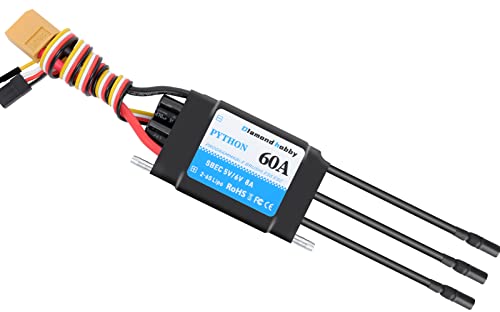
The DH 60A ESC offers a two-mode operation: Forward Only and Forward with Backward, designed for straightforward boat configurations. It includes waterproofing and a flat water-cooling design to dissipate heat. The 5V/6V 8A BEC provides reliable power to receivers and servos, supporting higher current loads and stable performance in varied conditions.
Who this is best for: builders seeking simple, dependable ESCs for boats that don’t require complex mode configurations. Choose this if you need a compact, waterproof ESC with predictable forward behavior and a robust BEC. Caution: ensure your motor and battery are within the 60A rating to avoid saturation during high-throttle runs.
Buying Guide
What size ESC do I need? Start with your motor’s current draw and your battery capacity. Higher-current motors require ESCs with ample headroom to prevent overheating and voltage drop.
Brushed vs. brushless: Brushless ESCs provide smoother throttle, higher efficiency, and longer runtime for high-end boats. Brushed ESCs can be simpler and cost-effective for entry-level setups or large, slow-moving craft.
Waterproofing and cooling: Marine environments demand waterproof designs and efficient cooling. Look for built-in water-cooling plates or robust sealing to survive splashes and humidity.
Protection features: A good ESC should include low-voltage cutoff, over-thermal protection, input-voltage protection, and throttle-signal loss protection to safeguard the motor and electronics during abuse or battery issues.
Bidirectional control: If your boat requires precise maneuvering, especially in twin-screw or catamaran setups, a bidirectional ESC minimizes half-power reversing and improves handling at low speeds.
BEC considerations: A stable BEC (5V or 6V) powers your receiver and servos. Verify the BEC current rating matches the load from your receiver and any additional components.
Compatibility: Confirm that the ESC’s connector type (XT60, XT90, etc.), motor type (brushless or brushed), and battery voltage range align with your build. Some ESCs list multiple operating voltages (2S–6S, etc.).
FAQ
- What is the difference between brushed and brushless ESCs? Brushed ESCs control brushed motors directly and are typically simpler and cheaper, while brushless ESCs control brushless motors for higher efficiency and performance.
- Do ESCs require a separate BEC? Many ESCs have a built-in BEC; if not, you’ll need an external BEC to power receivers and servos.
- Is waterproofing essential for RC boats? Yes, marine use benefits from waterproof designs and effective cooling to prevent moisture damage and overheating.
- What does bidirectional control mean? It means the ESC can reliably reverse motor direction, which improves maneuverability in certain hull designs.
- How do I choose the right ESC current rating? Match the ESC current rating to the maximum current your motor will draw under load; exceed it slightly to ensure reliability.
- Can I use a high-current ESC with a smaller motor? Yes, but you should ensure the system voltage and connector wiring can safely handle the current without overheating.