Best Pontoon Boat Switch Panel Solutions for Safe 12V Control
Answering the needs of boaters seeking reliable 12V control and monitoring, these pontoon boat switch panels are designed to simplify electrical management on water. They’re ideal for owners who want organized wiring, easy access to controls, and real-time voltage monitoring. The top picks below cover common setups for pontoons, deck lighting, bilge pumps, and auxiliary devices, with clear guidance on who benefits most from each option. The table summarizes key details to help you compare at a glance.
| Product | Best For | Key Feature |
|---|---|---|
| FXC KG0149-5B Blue | General 5-Device Control | 5-gang panel, voltmeter, dual USB, blue LED |
| Nilight 6 Gang Pre-Wired | Expandable, Easy Install | Pre-wired with multiple breakers and USB/PD-C |
| Kohree 6 Gang Marine | Marine Lighting & USB Charging | USB, voltmeter, 15A fuses, blue LED |
| DaierTek 6 Gang Marine | Budget-Friendly USB/Voltmeter | Dual USB, voltmeter, cigarette socket |
| Nilight 6 Gang ON/OFF | Rugged Off-Road & Marine | LED voltmeter, dual USB, cigarette lighter |
FXC Waterproof 5 Gang Marine Panel
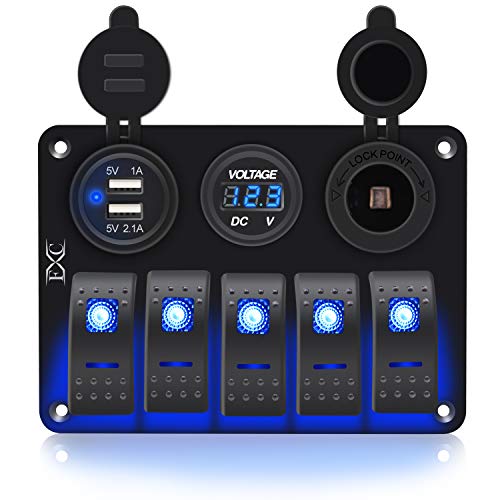
Best for: Pontoon owners who want a compact, all-in-one control hub. This panel includes a 12V cigarette socket, volmeter, and dual USB outlets, plus blue LED indicators for quick status checks. Its aluminum panel and IP66 rating signal durability in splash-prone deck areas. The set is suitable for 12V-24V systems, including trucks, RVs, and marine vessels.
Why selected: It combines essential control, digital voltage display, and water resistance in a single unit, reducing wiring complexity on deck installations. The dual USB ports and voltmeter provide practical, on-the-spot power management.
Limitations: May require additional mounting hardware for non-standard surfaces, and some users may want more than five switches for larger pontoon builds.
Nilight 6 Gang Pre-Wired Panel

Best for: Boat owners who value quick installation and robust overload protection. This panel bundles six rocker switches with circuit breakers, a PD Type-C USB, and a voltmeter, making it versatile for 12V-24V systems on boats and ATVs.
Why selected: Pre-wired design and clear circuit protection help prevent overloads, while the PD Type-C and USB ports support modern device charging. Suitable for both marine and off-road vehicles.
Limitations: The setup is best for users who want pre-wired functionality; extensive customization may require additional wiring know-how.
Kohree 6 Gang Marine Panel

Best for: Boaters needing built-in USB charging with a clear LED readout. The Kohree panel includes a 12V outlet, QC3.0 USB ports, and a blue LED voltmeter, appealing to those who run multiple electronic devices on the water.
Why selected: The USB USB charging and digital voltmeter provide practical visibility and power management in low-light conditions. Marine-grade construction supports harsher environments.
Limitations: The USB switch is convenient but may require careful power budgeting if many devices draw current concurrently.
DaierTek 6 Gang Marine Panel

Best for: Budget-conscious boaters who still want USB charging and a voltmeter. The panel features dual USB ports and a cigarette lighter socket, with dual LED lighting for nighttime visibility.
Why selected: Dual USB ports expand charging capability, while the voltmeter helps track electrical health. The waterproof design makes it practical for deck use.
Limitations: Fewer breakers than larger panels; users should plan for essential circuits to avoid overloading a single circuit.
Nilight 5 Gang Multi-Function Panel

Best for: Vehicle owners needing a compact, feature-rich panel with PD Type-C, USB charging, and a voltmeter. It supports a wide 12V-24V range for diverse platforms.
Why selected: The combination of PD Type-C and USB charging, plus a clear voltmeter, makes it a well-rounded choice for power management on boats and vehicles alike.
Limitations: With five gangs, it has fewer switches than larger panels; map your critical devices to the most important circuits first.
Buying Guide: How to Choose the Right Pontoon Boat Switch Panel
What should you consider when selecting a switch panel for a pontoon boat?
- Voltage range: Confirm the panel supports your boat’s 12V or 24V system and any accessories you plan to run.
- Number of circuits: Count lights, pumps, chargers, and other devices to determine how many switches you need.
- Protection features: Look for inline fuses or circuit breakers to prevent overloads and short circuits.
- Monitoring: A built-in voltmeter helps you monitor battery health and avoid deep discharge.
- Water resistance: Choose panels with IP-rated housing or marine-grade construction for splash zones and exposure to salt air.
- Charging options: USB outputs and PD Type-C can simplify charging for phones and accessories on board.
- Ease of installation: Pre-wired panels and clear wiring diagrams reduce DIY time and mistakes on a pontoon.
What configuration fits my boat size?
Smaller pontoons may only need a 5- to 6-gang panel for lighting, accessories, and essential power. Larger decks often benefit from 8- to 12-gang options to separate systems such as lighting, pumps, and entertainment devices.
Are waterproof panels worth it on a pontoon?
Yes. Marine-grade, waterproof or splash-resistant panels reduce corrosion risk and extend component life in wet environments on decks and storage areas.
Should I prioritize USB charging or voltmeter?
Both are useful. USB ports ensure devices stay powered during trips, while a voltmeter provides real-time battery status to prevent unexpected outages.
How important are circuit breakers?
Very important. Resettable or automatic breakers protect wiring and devices from overloads, helping maintain system safety during extended operation.
How do I install a pre-wired panel?
Follow the manufacturer’s wiring diagram, mount securely to a flat surface, and connect the main power wires to the battery, observing correct polarity. If unsure, consult a marine electrician.
FAQ
- What is the typical voltage range for these panels?
- Do these panels include mounting hardware?
- Is a voltmeter essential on a pontoon panel?
- Can I install these panels myself?
- What safety features should I look for?
- Are PD Type-C USB ports common on marine panels?
Most are designed for 12V to 24V systems, suitable for common pontoon electrical needs.
Many come pre-wired with mounting screws and instructions; some may require additional hardware for non-standard surfaces.
It helps monitor battery health and prevent deep discharge during trips, especially on longer outings.
If you have basic electrical wiring experience, pre-wired panels simplify installation; otherwise, hire a professional.
Overload protection, short-circuit protection, reverse polarity protection, and splash-proof construction are key.
Yes, several models integrate PD Type-C for fast charging of mobile devices and accessories.