Best Nav Lights for Boats: Bright, Safe Night Navigation
Surefire navigation lighting is essential for nighttime boating and visibility on the water. This guide highlights five top options, each chosen for different boat types and needs—from kayaks and Jon boats to pontoon and yacht applications. Read on to find which nav light kit fits your boat, desired brightness, and installation preferences.
The following quick table compares the five options by best use, installation style, and key visibility features.
| Product | Best For | Installation | Visibility |
|---|---|---|---|
| Seaperk Boat LED Navigation Light | General small to mid-size boats | ||
| Botepon Navigation Lights | Pontoon, Bass, Jon Boats | ||
| Obcursco Boat Navigation Lights | Pontoon, Skiff, Small Boats | ||
| QLOOASEA Navigation Lights | Pontoon, Bass, Jon Boats | ||
| AMBIPASION Anchor Light (12-24V) | Large boats needing stern light |
Seaperk LED Navigation Light for Boats

Best for small to mid-size boats that need a bright, adhesive-mounted option. The Seaperk light uses 18 Pils Germany 5050 LED chips and claims visibility up to 5 miles. It installs without drilling thanks to strong double-sided adhesive, making it ideal for rub rails or above/below-rail placements. The product markets itself as brighter and safer than factory nav lights.
Who this is best for: boat owners who want a quick, tool-free install on existing rub rails without buying new hardware. It’s especially suitable for bass boats, pontoon, and jon boats needing clear, visible signals at night.
Caution: Adhesive mounting may be less permanent in extremely rough conditions or on curved surfaces without proper surface prep. Ensure the adhesive bond is fully cured before exposure to heavy spray or vibration.
Botepon Navigation Lights for Boats
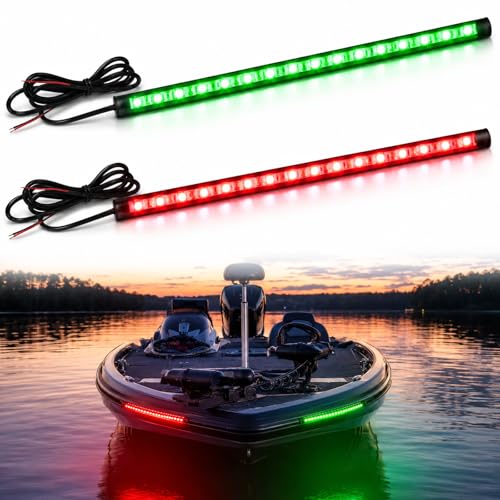
Best for pontoon, bass, and jon boats needing a strong, bright color signal. Botepon emphasizes brightness—described as at least three times brighter than factory lights—to enhance nighttime safety. It uses adhesive mounting for easy installation and targets multiple vessel types by offering red and green bow lights plus deck illumination considerations.
Who this is best for: boaters who want a standout, high-visibility upgrade without complex wiring or drilling, particularly if you want a striking presence on pontoons or bass boats.
Caution: While marketed as significantly brighter, actual performance can depend on surface adhesion and wiring setup. Confirm a secure, dry mount for outdoor exposure.
Obcursco Red/Green LED Navigation Lights

Best for pontoon, skiff, and small boats seeking durable, corrosion-resistant housing. Obcursco combines a die-cast zinc cover with red/green bi-color LEDs and IP67 waterproofing. It claims a 225-degree radiation angle and USCG 2 nautical mile visibility, with attention to anti-corrosion performance from salt spray tests.
Who this is best for: boaters needing a robust, weather-sealed pair of nav lights that can withstand marine salt spray and provide broad visibility for coastal and inland waterways.
Caution: Some users may prefer a less bulky housing if deck clearance is tight; verify rail clearance before mounting this design on narrow rub rails.
QLOOASEA LED Navigation Lights

Best for boats needing flexible installation with strong 3 NM visibility and 225-degree coverage. QLOOASEA uses strong double-sided adhesive backing for easy rub-rail mounting, with a flexible strip design to fit curved surfaces. It claims USCG compliance for safe navigation and emphasizes energy-efficient LEDs for longer lifespan.
Who this is best for: boaters who want a low-profile, adhesive-only solution suitable for curved rails and frequent reconfigurations, and who value broad illumination and efficiency.
Caution: Adhesive-only mounts may require surface prep for longevity on oily or wet surfaces; consider supplementary mechanical mounting for rough seas.
AMBIPASION 12 Inches Anchor Light

Best for longer stern lighting and anchor setups on larger boats. The AMBIPASION light uses 51 SMD2835 LEDs, delivering ultra-bright white light with 360° coverage. It runs on 12-24V and is designed to meet USCG standards for night visibility at a longer distance, with durable marine-grade construction.
Who this is best for: coastal or offshore boaters who require a robust stern/anchor setup with broad, long-range illumination and a weather-resistant build.
Caution: White anchor lights are essential for stern visibility but do not replace color navigation lights; use in combination with red/green bow lamps to meet full navigation requirements.
Buying Guide: Choosing The Right Boat Nav Lights
- Installation style: Adhesive strip vs. screw-in / clamp mounts. Adhesive options are quick to install but may require surface prep and can be less durable in rough conditions. Mechanical mounting tends to be more secure long-term.
- Brightness and coverage: Red/green bow lights should provide clear signaling at the intended distance. For night navigation, consider lights offering 2 nautical miles or more visibility and wide angular coverage (225° or more).
- Power and voltage: Check voltage compatibility with your boat’s electrical system (12V vs 24V). LEDs offer energy efficiency and longer life but verify that the current draw fits your system.
- Water and corrosion resistance: Look for IP ratings (IP67 or higher) and corrosion-resistant housings, especially for saltwater use.
- USCG compliance: Ensure the kit meets applicable navigation light requirements and visibility standards for your vessel size and operation area.
- Durability and material: Die-cast metal housings tend to offer greater durability; plastic housing can be lighter and cheaper but may wear faster in marine environments.
- Maintenance: Consider ease of cleaning and the availability of replacement parts (LED chips, lenses) if needed.
FAQ
- What is the typical visibility range for boat navigation lights?
– Most compliant navigation lights target 2 nautical miles of visibility, though some LEDs advertise up to 3 NM or more depending on design and lens. - Do adhesive nav lights stay on curved rails?
– Adhesive options can work on curved surfaces, but proper surface prep and additional mechanical mounting may improve long-term durability on curved rails. - Should I use separate bow lights and an anchor light?
– Yes. Bow lights (red/green) signal direction, while a separate anchor or stern light ensures visibility from behind and when anchored. Do not rely on a single light for full compliance. - Are these lights suitable for saltwater use?
– Look for IP67 or higher ratings and corrosion-resistant housings to ensure performance in saltwater environments. - What voltage should I choose?
– Match your boat’s electrical system: common options are 12V or 24V; LEDs typically use low power but verify wiring compatibility. - Will these lights meet USCG requirements for my vessel?
– Most listed products mention USCG-or-compliant visibility targets; always verify the exact requirements for your vessel size, area, and operation.