Best Marine Water Intake Hoses for Boats and RVs
Direct answer: choose hardwall, wire-reinforced hoses designed for marine water intake, exhaust connections, and cooling systems. These hoses resist heat, saltwater, and mild chemicals, making them reliable for engine raw water pumps, thermostat housings, and through-hulls. The top five options below are selected for different diameters and lengths to fit common marine setups. Best for boaters needing high-permeation resistance, and for RVs with engine cooling or bilge systems. See the quick-reference table for essentials on each product.
| Product | Brand | Diameter / Length | Best For |
|---|---|---|---|
| Hardwall Water/Wet Exhaust Hose wire 250 Series Shieldsflex Trident Shields (1″ per Foot) | Midnight Marine | 1″ per foot (sold per foot) | Engine raw water pump, through-hull, wet exhaust connections |
| 250 Series Hardwall Water/Exhaust Marine Hose with Wire Shieldsflex II (116-250) 3/4″ x 2.5′ | Midnight Marine | 3/4″ x 2.5′ | Thermostat housing, heat exchanger, cooling system |
| Hardwall Water/Wet Exhaust Hose wire 250 Series Shieldsflex Trident Shields (1-1/4″ per Foot) | Midnight Marine | 1-1/4″ per foot | High-flow raw water lines, through-hull connections |
| Pangda ID 1-1/4″ x 4′ Water/Fuel Fill/Exhaust Marine Hose with Wire | Pangda | 1-1/4″ x 4′ | Marine hose for engine pump, thermostat housing, and exhaust paths |
| Automotive Hardwall Water/Wet Hose Wire 100 Series Midnight Marine RV MPI (1-1/4″ per Foot) | Midnight Marine | 1-1/4″ per foot | Engine raw water pump and cooling connections on boats and RVs |
Hardwall Water/Wet Exhaust Hose 250 Series — 1″ Per Foot

Best for: boaters needing a flexible, per-foot supply for engine raw water pump lines, thermostat housing, and through-hull connections. This 1″ diameter hose is sold per foot, with continuous lengths available in multiples of 10 feet. It provides resistance to exhaust and mild chemical exposure, making it suitable for wet exhaust connections and bilge pump lines.
Why selected: it combines shielded wall construction with standard 1″ size for common marine configurations. Caution: verify both length and diameter before purchase to avoid non-return issues on per-foot cuts.
250 Series Hardwall Water/Exhaust Hose with Shield II — 3/4″ x 2.5′
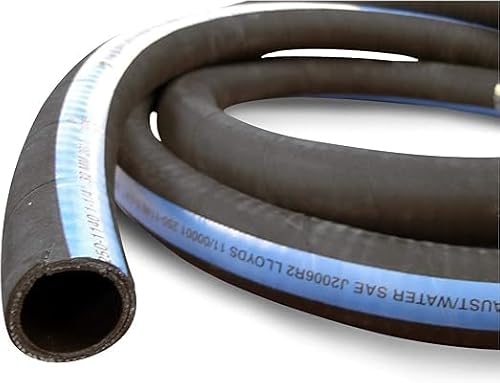
Best for: small-diameter cooling and exhaust paths where space is limited, such as compact engine compartments or smaller boats. This hose resists engine exhaust and mild chemicals, with high permeation resistance suitable for tight installations.
Why selected: reinforced design helps prevent wall collapse under pressure. Caution: ensure length units meet your exact routing because this is optimized for short segments.
Hardwall Water/Wet Exhaust Hose 250 Series — 1-1/4″ Per Foot
Best for: high-flow water intake and exhaust routes, where 1-1/4″ diameter is required to support larger engine cooling or through-hull assemblies.
Why selected: durable hardwall construction with vented, shielded walls resists heat and saltwater exposure. Caution: confirm availability of 1-1/4″ length per foot to match required route.
Pangda 1-1/4″ x 4′ Water/Fuel Fill/Exhaust Marine Hose

Best for: marine hoses requiring precise 1-1/4″ inner diameter with reinforced steel wire for reliability in high-pressure applications such as exhaust and through-hull connections.
Why selected: thickened construction and wire reinforcement reduce risk of wall collapse under pressure. Caution: ensure chemical resistance aligns with antifreeze and saltwater exposure in your system.
Automotive Hardwall Water/Wet Hose Wire 100 Series — 1-1/4″ Per Foot

Best for: large-diameter water intake lines and cooling system connections on boats and RVs where 1-1/4″ is needed. Sold per foot for flexible routing.
Why selected: robust wall construction and wire reinforcement support high-velocity water flow and exposure to engine heat. Caution: check per-foot pricing and ensure correct continuous length for your installation.
Buying Guide
What to look for when choosing a marine water intake hose
- Diameter and length: Match the hose to the through-hull or pump inlet and the available space. Common sizes include 3/4″, 1″, and 1-1/4″.
- Wall construction: Hardwall hoses with wire reinforcement resist kinking and collapse under pressure, especially in high-flow or high-heat segments.
- Chemical and saltwater resistance: Select hoses rated for engine antifreeze, salt, and mild chemicals to ensure long-term durability.
- Shielding and protection: Shielded variants help withstand heat and potential cavitation near exhaust paths.
- Length options: Per-foot sales enable precise routing; confirm unit length and continuity to avoid unwanted joins.
Which hose is best for your setup?
- Best for general engine cooling and raw-water intake: hoses with 1″ to 1-1/4″ diameters and per-foot sales offer straightforward installation.
- Better for tight spaces: smaller diameters like 3/4″ or 1″ with short lengths can simplify routing near pumps and thermostats.
- Choose this if you need reinforced reliability: wire-reinforced hardwall hoses prevent wall collapse under pressure.
- Avoid this if you require maximum flexibility at extreme angles: some hardwall options can be stiffer than silicone or flexible rubber hoses.
Installation notes
- Ensure clean, smooth hose ends and secure clamps rated for marine use to prevent leaks.
- Avoid sharp bends and maintain gentle curves to reduce stress on hose walls.
- Check for compatibility with antifreeze, engine coolants, and saltwater exposure in your system.
FAQ
- What diameter hose should I use for a typical marine engine raw water pump?
– Common diameters are 3/4″, 1″, and 1-1/4″; choose based on pump inlet size and space constraints. - Can I cut hoses to exact lengths?
– Yes, many hoses are sold per foot, but confirm return policies for cuts. - Are wire-reinforced hoses better for exhaust paths?
– They offer higher resistance to wall collapse in high-pressure or hot sections. - Should I mix hoses from different brands?
– Stick to hoses with compatible chemical resistance and temperature ratings for your system to avoid leaks. - How do I verify diameter during purchase?
– Measure the installed hose bore and verify from the product’s diameter specification before ordering.