Best Marine Battery and Charger Guides for 12V Power on the Water
Answer: To power boats reliably, choose a multi-bank, marine-rated charger that supports lead-acid and lithium chemistries, temperature compensation, and independent bank charging. This article highlights five top onboard chargers suited for different boat sizes and battery setups, from compact two-bank units to robust three-bank options. Best for anglers and weekend sailors who need simple, reliable maintenance; best for larger vessels that demand more charging capacity; and best for lithium-friendly systems that require careful regulation. A quick buyer’s table follows to help you compare at a glance.
| Product | Banks | Total Amps | ||
|---|---|---|---|---|
| 2 | 10 | Compact, versatile dual-bank maintenance | Temp compensation, 12V modes | |
| 3 | 15 | Medium to larger boats needing more amps | Independent bank modes | |
| 2 | 10 | Budget-friendly, versatile modes | 3 modes; practical dead-battery support | |
| 1 | 10 | Simple, automatic maintainer for smaller boats | Temp compensation, desulfator | |
| 3 | 20 | Higher-amp, triple-bank for bigger systems | Microprocessor-based charging |
NOCO Genius GEN5X2: 2-Bank Onboard Battery Charger
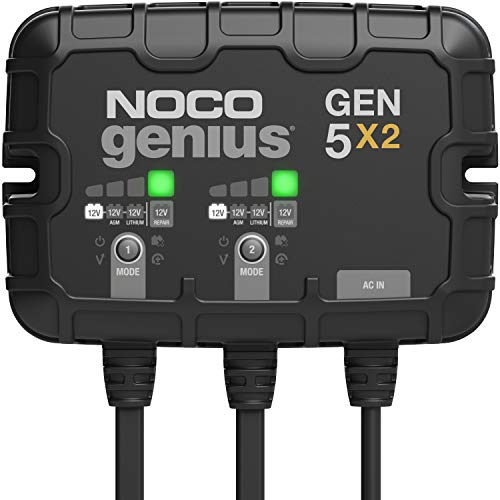
The GEN5X2 is a compact two-bank charger with a combined 10 amps (5A per bank). It supports 12V lead-acid and lithium systems, with selectable modes for 12V, 12V AGM, 12V Lithium, and a Repair Mode. Best for boaters who want a small, robust unit that can independently manage two batteries with temperature compensation and overcharge protection. The unit’s smaller footprint makes it ideal for smaller boats or spaces where weight and size matter. A potential limitation is that it provides 10A total, which may be insufficient for high-demand systems on larger vessels.
Who it’s best for: Small to mid-size boats, dual-battery setups, and users prioritizing space-saving, reliable maintenance.
Why selected: It delivers NOCO’s trusted multi-bank capability in a compact form, with precise control per bank and battery type selection.
Caution: Ensure your battery bank total does not exceed the unit’s 10A capacity to avoid slow charging on high-demand cycles.
NOCO Genius GEN5X3: 3-Bank Onboard Battery Charger
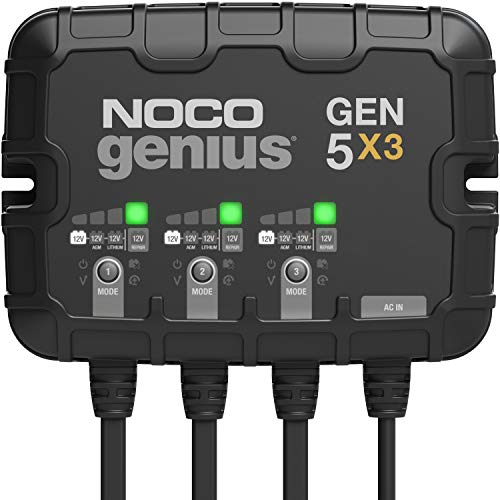
The GEN5X3 expands to three banks with a total of 15 amps (5A per bank), making it suitable for boats with multiple batteries and higher electrical loads. It offers independent charging modes for each bank—12V, 12V AGM, 12V Lithium, and a Repair Mode—allowing precise maintenance of varied chemistries. Best for mid-sized boats or systems where you want more total charging capacity without moving to a full 30A setup. A potential limitation is that the added bank increases size and cost versus two-bank models.
Who it’s best for: Boats with three batteries or diverse battery chemistries needing dedicated, independent charging paths.
Why selected: Provides more total amps with bank independence, supporting more complex electrical systems.
Caution: Check space and wiring for three-bank integration to avoid installation conflicts.
Smart 2 Bank Marine Charger, 10A (Zrfmib)

This two-bank charger provides 10A total (5A per bank) with IP-rated waterproofing and independent bank modes. It accommodates several battery types: 12V SLA/AGM, 12V Lithium, and 12V Calcium. It can automatically switch from full charging to float mode, making it suitable for boats that sit idle for extended periods. Best for budget-minded boaters who still want flexible mode selection. A limitation is that the unit may rely on user action to handle dead batteries effectively after a long storage period.
Who it’s best for: Small boats, shore-side storage users, and those needing a cost-effective, flexible two-bank charger.
Why selected: Offers practical mode options and dead-battery recovery features at an accessible price point.
Caution: If you routinely charge very high-RC or very large deep-cycle packs, verify total amperage aligns with your system’s needs.
NEXPEAK NC201 10-Amp Battery Charger

The NC201 is a smart, automatic maintainer and desulfator with 10A charging (12V) and 24V support on a single unit, plus temperature compensation. It’s designed to charge and maintain all standard 12V and some 24V lead-acid configurations, including AGM, GEL, SLA, and flooded batteries. Best for single-battery setups on moderate-sized boats or DIY projects where a straightforward, automatic maintainer is desired. A limitation is that it’s a single-bank unit, so it won’t replace multi-bank systems on larger boats.
Who it’s best for: Small to mid-size boats needing a reliable single-bank charger with maintenance and desulfation features.
Why selected: Combines fast charging with a desulfation function and temperature compensation for steady battery health.
Caution: Not ideal for vessels that require simultaneous charging of multiple separate batteries.
ProMariner 44021 ProSport HD 20A, 3 Bank

The ProSport HD 20A triple-bank charger distributes charging amps across three banks as needed, using microprocessor-controlled charging for fast, precise maintenance. It’s a higher-amp option intended for boats with more demanding electrical loads or larger battery banks. Best for larger vessels needing robust, distributed charging. A potential limitation is that this unit is larger and may require a more substantial mounting space and wiring setup compared with two-bank or single-bank models.
Who it’s best for: Larger boats with multiple battery banks and higher current requirements.
Why selected: Offers strong total charging capacity with intelligent distribution to maximize charging efficiency.
Caution: Ensure there is adequate space and proper cabling to accommodate three banks and higher current.
Buying Guide: Key Purchase Considerations
- Number of banks vs. vessel size: Small boats may only need 1–2 banks, while bigger boats benefit from 3-bank or higher systems to support more batteries and loads.
- Total charging amperage: Higher-amp models charge faster but require appropriate cabling and space; ensure your boat’s wiring can handle the load.
- Battery chemistry support: Look for chargers that clearly support lead-acid, AGM, GEL, and lithium (LiFePO4) if you use mixed chemistries.
- Temperature compensation: Essential in fluctuating marine environments to prevent over- or under-charging.
- Waterproofing and IP rating: Marine-grade chargers should withstand splashes and spray; consider IP68 or equivalent for exposed installs.
- Maintenance vs. repair modes: Some models include a repair or desulfation mode that can help recover sulfated batteries.
- Dead-battery recovery: Some units offer modes or “force charge” features to wake severely discharged batteries; verify this capability if you frequently encounter dead packs.
- Size and installation: Ensure mounting space and ventilation are adequate for the chosen unit, especially higher-amp models.
FAQ
- What is the advantage of a multi-bank charger? It charges multiple batteries independently, reducing cross-interference and allowing tailored charging for each bank.
- Can these chargers handle lithium and lead-acid equally? Many models advertise compatibility with both, but verify mode options for each chemistry to prevent overcharge.
- Is temperature compensation important? Yes, it helps maintain safe charging voltages across temperature ranges typical on boats.
- Should I choose a 2-bank vs 3-bank charger? Choose based on the number of batteries and required charging capacity; more banks offer greater flexibility for larger systems.
- What about dead-battery recovery? Some chargers include a force charge or repair mode to wake dead batteries; not all units offer this feature.
- Are waterproof ratings necessary? For exposed installations, IP-rated or waterproof units reduce risk from spray and humidity.