Best Marine Aquarium Test Kit for Saltwater Tanks You Can Buy Online
Answering the need for reliable water monitoring, this guide highlights top marine aquarium test kits for saltwater tanks. Each pick targets different user needs—from beginner setups to serious reef systems. The buyers most likely to benefit include hobbyists who want quick, color-mimicking results, reef-keepers needing precise parameter tracking, and those managing mixed-species tanks. The following table summarizes the featured products, their focus, and ideal use cases.
| Product | Brand | Best For |
|---|---|---|
| API Saltwater Master Test Kit 550 | API | Comprehensive saltwater monitoring for beginners to intermediate hobbyists |
| Red Sea Marine Care Test Kit | Red Sea | All-in-one marine chemistry checks for reef and mixed-tank enthusiasts |
| 11 in 1 Aquarium Test Strips (SJ WAVE) | SJ WAVE | Convenient, broad-screen testing for quick checks and ongoing maintenance |
| Pawfly 5 in 1 Master Test Kit | Pawfly | Combined freshwater/saltwater monitoring with lab-like color matching |
| Salifert Master Reef Testing Combo | Salifert | In-depth, multi-parameter reef testing for advanced systems |
Below are detailed profiles of five marine-focused test kits, with guidance on who should buy each and why.
API Saltwater Master Test Kit 550-Test
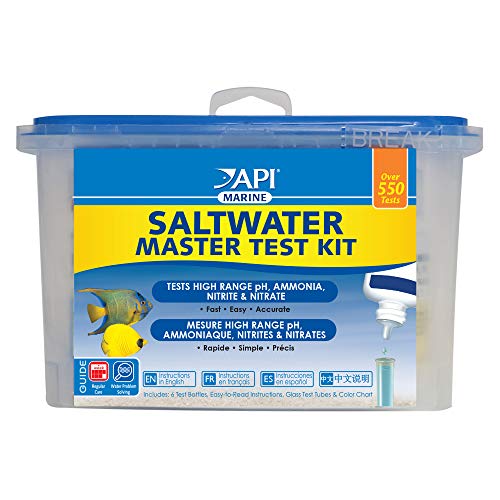
The API Saltwater Master Test Kit 550-Test covers six bottles of testing solution, a color card, and four test tubes with caps. It focuses on four vital saltwater parameters: high-range pH, ammonia, nitrite, and nitrate. Best for beginners and intermediate hobbyists who want a single kit that reliably screens core water quality without extra complexity. Use this when starting a new reef or fish-only saltwater tank to prevent invisible water issues that can harm livestock. A potential limitation is the kit’s emphasis on four tests; more advanced reef systems may require additional calcium and alkalinity tools beyond this kit.
Red Sea Marine Care Test Kit

The Red Sea Marine Care Test Kit provides the main kits needed to monitor nitrate, nitrite, ammonia, pH, and alkalinity. It emphasizes ease of use with simple instructions and color charts. This kit is well suited for hobbyists managing reef systems or mixed-tank setups where stable alkalinity and pH matter. The clear color charts help reduce ambiguous readings. Limitation: while comprehensive for many hobbyists, reef keepers may still need separate calcium and magnesium checks for complete reef maintenance.
11 in 1 Aquarium Test Strips (SJ WAVE)

SJ WAVE’s 11 in 1 test strips deliver broad coverage in a single strip, measuring multiple parameters including ammonia, pH, nitrate, nitrite, and more. It’s best for quick checks and for hobbyists who prefer color charts and convenience over lab-style droppers. It supports both freshwater and saltwater, making it versatile for mixed-tank households. Caution: color-interpretation can vary with lighting and strip exposure time, so follow the included color chart and timing precisely for best accuracy.
Pawfly 5 in 1 Master Test Kit

The Pawfly 5 in 1 Master Test Kit monitors pH, nitrite, nitrate, ammonia, and phosphate. It’s designed for both freshwater and saltwater tanks, using precise color-matching charts to deliver results quickly. This kit is best for hobbyists who want a compact, all-in-one solution and value a straightforward comparison process over lab-grade precision. Limitation: while offering broad coverage, it may not include calcium or alkalinity tests critical for active reef systems.
Salifert Master Reef Testing Combo

The Salifert Master Reef Testing Combo includes six individual test kits: calcium, nitrate, phosphate, pH, alkalinity, and magnesium—covering the core parameters essential for reef tanks. This kit is best for advanced hobbyists and reef keepers who require high-precision, repeatable results for maintaining closed or heavily stocked marine environments. A potential limitation is that it focuses on reef-specific chemistry; those with simpler systems may not need all six tests at once.
Buying Guide: Key Considerations For Marine Test Kits
- Scope of testing: Decide whether you need 4 major parameters or a broader panel. Reef tanks often require calcium, alkalinity, and magnesium in addition to nitrate and phosphate.
- Test method: Liquid reagent kits tend to be precise but require more handling; test strips and digital options offer speed and ease with trade-offs in precision.
- Ease of use: Color charts, dropper-based tests, and app-enabled readers each have a learning curve. Consider your comfort level and maintenance routine.
- Tank type and size: Small or nano tanks may need fewer tests, while large or heavily stocked reefs demand more comprehensive monitoring.
- Frequency of testing: Frequent testing requires faster results; select kits that fit your maintenance cadence (daily, weekly, or biweekly).
- App integration and data tracking: Digital readers and app-enabled kits help log trends over time, which is valuable for proactive care.
FAQ
- What parameters are most important for saltwater fish tanks?
– Ammonia, nitrite, nitrate, and pH are foundational; reefs additionally require calcium and alkalinity management. - How often should I test a new saltwater tank?
– Start with daily testing for the first 1–2 weeks, then shift to weekly or biweekly as stability improves. - Are test strips reliable for reef tanks?
– They are convenient for quick checks but may be less precise than liquid tests for critical reef parameters. - Can I use the same test kit for freshwater and saltwater?
– Some kits are designed for both, but many are optimized for one environment. Check the product description for suitability. - Should I trust digital testers over color-based kits?
– Digital testers can reduce color-guessing errors, but ensure the device is calibrated and used as directed. - What is the best practice for reading color charts?
– Read under natural or daylight-balanced lighting, wait the recommended time after testing, and compare against the correct chart.