Best Portable Marine Battery Charger Options for 12V and 24V Boats
Answering the question: which portable marine battery charger best protects and maintains your boat’s batteries across different chemistries? This guide highlights five top-onboard, portable chargers ideal for cruisers, anglers, and weekend boaters. Each option supports lead-acid and lithium batteries, with smart features like temperature compensation and overcharge protection. The selections are grouped to fit different boat setups, from single-bank maintainers to multi-bank systems. The buyer profiles below help you choose based on battery type, portabilty, and maintenance needs.
Summary table of selected products:
- NOCO Genius GEN5X2: Best for two-battery systems on mid-sized boats seeking compact power and independent bank control.
- NOCO Genius GEN5X3: Best for boats with three 12V battery banks requiring precise, bank-by-bank management.
- NOCO Genius GEN10: Best for larger fleets or boats needing higher overall current with strong temperature compensation.
- FirstPower Pro 2-Bank 5X2: Best for 24/7 on-board maintenance with robust waterproofing and independent mode per battery.
- NOCO GEN5X1: Best for small vessels or minimal shore-power needs with a compact, single-bank charger.
NOCO Genius GEN5X2: 2-Bank Marine Charger
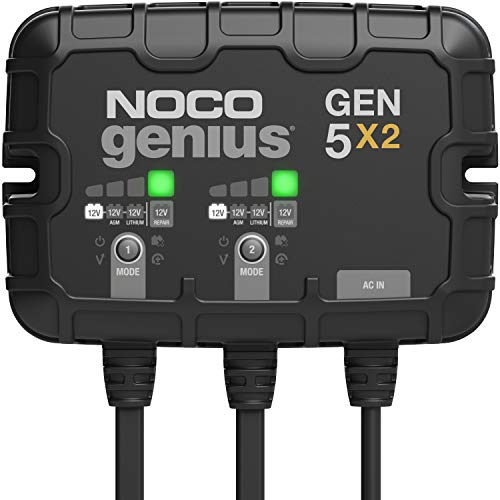
The GEN5X2 provides 10 amps total, with 5 amps per bank, and offers independent charging modes for 12V, AGM, and Lithium batteries plus a 12V Repair Mode. It is designed for use in harsh marine environments and is notably compact for its capacity. Best for boaters with two battery banks who want precise, bank-specific charging and maintenance without swapping cables mid-season. Caution: ensure your battery types align with selectable modes per bank to avoid suboptimal charging.
NOCO GENIUS1: 1A 6V/12V Smart Charger

The GENIUS1 is a compact, all-in-one charging solution for smaller boats or garages where shore power is limited. It supports 6V and 12V lead-acid and lithium chemistries with overcharge protection and temperature compensation. Best for boaters with a single battery or a small set of batteries who need a reliable maintainer and trickle charger in one unit. Choose this if space and weight are critical on your vessel. Caution: higher-capacity boats may require a multi-bank unit for simultaneous charging.
NOCO Genius GEN5X3: 3-Bank Marine Charger
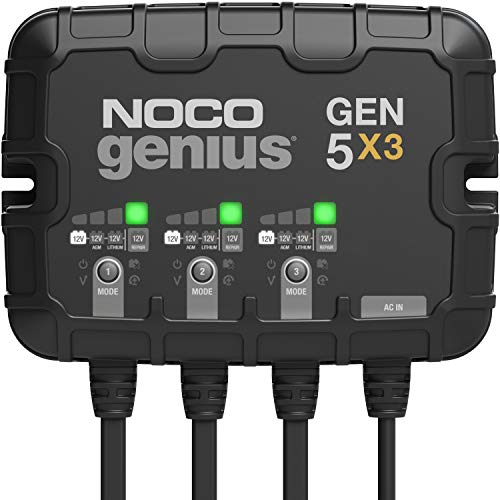
The GEN5X3 delivers 15 amps total across three banks (5A per bank), with selectable charging modes for each bank: 12V, 12V AGM, 12V Lithium, and 12V Repair Mode. This model suits boats with three 12V batteries across different uses—starting, deep cycle, and auxiliary systems. Best for larger boats or families with multiple battery needs who require independent control per bank. Limitation: more cables and mounting space required than a two-bank model.
NOCO GENIUS10: 10A Smart Charger

The GENIUS10 offers 10 amps of charging power with advanced temperature compensation and a broad compatibility range for 6V and 12V lead-acid and LiFePO4 batteries. It functions as a complete charger, maintainer, trickle charger, and desulfator. Best for boats that need a robust all-in-one solution with higher current for faster charging and winter maintenance. Caution: larger footprint than single-bank units, so check mount space and venting on enclosed compartments.
FirstPower Pro 2-Bank 5X2

This 2-bank model provides 10A total (5A per bank) with IP68 waterproofing and 24/7 onboard charging capability. It supports 12V SLA/AGM, 12V Lithium, and 12V Calcium modes, with independent mode selection per battery. Best for saltwater rigs or boats stored outdoors where waterproofing is critical. A caution: advanced users may need to verify compatibility with specific LiFePO4 chemistries beyond general Li-ion support.
Buying Guide: Key Considerations For Choosing A Portable Marine Battery Charger
- Battery chemistries supported: Verify compatibility with lead-acid (AGM, Gel, Flooded) and lithium (LiFePO4) batteries to avoid mismatch.
- Bank count and current: Choose 1-, 2-, or 3-bank units based on the number of batteries and desired charging speed. High-bank models offer more simultaneous charging, but require more space.
- Charging modes per bank: Look for selectable modes (12V, AGM, Lithium) and a dedicated maintenance or repair mode for aging cells.
- Temperature compensation: A built-in sensor ensures safe charging across hot summers or cold winters, preserving battery life and performance.
- Waterproofing and ruggedness: For boats exposed to rain, spray, or splashes, IP ratings (like IP68) provide extra reliability for on-deck or open-boat installations.
- Mounting footprint and installation: Consider unit size, mounting hardware, and whether it fits your bilge, cabin, or outdoor storage area without obstructing access.
- Maintenance and safety features: Overcharge protection, reverse polarity protection, and short-circuit protection help prevent battery damage and safety hazards.
Frequently Asked Questions
- What is the benefit of a multi-bank charger on a boat?
It allows independent charging for each battery, improving charging efficiency and battery longevity for boats with separate starting, trolling, and house batteries. - Can these chargers maintain batteries during long storage?
Yes. Most models include a maintenance or float mode designed to keep batteries topped up without overcharging. - Are these chargers safe for LiFePO4 batteries?
Most listed models support LiFePO4, but always check the charging modes and recommended battery types in the product details. - Do I need a separate charger for each battery?
Not usually. A two- or three-bank charger can manage multiple batteries simultaneously if the banks are properly matched to each battery type and capacity. - What is temperature compensation and why is it important?
It adjusts charging based on ambient temperature to avoid overcharging in heat and undercharging in cold, extending battery life. - Is waterproofing essential for marine use?
Yes, especially for exposed installations. IP68-rated units provide better protection against water intrusion in harsh marine environments.