Best Lithium Batteries for Marine Use: Durable Power on the Water
Answering the needs of boaters and coastal travelers, these lithium batteries deliver reliable deep-cycle power for trolling motors, electronics, and auxiliary house power. They are best for marine owners seeking longer life, easier installation, and safer operation in outdoor environments. This guide highlights five options that balance capacity, protection, and practicality for boats of varying sizes and power needs. The quick comparison table helps you scan key specs at a glance.
| Product | Key Capacity | Best For | Notable Feature |
|---|---|---|---|
| SUPER EMPOWER 12V 100Ah LiFePO4 | 1280Wh | Small to mid-size boats, trolling motors | Low-temp protection, 10-year lifespan |
| DJLBERMPW 12V 100Ah LiFePO4 | 1280Wh | All-around marine and RV use | 100A BMS, low-temp cut-off |
| LiTime 12V 165Ah Dual Purpose | ~1980Wh | Starting & storage on larger boats | 1200 CCA, ABYC-compatible |
| GOKWH 12V 100Ah LiFePO4 | 1280Wh | Trolling motors and electronics | Bluetooth monitoring |
| BUKNUWO 12.8V 100Ah LiFePO4 | 1280Wh | Bluetooth-enabled monitoring for on-water use | 40% energy density boost, long life |
SUPER EMPOWER 12V 100Ah LiFePO4 Battery

Best for: small to mid-sized marine setups needing reliable house power or a trolling motor power source. This battery uses premium LiFePO4 cells with an integrated BMS to handle overcharge and temperature extremes, supporting thousands of cycles at deep discharges. It fits common BCI Group 24 footprints, making it a simple drop-in for many boat power boxes.
Why selected: It combines long lifespan, robust cycle performance, and practical compatibility for marine electrical systems. It’s particularly suitable for auxiliary power and daily on-deck electronics without engine-start demands. A key caution: designed for energy storage use only and not appropriate for starting engines.
DJLBERMPW 12V 100Ah LiFePO4 Battery

Best for: boaters who want a high-protection pack with strong short-term power and low-temp safety for use in cooler conditions. The 100A BMS guards against charging and discharging faults, and a low-temperature cut-off helps prevent unsafe charging in cold environments. The cell chemistry supports a long cycle life equivalent to rugged marine use.
Why selected: It provides clear protections and a long cycle life, suitable for integrated boat electrical systems and seasonal storage. Limitation: the data notes standard charging practices; plans should align with the recommended 14.6V charging and <50A charging current for optimal longevity.
LiTime 12V 165Ah Dual Purpose Battery

Best for: boats needing a single unit that can both start an outboard and store power for electronics. With 165Ah and 1200 CCA, this battery covers starting power on cold mornings and supplies house loads efficiently. ABYC-compatible installation helps ensure safe cross-brand use on water.
Why selected: It streamlines a boat’s battery setup by combining cranking and storage capabilities in one unit, saving space and weight. Caution: ensure mounting and ventilation match the manufacturer’s guidelines for LiFePO4 packs.
GOKWH 12V 100Ah LiFePO4 Battery With Bluetooth

Best for: boat owners who want real-time battery status from the cockpit or trolling motor control area. The integrated Bluetooth 5.0 monitor lets you track voltage, current, and temperature, enabling proactive maintenance on long fishing trips or offshore runs.
Why selected: The wireless monitoring feature provides practical, on-the-water visibility that can prevent unexpected power loss. Limitation: Bluetooth range and connectivity may vary depending on environmental interference on the water.
BUKNUWO 12.8V 100Ah LiFePO4 With Bluetooth
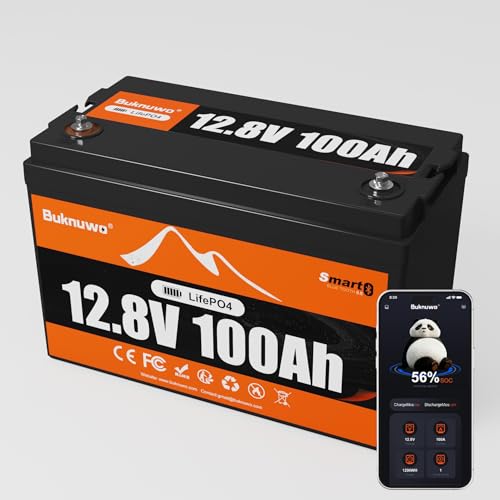
Best for: on-water users who value lightweight design and advanced monitoring. Its Bluetooth app supports real-time readings and up to 15,000 cycles, with a compact 12.8V format suitable for tight spaces on smaller vessels.
Why selected: It offers a strong balance of weight savings, high cycle life, and convenient remote monitoring. Caution: ensure the 12.8V system is compatible with your boat’s 12V accessories and charger configurations, as some devices expect strictly 12.0V systems.
Buying Guide: What To Check Before Choosing
- Cycle life and depth of discharge: Look for batteries rated for thousands of cycles at high DoD (60-100%). This reduces replacement frequency on long boating seasons.
- BMS protections: A robust BMS should guard against overcharge, over-discharge, overcurrent, short circuits, and temperature extremes. Low-temperature and high-temperature cutoffs help prevent unsafe charging or discharging.
- Form factor and compatibility: Confirm the battery’s size, terminal type (M8), and Group size match your boat’s battery box and wiring. Drop-in replacements simplify installation.
- Protection for on-water use: Marine environments demand corrosion resistance and safe operation in heat and humidity. ABS casings and flame retardance can improve safety margins.
- Monitoring options: Bluetooth or app-based monitoring helps you track voltage, current, and temperature from the cockpit or bow, reducing the risk of sudden power loss.
- Charging guidelines: LiFePO4 chemistries typically require charging at around 14.4-14.6V with appropriate amperage. Check manufacturer recommendations to maximize cycle life.
- Best-fit scenarios: Choose based on vessel size and power needs. For simple trolling motor setups, 100Ah packs are usually sufficient. For boats with multiple electronics or starter needs, consider higher Ah and dual-purpose packs.
Frequently Asked Questions
- What makes LiFePO4 batteries suitable for marine use?
– They offer longer life, lighter weight, broad temperature tolerance, and safer chemistry than many lead-acid options, which is beneficial for boats and offshore use. - Can I use a LiFePO4 battery to start my engine?
– Most LiFePO4 marine batteries are designed for deep-cycle or starting-support roles depending on the model. Always follow the manufacturer’s stated use; some are primarily for storage and auxiliary power. - Is Bluetooth monitoring necessary?
– Not strictly necessary, but it helps prevent unexpected outages by enabling real-time status checks of voltage, current, and temperature on the water. - How do I know which Ah rating to choose for my boat?
– Estimate total daily power use (lights, electronics, trolling motor, etc.) and select a battery (or bank) sized to cover your 1-2 day trips with a safe buffer for peaks. - What maintenance does a LiFePO4 battery require on a boat?
– Maintain proper charging, avoid deep discharges to 0%, and periodically inspect connections for corrosion. Store and charge according to the user manual when not in use for extended periods.