Best Floating VHF Radios With GPS and DSC for Safe Sea Travel
This guide highlights five floating handheld VHF radios that offer GPS and DSC features where available, helping sailors, boaters, and coastal travelers stay connected and safe. Key picks include models with built‑in GPS for precise location sharing and distress signaling, plus floatable designs for quick recovery after a drop. The table below summarizes each selected product’s core strengths and best-use scenarios.
| Product | Best For | Key Benefit |
|---|---|---|
| Retevis RM40 Marine Radio | Coast Guard or offshore small-boat crews | DSC distress, MOB alarm, real-time GPS updates |
| Uniden MHS338BT | Disaster-prone or weather-alert aware boaters | GPS, NOAA alerts, Bluetooth, submersible |
| Atlantis 275 | Casual coastal users needing NOAA alerts | Large display, floating, NOAA alerts |
| Cobra BlueBound 350 | Compact, budget-friendly floating option | IPX7, long-range capability, NOAA alerts |
| Cobra BlueBound 150 | Lightweight, basic floating VHF radio users | IPX7, NOAA alerts, USB-C |
Retevis RM40 Marine Radio With GPS And DSC

The RM40 provides built-in GPS for precise positioning and real-time location sharing. It supports DSC distress calls, MOB alarms, and preset distress messages. Best for watermen who navigate in offshore or coastal areas and need rapid rescue information. The device is designed to enhance safety during bass fishing trips, offshore fishing, and sailing. A limitation is that DSC configuration and message presets require setup; ensure your emergency contacts are correctly programmed before use.
Uniden MHS338BT Floating, GPS and Bluetooth

The Uniden MHS338BT combines submersible IPX8 protection with an integrated GPS and NOAA weather alerts. It also features Bluetooth for smartphone integration and a drop-in charging cradle. This model is well suited for boaters who want direct weather updates, hands-free connectivity, and the ability to save location waypoints. Best for sailors seeking robust weather awareness and easy recharging. A caveat is that Bluetooth pairing requires compatible devices and app setup for best results.
Cobra BlueBound 350 VHF Floating, 6-Watt

The Cobra BlueBound 350 offers a high-visibility floating core and 6-watt transmit power with selectable 1/3/6 watts. It includes NOAA weather alerts and international functionality in a compact, IPX7-rated form. This choice is best for users who need strong range control and simple operation on small to mid-size vessels. Choose this if you value a bright, easy-to-retrieve float and straightforward power options; avoid if you need integrated GPS or DSC capabilities not listed in its features.
Cobra BlueBound 350 Black

Similar to the white version, this Black variant provides 6-watt output and a floating core with IPX7 waterproofing, NOAA weather alerts, and USB-C. It’s best for users who want a discreet color option while maintaining the same performance profile. The same caveat applies: GPS and DSC are not listed in the feature set, so this is a more basic floating radio compared with models that advertise GPS or DSC.
Retevis RM01P Marine Radio

The RM01P is an IP67 floating VHF handheld radio with 1750mAh battery and NOAA support. It features one-handed operation and durable, rain-shielded construction. Best for port operations or coastal fishing where a compact, rugged radio that floats is essential. A limitation is the absence of explicit GPS and DSC features in its listed specifications, so consider alternatives if those capabilities are required.
Uniden Atlantis 275 VHF Floating Radio
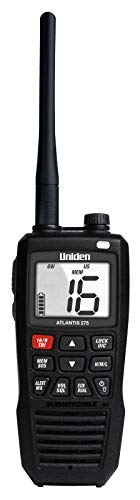
The Atlantis 275 emphasizes a large dual-color LCD screen and an all-ocean channel set, with IPX8 submersible protection and a built-in emergency strobe. It is best for users who prioritize readability and visibility during day or night operations. It does not highlight GPS or DSC in its feature list, so it’s more suitable for general floating VHF use with NOAA weather alerts rather than advanced distress signaling.
Buying Guide
- GPS and DSC: Do you need real-time GPS positioning and DSC distress calls? If yes, prioritize models like the RM40 or Uniden MHS338BT that list GPS and DSC features explicitly.
- Floatability and durability: Is IP rating or submersion protection important? For rough seas or frequent exposures to rain, choose radios with IPX7/IPX8 ratings and floating cores.
- Weather alerts: How important are NOAA weather alerts? All listed models offer NOAA alerts; this is crucial for pre-storm planning and offshore trips.
- Power and range: What power level suits your area? 6-watt radios provide longer-range capability, while 1–3 watt settings help conserve battery for nearshore use.
- Ease of use: Do you need integrations like Bluetooth or smartphone apps? Uniden MHS338BT adds Bluetooth connectivity, which can aid messaging and setup via compatible devices.
- Display and visibility: Will you operate in bright sun or at night? Large backlit displays and Day/Night modes improve readability in adverse conditions.
- Battery life and charging: How long should you stay powered? Look for devices with rechargeable batteries and accessible charging docks or USB-C charging for convenience.
FAQ
- What does DSC do on a handheld VHF radio? Digital Select Calling allows distress and calling to other vessels and authorities, enabling quicker location sharing.
- Is GPS always required on a floating VHF radio? No; some models include GPS for location sharing, while others focus on basic communication and weather alerts.
- Are GPS-enabled models more expensive? They can be pricier due to additional capabilities like location reporting and waypoint storage.
- Can these radios float if dropped overboard? Most listed models feature a floating core and IP ratings designed to prevent sinking.
- Do I need a separate DSC license or activation? In many regions, DSC is a standard feature, but check local maritime radio regulations for your area.
- Which radio is best for offshore fishing? A model with GPS, DSC, and MOB features, such as the RM40, is well-suited for offshore conditions and safety signaling.