Best Fire Extinguishers for Boats: Top Picks for Marine Safety
When choosing a boat fire extinguisher, look for compact, corrosion-resistant options that cover Class A, B, and C fires common on vessels. This guide highlights five marine-focused extinguishers designed for boats, with clear pros, ideal users, and practical cautions. The best picks balance quick discharge, durability, and ease of use for boaters, captains, and crew members.
Buyer Summary Table
| Product | Best For | Key Benefit | Limitations |
|---|---|---|---|
| Kidde Fire Extinguisher for Boats, Single-Use 5BC | Small to mid-size boats; day sailors | 12X corrosion resistance; all-metal construction | Single-use, must be recharged by pro after use |
| First Alert Marine1 Fire Extinguisher | Commercial-grade reliability on larger boats | UL 1-A:10-B:C; all-metal; includes bracket | Bracket required for Coast Guard approval |
| First Alert Fire Extinguisher Marine 14″ | Longer reach and visibility on deck | All-metal construction; multipurpose | Single-use; needs recharge |
| Kidde Mariner 5 Fire Extinguisher for Boats | Moderate to larger vessels | 8–12 second discharge; 4–6 ft range | Single-use design |
| Kidde Fire Extinguisher for Boats, Single-Use 1A10BC | Compact boats and tight spaces | Broad Class A,B,C coverage; corrosion resistance | Single-use; not rechargeable |
Kidde Fire Extinguisher for Boats, 5BC
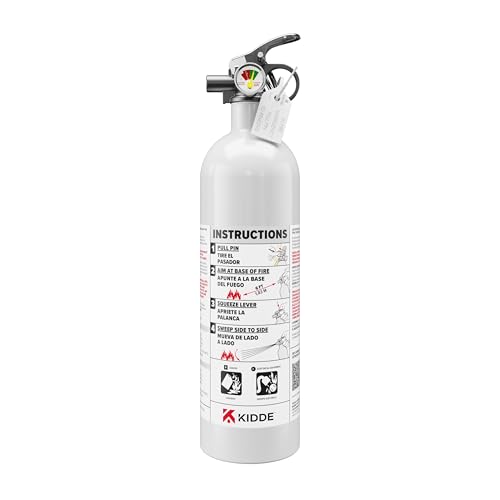
Best for small to midsize boats that need reliable Class B and C fire protection. This 5BC unit is designed to combat flammable liquids, gases, and electrical equipment fires aboard vessels. It features 12X corrosion resistance due to durable aluminum and stainless-steel components, an all-metal valve assembly, rust-resistant lever, and an easy pull safety pin. Choose this if you want a compact, durable option that can be quickly deployed in tight engine rooms or cabins. Caution: being single-use, it requires professional recharging after discharge.
Kidde Fire Extinguisher for Boats, Single-Use 1A10BC

Best for boats needing broad fire coverage in compact spaces. The 1A10BC class rating supports fires from wood, paper, and textiles (Class A) as well as flammable liquids (Class B) and electrical equipment (Class C). It has 12X corrosion resistance and delivers a quick discharge (8–12 seconds) with a 6–8 feet range at 100 PSI. Ideal for small cabins or tight cockpit lockers. Limitation: single-use design; recharging is necessary after use.
Kidde Mariner 5 Fire Extinguisher

Best for boats that require a robust, mid-sized extinguisher with a solid discharge profile. The Mariner 5 provides a discharge time of 8–12 seconds and a 4–6 foot discharge range at 100 PSI. Its aluminum and stainless-steel construction enhances corrosion resistance in marine environments. Best for boats with engine compartments or areas where quicker reach is advantageous. Caution: single-use design; professional recharge is needed after use.
Kidde Fire Extinguisher for Boats, 10BC
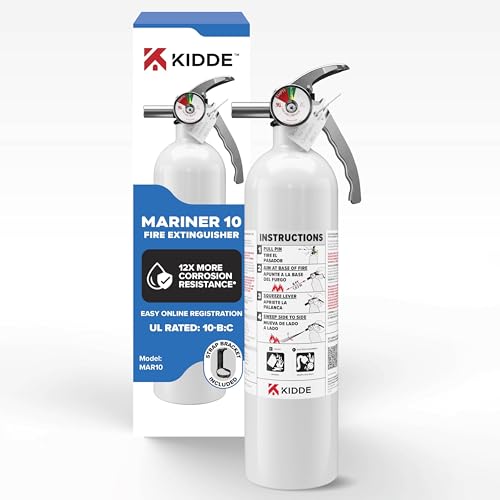
This 10BC model covers a broad range of marine fire scenarios, including Class B and Class C fires, with strong corrosion resistance from aluminum and stainless-steel components. It offers a discharge time of 8–12 seconds, a 6–8 foot range, and 100 PSI operating pressure. Best for boats that need strong general-purpose coverage in a compact form. Limitation: like other single-use units, it must be recharged by a professional after discharge.
AmzBoom Fire Extinguisher For Home, Car, Boat 3-Pack

Best for boat owners who want multiple extinguishers for different compartments. This three-pack includes extinguishers suitable for kitchens, cars, boats, and homes, with mounting brackets for quick access. It covers multiple fire types, including lithium-ion battery fires, and uses a water-based formulation designed to leave minimal residue. Choose this if you desire redundancy across a larger vessel or several storage locations. Caution: not marine-specific in strict certification terms; verify compatibility with your boat’s regulations.
Buying Guide: Key Considerations For Marine Fire Extinguishers
- Fire type coverage: For most boats, aim for extinguishers that cover Class A, B, and C fires. Look for ratings like 1-A:10-B:C or 5BC, which indicate broad protection against common marine fires.
- Material and construction: All-metal valve assemblies with aluminum and stainless-steel components resist corrosion in a salt-air environment and tend to last longer on boats.
- Discharge time and range: Shorter times (8–12 seconds) and longer reach (6–8 feet) provide quicker and safer responses in engine rooms or cabins.
- Rechargeability: Most marine extinguishers on the market are single-use. Consider the logistics, cost, and availability of professional recharge services when selecting models.
- Size and mounting: Choose a compact unit that fits your boat’s compartments and comes with a secure mounting bracket or strap to prevent movement during rough seas.
- Coast Guard and regulatory alignment: Some extinguishers require certain mounting or labeling to meet U.S. Coast Guard recommendations. Verify what’s included with your mounting bracket and the specific model’s approval status when applicable.
FAQ
- Q: Are all marine extinguishers single-use? A: Many marine extinguishers are designed for single use and require professional recharge after discharge. Some models and brands offer rechargeable options; check the product details.
- Q: Which class ratings should I prioritize for a boat? A: Look for Class A, B, and C coverage (A: ordinary combustibles, B: flammable liquids, C: electrical equipment). A 5BC or 1A:10-B:C rating is common for boat models.
- Q: Do I need more than one extinguisher on a boat? A: For safety and redundancy, placing extinguishers in multiple locations (galley, engine room, cockpit) is advisable, especially on larger boats.
- Q: What maintenance is required? A: Inspect gauges, seals, and hoses regularly, replace or recharge after any discharge, and ensure brackets are secure and accessible.
- Q: Will a water-based extinguisher work on a boat? A: Water-based models are effective for certain fire types but may not be suitable for electrical fires if electrical components are exposed. Verify compatibility with your boat’s risk profile.
- Q: Are there safety certifications I should look for? A: While certifications vary, Coast Guard recommendations and manufacturer instructions are important. Prefer units with robust marine-grade construction.