Best Electric Sailboat Outboard Motors for Quiet, Efficient Propulsion
Answering the buyer’s search for reliable electric propulsion, this guide highlights five top electric outboard and trolling motors suited for sailboats, dinghies, and small to mid-size sailcraft. These units emphasize quiet operation, efficient power, and low maintenance, with practical notes on best use cases. Perfect for anglers, coastal cruisers, and day sailors seeking emissions-free propulsion and extended range in salt or freshwater environments.
Summary table of chosen products
| Product | Thrust / Power | Shshaft Length | Best For |
|---|---|---|---|
| Newport NT300 Electric Outboard Motor | 3 HP (1300 W, 110 lb thrust) | 36 in | Saltwater or freshwater adventures with long range |
| Newport NV-Series 62 lb Thrust | 62 lb thrust | 36 in | Larger boats needing robust trolling power |
| Newport NV-Series 36 lb Thrust | 36 lb thrust | 30 in | Kayaks, canoes, small boats, light trolling |
| PEXMOR 55 Lbs Thrust | 55 lb thrust | Adjustable (via shaft handle) | Saltwater or freshwater with moderate weight |
| VEVOR 55 lbs Thrust | 55 lb thrust | 30 in | Kayaks to small boats, versatile mounting |
Newport NT300 Electric Outboard Motor

Features: 3HP equivalent (1300 watts) with 110 lb thrust, designed for saltwater and freshwater. Includes a digital throttle with LCD display, 24.6″ shaft, and a 9.8″ 2-blade composite propeller. Trim/tilt angles and field-oriented control support smooth operation across water conditions. Top speed around 6.5 MPH with up to 66 miles range on a single charge and up to 30 hours runtime.
Best for: Sailboats and larger tender setups needing substantial thrust and long-range electric propulsion. Choose this for extended day sailing or fishing trips where quiet, emission-free power is desirable. Caution: runtime varies with boat weight and conditions; ensure battery capacity matches planned trip length.
Newport NV-Series 62lb Thrust Trolling Motor

Features: 12V electric trolling motor with 62 lb thrust, 36″ shaft, 3-blade propeller, and LED battery meter. Adjustable mount height and direction with 8 speeds (5 forward, 3 reverse). Designed for trolling on larger boats or salinity-tolerant sailing crafts. Best for: You’ll appreciate steady low-noise propulsion for trolling or slow cruising. Limitation: top speed is moderate and depends on boat shape and weight.
Newport NV-Series 36lb Thrust Trolling Motor
Features: 12V system with 36 lb thrust, 30″ shaft, 5 LED battery meter, 6″ telescoping tiller handle, and 3-blade prop. Adjustable mount and direction, with 8 speeds for flexible control. Best for: Kayaks, canoes, and small boats requiring light, quiet propulsion. Caution: lower thrust may be insufficient on heavier hulls or windy days.
PEXMOR 55LBS Thrust Trolling Motor
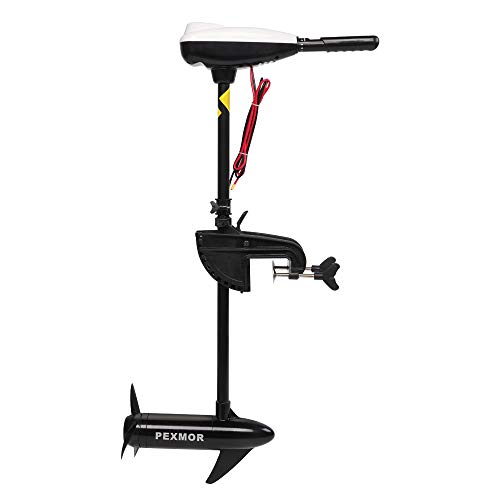
Features: 55 lb thrust on 12V, with 6″ adjustable handle and 5 forward/3 reverse speeds. Includes adjustable shaft depth and angle with a user-friendly knob. Best for: Saltwater or freshwater boats needing reliable all-day operation with moderate noise. Limitation: actual speed varies with boat weight and water conditions; ensure motor weight balance on paddle boats or smaller hulls.
VEVOR Electric Trolling Motor 55lbs

Features: 55 lb thrust, 8 speeds (5 forward, 3 reverse), LED battery indicator, 30″ shaft. Transom-mounted for kayaks and small boats with saltwater and freshwater compatibility. Best for: Versatile mounting in varied conditions; the adjustable shaft and depth make it suitable for shallow waters. Limitation: performance can vary with water current and hull weight.
Buying Guide
- Hull size and weight: Heavier boats require higher thrust, such as 62 lb or 55 lb units. Lighter craft can perform well with 36 lb or 55 lb motors.
- Saltwater vs freshwater: Corrosion-resistant builds are essential for saltwater use; confirm materials and coating suitability for marine environments.
- Shshaft length: Match shaft length to transom height to prevent propeller cavitation and ensure efficient planning.
- Battery and range considerations: For longer days on the water, pair with appropriate battery capacity to achieve your target range and runtime.
- Control and handling: Tiller handle length, adjustability, and the number of forward/reverse speeds affect maneuverability in tight spaces.
- Maintenance and noise: Electric outboards are generally low-maintenance and quiet, which benefits fishing, sailing, and wildlife observation.
FAQ
- What is the practical range of an electric outboard on a sailboat? Range depends on battery capacity, motor efficiency, hull weight, and conditions; expect longer runtimes with lighter loads and efficient hull design.
- Can I use a trolling motor as a primary sailboat propulsion? It can power auxiliary movement and docking, but typical trolling motors are designed for trolling or shallow-water propulsion rather than steady open-water cruising.
- What shaft length should I choose? Choose a shaft long enough to keep the propeller fully submerged in choppy water and to prevent cavitation; longer shafts are common on larger transoms.
- Are these motors suitable for saltwater? Yes, several models are built for both saltwater and freshwater; verify corrosion protection and seals for marine use.
- Do electric outboards require maintenance? Generally lower maintenance than gas engines, focusing on battery care, propeller inspection, and electrical connections.
- What’s the best option for a small sailboat? A lighter 36–55 lb thrust motor with a 30–36 inch shaft is typically a good match for small to mid-size dinghies and tender boats.