Best Battery Switches for Boats: Durable, Safe Power Control
Answering the need for simple, reliable power control on a boat, these battery switches help you isolate, connect, or combine battery banks. They’re best for boaters who want quick, secure power management without rewiring. Ideal buyers include weekend sailors, small motorboat owners, and anglers who need dependable starting power or emergency battery combines. Below are five top options with clear use cases and practical trade-offs to help you choose.
| Product | Best For | Key Benefit |
|---|---|---|
| Seachoice Battery Select Switch, Disconnect Isolator Cutoff, Dual, 12 -50V | Two-battery setups | Versatile selection between batteries for starting or charging |
| Blue Sea Systems 4‑Position Mini Selector Battery Switch, Red, 6007 m‑Series | Emergency combine and space savings | Compact with emergency combine and flexible mounting |
| Nilight 90015A Battery Switch 12-48V Waterproof Heavy Duty | Rugged, all-weather boats | High amperage with sturdy waterproof housing |
| Nilight 1-2-Both-Off Battery Switch, 12V-48V | Two-battery systems with both/both-off options | 4-position versatility for full control |
| Malictele 300A 1-Both-2-Off 4-Position | Heavy-duty isolation | Ignition protected, robust for tough environments |
The table above highlights practical fits. Read on for detailed comparisons, including installation notes, who each product serves best, and potential limitations to consider before you buy.
Seachoice Battery Select Switch

Best for two-battery boats needing straightforward switching. Features include selection between batteries for starting, charging, or operation in parallel. Suitable for systems under 50V and rated UL listed, ignition protected, and CE approved. Best for boats where one battery is for starting and another for electronics or backup power. Caution: ensure your battery bank wiring matches the device’s voltage range to avoid misconnection.
Blue Sea Systems 4‑Position Mini Selector Battery Switch

Better for tight spaces with an emergency combine feature that draws power from both batteries during engine start or radio use. Compact design supports three mounting methods—surface, flush, or rear—so it fits varied panel layouts. This is ideal for boats with limited dash space or where you want a quick, safe power transition. Limitation: the compact form may limit wiring options on larger, multi-battery configurations.
Blue Sea Systems e-Series 4-Position 32V Selector
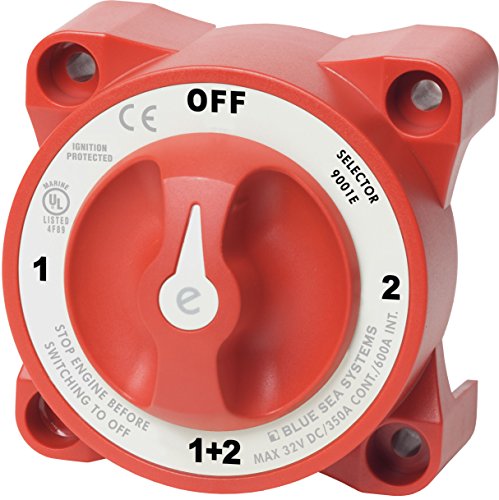
Best for compact installations with multiple mounting options. Its four-position configuration supports easy switching between banks while maintaining ignition protection. Suitable for engine rooms in gasoline-powered boats where space is at a premium. Caution: ensure your mounting location is well-ventilated to avoid heat buildup in tight spaces.
Nilight 90015A Battery Switch

Best for rugged, all-weather boats needing waterproof heavy duty performance. Operates on 12-48V systems with 275 A continuous at DC 12V and higher intermittent/ momentary ratings. Suitable for standalone use or combined with other switches for larger systems. Limitation: higher amperage models require careful heat management and secure mounting to prevent water ingress in rough seas.
Malictele 300A 1-Both-2-Off 4-Position

Best for demanding power control with 300A continuous rating. The 1-Both-2-Off design enables uninterrupted power switching and prevents accidental discharge. Made with ABS housing and tinned copper studs for reliable conductivity. Consider this option if you need ignition protection and heavier-duty construction for harsh marine environments. Caution: ensure the switch geometry allows full knob travel in your installation area to avoid contact with panels.
Buying Guide
Key considerations help match the right switch to your boat’s electrical system:
- Voltage and current: Confirm system voltage (12V–48V) and the continuous/current ratings to avoid overheating or poor contact.
- Number of batteries: Choose 2- or 4-position switches based on whether you need simple on/off, combined banks, or separate banks for starting and house loads.
- Ignition protection and waterproofing: For engine rooms and exposed areas, select ignition-protected and waterproof models to reduce fire risk and water ingress.
- Mounting options: Look for surface, rear, or flush mounting to fit your dashboard or bulkhead space.
- Safety features: Removable knobs or lockable designs help prevent accidental switches during maintenance or transit.
Installation tips
- Plan wiring routes to minimize resistance and prevent short circuits. Use appropriately sized gauge wires for the load plus safety margins.
- Follow the manufacturer’s diagrams for battery polarity and load connections to ensure correct operation.
- Secure the switch firmly to reduce vibration and wear in rough seas.
FAQ
- What is a battery switch for boats? It isolates or connects battery banks, preventing drain and enabling emergency starts or separate house loads.
- How do I choose between 2- or 4-position switches? 2-position handles basic on/off or combine functions; 4-position adds separate banks or both-on modes for flexible power management.
- Is ignition protection important on marine switches? Yes, it reduces ignition risk in gasoline-engine compartments and similar environments.
- Can I install a battery switch myself? Many do-it-yourself installations are possible with basic electrical knowledge, but consult an electrician if unsure about wiring or wiring code compliance.
- Do waterproof switches matter for boats? In wet environments, waterproofing minimizes corrosion and accidental short circuits, especially in exposed helm settings.
- When should I replace a battery switch? Replace if you notice loose connections, corrosion, overheating, or inconsistent switching performance.