Best Flotation Foam for Boat Buyer’s Guide
When choosing flotation foam for a boat, look for closed‑cell polyurethane foam designed for marine use. This guide highlights five reliable options ideal for nonstructural buoyancy, insulation, and void filling. Best fits: small DIY boat projects, repairs, deck void filling, and temporary flotation supports. Compare density, curing, and resin compatibility to decide which foam matches your project needs.
Buying summary table
| Product | Brand | Density | Best For | Notes |
|---|---|---|---|---|
| TotalBoat 2 Lb Density Kit | TotalBoat | 2 Lb/ft³ | Lightweight buoyancy & insulation | Fast cure, 1:1 mix |
| TotalBoat 6 Lb Density Kit | TotalBoat | 6 Lb/ft³ | Stronger flotation & structural support | Higher compressive strength |
| Fiberglass Supply Depot 2 Lb Density (1 Gallon) | Fiberglass Supply Depot | 2 Lb/ft³ | Void filling under decks | 1 gallon kit |
| Fiberglass Supply Depot 4 Lb Density (1 Gallon) | Fiberglass Supply Depot | 4 Lb/ft³ | Higher density applications | 1 gallon kit |
| Fiberglass Supply Depot 2 Lb Density (2 Gallon) | Fiberglass Supply Depot | 2 Lb/ft³ | Larger volume flotation | Produces 10 cubic feet |
TotalBoat 2 Lb Density Expanding Foam Kit

Brand: TotalBoat. This two‑part polyurethane foam is lightweight and designed for buoyancy, insulation, and gap filling in nonstructural boat applications. It expands rapidly and cures in about five minutes at typical workshop temperatures. The foam forms a 94% closed cell structure, resisting water absorption and damage from solvents. It can be coated with polyester, epoxy, or vinyl ester resins and can be cut or carved after curing. Best for lightweight flotation under decks or in voids where minimal weight is desired.
Best for: DIY boat owners seeking fast, easy flotation with good insulation properties. Choose this when you need quick cure times and ease of application in small to mid‑sized voids. Limitation: not intended for structural flotation or load-bearing use.
TotalBoat 6 Lb Density Expanding Foam Kit
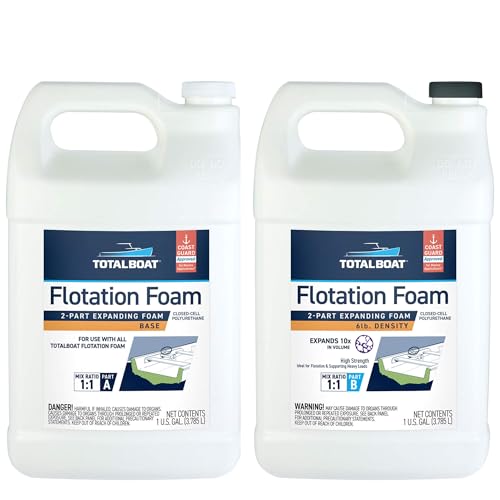
Brand: TotalBoat. This higher‑density two‑part foam cures very hard and rigid with high compressive strength, suitable for structural reinforcement, casting, carving, and boat or buoy flotation where extra rigidity is beneficial. It yields a 94% closed cell foam compatible with epoxy, polyester, or vinyl ester resins and can be painted after curing. Best for projects that demand stronger flotation and capacity to hold shape under load.
Best for: Projects requiring enhanced buoyancy and durability, such as larger flotation voids or parts that must maintain form under stress. Caution: higher density means more weight and potentially longer cure times in cooler environments.
Fiberglass Supply Depot 2 Lb Density (1 Gallon)

Brand: Fiberglass Supply Depot. This 2‑pound density foam is designed for void filling and lightweight flotation. It is poured in equal parts and cures to provide buoyancy, insulation, and soundproofing in nonstructural applications. The kit typically yields several cubic feet of foam and accepts lamination with various resins after curing. Best for: filling under decks or cavities where light weight buoyancy is needed. Limitation: not suitable for load‑bearing structural flotation.
Fiberglass Supply Depot 2 Lb Density (2 Gallon)

Brand: Fiberglass Supply Depot. This two‑part, closed‑cell foam is designed for larger flotation needs and void filling in nonstructural applications. The 2 gallon kit produces about 10 cubic feet of foam, expanding to form buoyant, water‑resistant voids. Best for: bigger boats or multiple voids that require substantial flotation. Caution: ensure proper ventilation during mixing and curing.
Fiberglass Supply Depot 4 Lb Density (1 Gallon)

Brand: Fiberglass Supply Depot. This higher‑density 4 lb foam provides stronger buoyancy and is suitable for applications requiring increased rigidity and load tolerance. The 1 gallon kit comprises parts A and B that mix to a rigid, closed‑cell foam compatible with resin laminates for marine use. Best for: heavier flotation needs or where a sturdier core is desired. Limitation: heavier than 2 lb variants and may require more careful handling.
Buying Guide
What density should you choose?
Lower densities (around 2 Lb) deliver lighter flotation with easier shaping and trim, useful under decks or in small voids. Higher densities (6 Lb or 4 Lb) offer more rigidity and strength for larger voids or load‑bearing considerations, though add weight.
Is resin compatibility important?
Most marine foams are designed to be compatible with common resins like epoxy, polyester, or vinyl ester. If you plan to laminate a surface after curing, verify resin compatibility to avoid delamination or heat issues.
What about curing time and conditions?
Foams cure faster at higher temperatures and slower in cooler environments. For best results, apply in a well‑ventilated area and follow manufacturer instructions for mixing ratios and curing temperatures.
Where should you apply flotation foam?
Use nonstructural flotation foam to fill voids under decks, within cavities, or to insulate compartments. Avoid using these foams as primary structural support or load‑bearing flotation unless specified by the manufacturer and approved for such use.
What are practical safety considerations?
Wear protective gear when mixing and applying foam, including gloves and eye protection. Ensure adequate ventilation to avoid inhaling isocyanates and fumes. Follow material safety data sheets provided with each product.
Maintenance and finishing
Upon curing, many foams can be coated with resins or painted for protection and aesthetics. For long‑term durability in saltwater environments, consider sealing with a compatible coating after curing.
Summary of key distinctions
- Best for quick, light buoyancy: 2 Lb density kits from TotalBoat or Fiberglass Supply Depot.
- Better for stronger buoyancy and structure: 6 Lb density kit from TotalBoat.
- Larger volumes: 2–Gallons kits from Fiberglass Supply Depot provide more cubic feet of foam.
- Higher density for durability: 4 Lb density option from Fiberglass Supply Depot.
FAQ
- What is the primary use of flotation foam in boats?
To add buoyancy, fill voids, insulate, and dampen sound in nonstructural areas.
- Can flotation foam be used for structural support?
Not typically; most foams are designed for nonstructural applications unless explicitly rated by the manufacturer.
- Which foam expands the most?
Higher‑density formulations generally produce more expansion and rigidity, though actual expansion depends on batch and temperature.
- Do these foams require laminating with resins?
Many are compatible with common marine resins and can be laminated or painted after curing.
- How long does curing take?
Curing often occurs within minutes to hours depending on temperature, humidity, and product; follow the product’s stated cure time.
- Is ventilation important during mixing?
Yes. Use in a well‑ventilated area and wear protective gear to avoid exposure to fumes.