Best Battery Monitor System 12V for Reliable Power Management
Looking for a reliable battery monitor system 12V to protect and optimize your power storage? This guide highlights five top options, with clear criteria on who they’re best for and why. These monitors suit RVs, boats, solar setups, cars, and other 12V–24V systems. Each option supports multiple battery chemistries and offers alarms, real-time reads, and rugged builds. The following table summarizes the standout choices for quick comparison.
| Product | Best For | Key Feature | Limitations |
|---|---|---|---|
| Renogy 500A Battery Monitor with Shunt | Large 12V solar or off-grid systems | High accuracy shunt-based measurement | Requires proper wiring for accurate shunt readings |
| ANCEL BM300 Pro Battery Monitor | Versatile vehicles and multi-battery setups | Bluetooth 5.3 with auto-detect 6–24V systems | Some features limited to monitoring, not full charging tests |
| ANCEL BM200-US Car Battery Tester | Everyday vehicle owners with 12V systems | Voltage, cranking, charging tests with history logs | More focused on testing than continuous monitoring |
| IPX7 SUPNOVA Battery Monitor | Outdoor or water-prone environments | IPX7 waterproof rating with wide voltage range | Basic alarm features; more ruggedized for outdoors |
| BINTA Battery Monitor with Shunt | RV, boats, solar arrays needing real-time SOC | Real-time SOC, up to 500A peak | Display clarity can vary in bright sunlight |
Note: All selections are 12V-compatible or adaptable to higher voltage systems with proper shunts or wiring. Each option aims to help prevent deep discharge, plan charging, and extend battery life in mobile or stationary setups.
Renogy 500A Battery Monitor With Shunt
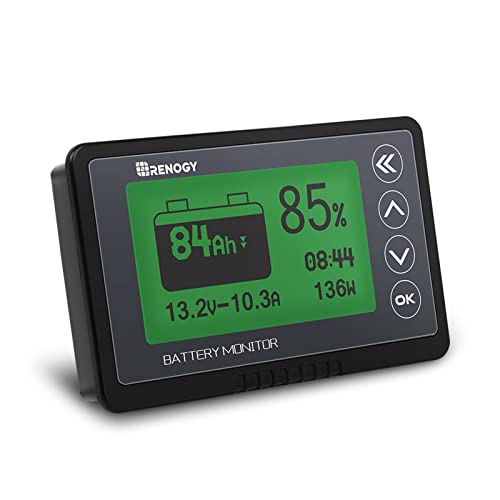
The Renogy battery monitor uses a shunt-type design for high-accuracy real-time voltage and current readings. It includes high and low voltage alarms to protect the battery from over-discharge. Compatible with multiple chemistries including Lead Acid (AGM, GEL), Lithium Iron Phosphate, and Lithium-ion and works with 12V, 24V, and 48V systems. This makes it a strong choice for off-grid solar, RV, marine, or backup power setups where precise monitoring matters. Best for large, mixed-battery environments where accuracy and alarms are critical. Caution: Proper installation is essential to ensure accurate shunt readings and alarm triggering.
ANCEL BM300 Pro Battery Monitor
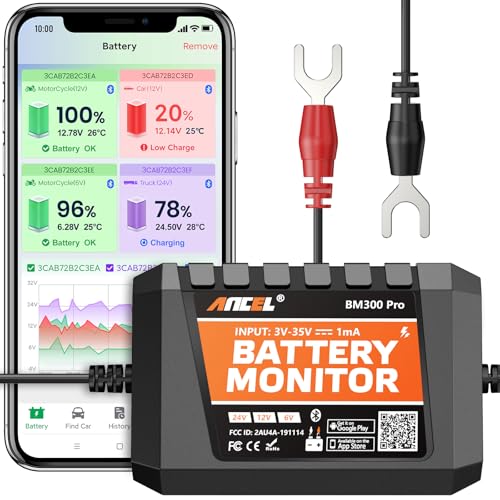
The BM300 Pro provides a universal solution for 6V–24V systems and automatically adapts to common battery types including Lead-Acid and Lithium-Ion. It supports monitoring up to four batteries simultaneously and delivers instant alerts for voltage drops, charging failures, or weak cranking. Best for enthusiasts with multiple batteries or evolving vehicle needs. Caution: While it offers Bluetooth connectivity and broad compatibility, 6V monitoring is limited to state of charge and temperature, not charging/cranking tests.
ANCEL BM200-US Car Battery Tester

The BM200-US focuses on 12V automotive batteries, offering voltage, cranking, and charging tests with alarm history. It’s well-suited for car, RV, motorcycle, truck, and boat owners who want ongoing testing capability along with quick alerts for potential issues. Choose this if you mainly need test-focused monitoring rather than continuous multi-battery supervision. Limitation: It emphasizes testing functions and may not provide continuous real-time monitoring across multiple batteries.
IPX7 SUPNOVA Battery Monitor

The SUPNOVA monitor covers 7–100V systems with a digital display showing remaining capacity and percentage, plus a buzzer alarm and temperature reading. Its IPX7 waterproof rating makes it ideal for outdoor usage on boats, golf carts, or other exposed installations. Best for environments where moisture or rain is a concern. Caution: The feature set is more focused on basic capacity readings and alarms; advanced multi-battery tracking is limited compared to shunt-based monitors.
BINTA Battery Monitor With Shunt

The BINTA monitor with shunt provides real-time state of charge, remaining capacity (up to 999Ah), voltage, and current. It supports 8–120V lead-acid, LiFePO4, and lithium-ion batteries, with a peak rating up to 500A. It’s a solid choice for RVs, boats, golf carts, or solar arrays needing accurate SOC information. Best for power users who want a fuel-gauge style readout. Limitation: Backlight readability can be affected by bright sunlight, so placement matters for visibility.
Buying Guide
What should I consider when choosing a 12V battery monitor?
- Voltage range and system type: Ensure the monitor supports your system voltage (6V, 12V, 24V, or higher) and the number of batteries you plan to monitor.
- Monitoring method: Shunt-based monitors provide high accuracy for current and SOC; non-shunt models may offer basic voltage and alarms but fewer current readings.
- Battery chemistries: Check compatibility with lead-acid (AGM, Gel, Flooded), LiFePO4, and lithium-ion, especially if you mix chemistries.
- Alarms and alerts: Look for high/low voltage alarms, temperature monitoring, and Bluetooth or wireless alerts if you want remote access.
- Durability and enclosure: For outdoor or vehicle installations, IP ratings (like IP67 or IPX7) and rugged shells protect against dust, water, and vibration.
- Display and visibility: A clear display (backlit, wide viewing angle) helps in daylight and night conditions. Consider placement for optimal readability.
- Installation complexity: Some monitors require only a few wires, while shunt-based systems need precise wiring for accuracy.
Single vs. multi-battery monitoring
For RVs, boats, or solar arrays with multiple batteries, a device that can monitor several batteries simultaneously (or provide a robust SOC across the bank) offers greater value. If you only need to verify a single battery’s health, a simpler tester may suffice, but it won’t provide ongoing monitoring across a system.
What configuration best fits a mobile power setup?
In mobile environments, choose a monitor with a rugged enclosure, weather resistance, and an alarm system that can operate without constant interaction. Bluetooth or wireless options add convenience for remote checks, but ensure the device can run reliably in vibrations and temperature changes typical of vehicles or boats.
FAQ
Q: Do I need a shunt-based monitor for accuracy?
A: Shunt-based monitors measure current directly and often provide more precise state-of-charge readings, especially in larger battery banks.
Q: Can these monitors work with lithium batteries?
A: Yes, many models support LiFePO4 and other lithium chemistries, but always confirm compatibility with your exact battery type.
Q: Is Bluetooth connectivity necessary?
A: Bluetooth enables remote monitoring on mobile devices, but some setups work fine with on-panel displays. Consider your preferred access method and environment.
Q: Are there monitors built for outdoor use?
A: Some models offer IP ratings like IPX7 or IP67, which are better suited for outdoor or marine installations.
Q: How many batteries can a monitor track?
A: Certain models monitor multiple batteries simultaneously, while others focus on a single battery. Check the product’s stated capacity to monitor more than one battery bank.