Best Lithium Ion Marine Battery Options for Reliable Boat Power
For boaters and anglers seeking dependable, long-lasting marine power, lithium iron phosphate (LiFePO4) batteries offer superior cycle life, lighter weight, and safer operation than traditional lead-acid cells. This guide highlights five high-quality lithium battery options well-suited for marine use, RVs, and off-grid systems. Each choice targets a specific boat size, trolling motor needs, or living-aboard setup, helping you pick the right balance of capacity, weight, and expansion potential.
Quick reference table:
| Product | Best For | Key Benefit |
|---|---|---|
| GRNOE 2 Pack 12V 100Ah LiFePO4 | Small-to-midcraft boats, RVs with space to expand | Expandable 4S4P to 51.2V 400Ah |
| SUPER EMPOWER 12V 100Ah (Group 24) | Drop-in replacement for lead-acid; compact spaces | Long cycle life with integrated BMS |
| SUPER EMPOWER 12V 100Ah (Group 31) | Medium boats and trolling-motor setups | Drop-in fit, high cycle life, IP-reliable |
| Eiiev 12V 100Ah LiFePO4 (Group 31) | Lightweight upgrades for small to mid boats | 10-year lifespan; 95% usable capacity |
| ECOBOSS 12V 100Ah LiFePO4 (Group 31) | Reliable daily power for boats and RVs | Up to 15,000+ cycles; robust low-temp protection |
GRNOE 2 Pack 12V 100Ah LiFePO4 Batteries
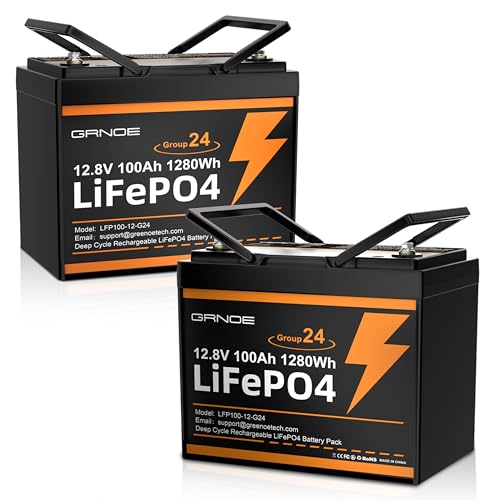
Two 12.8V 100Ah LiFePO4 units deliver up to 15,000 cycles at 60% depth of discharge, offering endurance well beyond lead-acid alternatives. A built-in 100A BMS provides protection against overcharge, over-discharge, overcurrent, and short circuits, with dustproof and moisture resistance that suits wet marine environments. Flexible 4S4P expansion enables up to 51.2V 400Ah (20.48kWh). Best for boaters who anticipate growing power needs, or for off-grid cabins and larger trolling-motor setups. Caution: expansion requires compatible charging schemes and wiring to maintain safety and performance.
Why this is a strong pick: The two-battery configuration reduces weight while enabling significant future growth via series/parallel expansion. The 100A BMS covers common protection needs for marine power systems. Best for small to mid‑sized boats or RV installations that may scale up over time.
SUPER EMPOWER 12V 100Ah LiFePO4 Group 24

This Group 24 LiFePO4 battery is designed for deep-cycle use in RVs, boats, and solar island setups. It integrates a 100A BMS to manage charging, discharging, and temperature, and is pitched as a drop-in replacement for lead-acid systems. It’s best for recreational boats with standard Group 24 boxes seeking longer life and safer charging. Caution: designed for energy storage; not suitable for engine starting.
Why this is a strong pick: Combines a familiar size with modern LiFePO4 chemistry, making it easy to upgrade existing lead-acid racks without layout changes. It supports steady daily use with a robust BMS for protection in damp marine environments.
Limitations to consider: Not intended for engine cranking; ensure compatible charging equipment for lithium chemistry.
SUPER EMPOWER 12V 100Ah Group 31
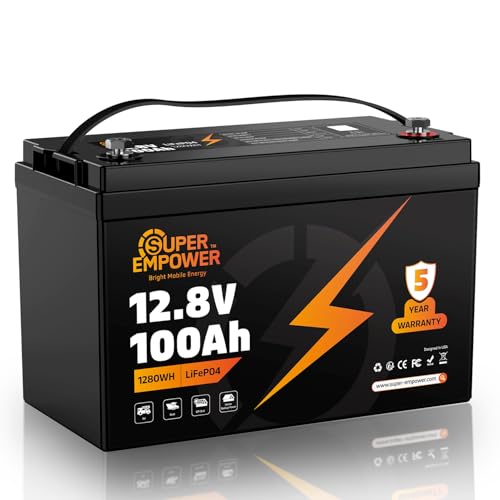
Group 31 LiFePO4 battery optimized for trolling motors and deeper house power banks. It features Grade A+ LiFePO4 cells with a protective BMS and a compact form factor suitable for standard Group 31 boxes. Best for larger boats or longer trips where a higher storage reserve is needed without increasing footprint. Caution: always use a lithium charger or DC-DC charger aligned to lithium standards for optimal behavior.
Why this is a strong pick: The Group 31 size delivers ample energy while remaining portable, making it a versatile upgrade for mid-range marine vessels or RVs relying on sustained power.
Eiiev 12V 100Ah LiFePO4 Group 31

Eiiev’s 100Ah LiFePO4 battery offers a 10-year life with 4000–15000 cycles depending on depth of discharge. It emphasizes a lightweight build (about 24 lbs) and a flat discharge curve that preserves most capacity for longer runtimes. Best for boaters who want a long-lasting, easy-to-handle upgrade in compact spaces. Caution: ensure your charging system accommodates 60% DOD to maximize cycle life claims.
Why this is a strong pick: The 70% lighter weight compared with lead-acid versions makes installation and handling much easier on smaller vessels, while maintaining substantial energy capacity.
ECOBOSS 12V 100Ah LiFePO4 Group 31

ECOBOSS offers a robust LiFePO4 option with 15,000+ cycles and a 120A BMS plus low-temperature protection. Weighing about 24.69 lbs, it fits a standard Group 31 footprint and provides all-weather energy for RVs, trolling motors, and marine systems. Best for daily-use vessels where reliability and long life justify a higher upfront investment. Caution: ensure proper lithium charging profiles for best performance in cold weather.
Why this is a strong pick: High cycle life and strong cold-weather protection make ECOBOSS suitable for year-round boating and off-grid setups in varied climates.
Buying Guide: What to Consider Before Buying a Marine LiFePO4 Battery
- Battery chemistry and cycle life: LiFePO4 offers long life, typically thousands of cycles. Higher cycle counts translate to lower replacement frequency and lower long-term cost.
- Capacity and depth of discharge: Look at usable capacity at your typical depth of discharge. A 60% DOD rating often yields more cycles than a 100% DOD rating, influencing real-world run time.
- Size and weight: Group size (31 vs 24) and overall weight affect installation in cramped compartments or trolling-motor pods. Lighter batteries ease mounting and reduce boat weight.
- Built-in management system (BMS): A strong 100A or higher BMS with protections for overcharge, over-discharge, and short circuits helps prevent battery damage in marine environments.
- Expansion potential: Some models support series and/or parallel expansion to grow voltage or capacity as needs evolve.
- Temperature considerations: Low-temperature protection matters for cold-weather boating. Some models disable charging below freezing to protect cells.
- Maintenance and safety: LiFePO4 cells are generally maintenance-free and safer than other chemistries, but follow manufacturer charging instructions and use appropriate lithium-compatible chargers.
- Compatibility with charging sources: Ensure your solar, shore power, or generator charging system supports lithium profiles (CC/CV chargers) to maximize performance and lifespan.
FAQ
- Q: Do LiFePO4 batteries require special chargers for marine use?
A: Yes. Use chargers designed for lithium chemistry (lithium mode) or a DC-DC charger compatible with LiFePO4 to ensure proper charging voltages and protections. - Q: Can I replace multiple lead-acid batteries with LiFePO4 in my boat?
A: Yes, and you may gain weight savings and longer life. Check battery box dimensions and BMS compatibility with your existing wiring and fusing. - Q: Is it safe to use LiFePO4 batteries in wet marine environments?
A: LiFePO4 cells are typically protected by IP-rated housings and BMS safety features, but always secure batteries in appropriate enclosures and follow installation guidelines. - Q: How many cycles can I expect from a LiFePO4 marine battery?
A: Most models advertise 5,000 to 15,000 cycles depending on depth of discharge and usage patterns, offering a long service life compared with lead-acid. - Q: Do lithium batteries work well in cold weather?
A: Many LiFePO4s include low-temperature protection, stopping charging below freezing. Some also limit discharge flow or have built-in safeguards for cold starts. - Q: What size battery is best for a trolling motor?
A: A Group 31 or Group 24 LiFePO4 with 100Ah capacity is a common starting point for mid-range trolling motors, offering extended run times with lighter weight than lead-acid.