Best Battery Chargers for Boats: Marine-Grade Onboard Chargers
Get safe, reliable power for your boat with onboard battery chargers that handle lead‑acid and lithium batteries. This guide highlights top options suited for different boat setups, from compact two-bank systems to feature-rich three-bank models. The listed products are chosen for durability, temperature compensation, and compatibility with marine applications. Ideal buyers include racers needing compact units, long-term cruisers seeking reliable maintainers, and boat owners who want easy, worry-free charging while afloat.
| Product | Type | Best For |
|---|---|---|
| NOCO GEN5X3 | 3-Bank, 15A | Big boats with multiple battery banks |
| NOCO GEN5X2 | 2-Bank, 10A | Medium boats with two battery banks |
| NOCO GEN5X1 | 1-Bank, 5A | Small boats needing a compact single-bank charger |
| NOCO GENIUS2D | Direct-mount 2A | Under-hood installs on small engines and RVs |
| NEXPEAK NC201 | 10-amp 12V/24V | Versatile maintenance for mixed battery chemistries |
NOCO GEN5X3: 3-Bank, 15A Onboard Charger
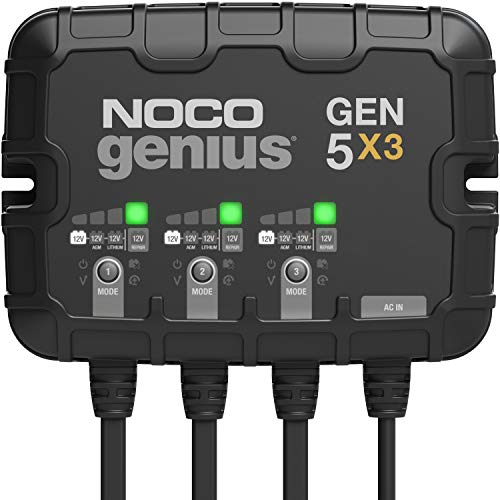
Best for boats with multiple battery banks that require independent charging per bank. The GEN5X3 provides 15 amps total across three banks (5 amps per bank) and supports 12V, 12V AGM, and 12V Lithium modes, plus a Repair Mode. It’s engineered for marine environments with temperature compensation and overcharge protection. This model is preferable for larger boats or systems that separate starting batteries from deep-cycle banks.
Who it’s best for: boat owners with three batteries or three distinct circuits and a need for robust, independent charging. Why selected: offers flexible bank-by-bank charging with precise mode selection for different battery chemistries. Caution: larger footprint; ensure mounting space and power supply meet requirements.
NOCO Genius GEN5X2: 2-Bank, 10A Onboard Charger
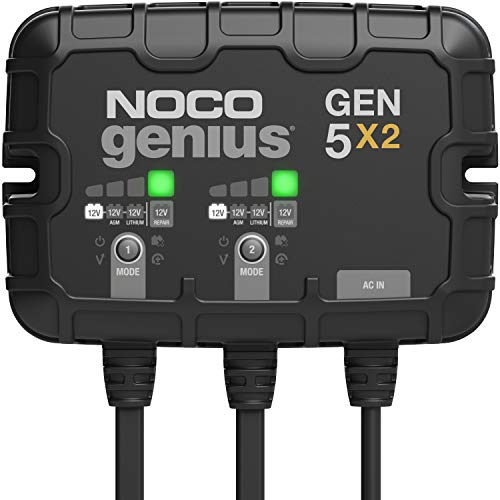
This is a two-bank onboard charger ideal for boats with separate starting and deep-cycle batteries. The GEN5X2 provides 10 amps total (5A per bank) and includes selectable modes for 12V, 12V AGM, and 12V Lithium, along with a Repair Mode. Best for mid-sized boats needing reliable two-bank charging and precise battery management. Caution: two-bank design may require careful layout to avoid heat buildup in tight compartments.
NOCO GEN5X1: 1-Bank, 5A Onboard Charger
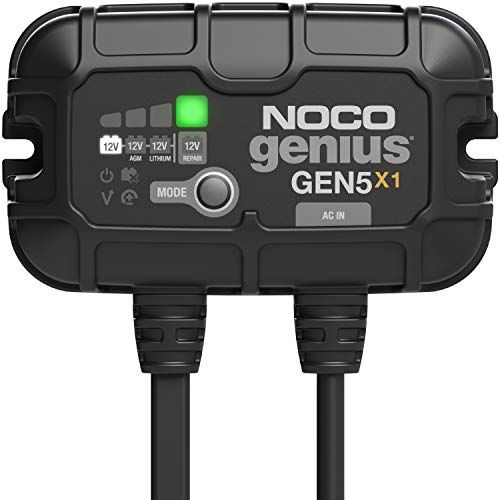
Best for small boats or a single-battery setup requiring a compact onboard charger. The GEN5X1 delivers 5 amps to one bank with modes for 12V, 12V AGM, and 12V Lithium and includes overcharge protection and temperature compensation. Choose this if space is limited and you only need to maintain one battery bank. Limitation: not suitable for multi-bank systems.
NEXPEAK NC201: 10-Amp Battery Charger

Best for boats that need a versatile 12V/24V charger with fast 10A charging and a built-in repair mode. The NC201 supports multiple battery chemistries (AGM, GEL, SLA, Flooded) and includes temperature compensation. It’s a good fit for mixed systems on mid-sized boats. Caution: general guidance warns that charging currents above 15A can risk battery chemistry if matched to battery size; ensure correct setting.
SMART 2 Bank Marine Battery Charger

Best for two-battery boats seeking independent bank control with 12V SLA/AGM, 12V Lithium, and 12V Calcium modes. It automatically switches from full charging to float mode and can recover batteries that are not completely dead. Choose this if you value independent bank settings and a built-in recovery option. Limitation: not explicitly stated for all LiFePO4 chemistries beyond Lithium mode; verify compatibility.
YONHAN Battery Charger 20A

Best for fast charging and maintainers of larger boat battery banks. The 20A unit supports 12V and 24V, includes seven-stage charging, and features winter mode and pulse repair. It handles LiFePO4 and multiple lead-acid chemistries. Caution: higher output requires appropriate power supply and ventilation; not ideal for very small boats or limited shore power.
Buying Guide: Key Considerations For Boat Battery Chargers
What boat size and battery layout do you have? For boats with multiple banks, a multi-bank charger offers independent charging per bank, reducing cross-charge conflicts. For smaller boats, a single-bank charger reduces complexity and space needs.
What battery chemistries need support? Marine boats often use a mix of lead-acid (AGM, Gel) and LiFePO4. Ensure the charger supports all relevant chemistries and includes proper mode options (12V, AGM, Lithium).
Do you need temperature compensation? Temperature changes impact charging efficiency and battery life. Chargers with temperature compensation reduce overcharge risk in hot climates and undercharge risk in cold climates.
Is water exposure a factor? Marine environments demand waterproof or water-resistant designs. Look for IP ratings or marine-grade housings and sealed connectors to withstand spray and humidity.
What is your installation style? Some models are direct-mount or under-hood friendly, which can simplify installation on compact boats or RVs. Consider space, mounting options, and cable routing.
Buying Tips: Quick Comparisons
- Best for three banks: NOCO GEN5X3 offers independent bank control and diverse modes.
- Best for two banks: NOCO GEN5X2 balances power and space for mid-sized boats.
- Best for small boats: NOCO GEN5X1 or NOCO Genius2D for compact installations.
- Best for mixed chemistries on boats: NEXPEAK NC201 provides strong versatility with temperature compensation and repair mode.
FAQ
- Do onboard chargers work with LiFePO4 batteries? Yes, many models support LiFePO4 alongside lead-acid; verify the exact modes listed by the manufacturer.
- Should I choose a 2-bank or 3-bank charger for my boat? If you have three distinct battery groups (starter, trolling, house), a 3-bank unit is advantageous; otherwise, 2-bank may suffice.
- Is overcharge protection necessary? Yes. It prevents battery damage and extends life, especially in marine environments with variable temperatures.
- Can a charger maintain batteries during winter storage? Many models include a float/maintenance mode to minimize self-discharge and extend life during downtime.