Best 3.5 Hp 2 Stroke Outboard Motors for Small Boats and Dinghies
Answering the top question for buyers seeking a compact, reliable 3.5 HP 2-stroke outboard motor: these models are best for small, lightweight boats, kayaks, inflatable dinghies, and as emergency propulsion in calm waters. They balance portability, fuel efficiency, and sufficient thrust for short trips. The five selected products below cover light-weight builds, CDI ignition, water cooling, and short shaft designs, making them suitable for rubber boats and small inflatables. The guide highlights who each model is best for and where compromises appear.
| Product | Best For | Why Pick |
|---|---|---|
| Gosangom 2-stroke 3.5HP Outboard | Portable boaters and casual anglers | Lightweight aluminum, water-cooled CDI, fuel-efficient |
| GrfceVue HANGKAI 3.5HP | Beginner and easy-start users | CDI ignition, low-noise design, simple throttle control |
| Cbhfmljd 2 Stroke 3.5HP | Reliable cruising in shallow water | CDI ignition, water cooling, 360° steering |
| LTIGOAW HANGKAI 2-Stroke 3.5HP | Budget-friendly, easy maintenance | Half water/air cooling, lightweight, manual start |
| LUPENGSHOP 3.5HP | Small inflatables and kayaks | High thrust propeller, step-less speed control |
Gosangom 2-stroke 3.5HP Outboard Motor

Best for light boats and frequent short trips, this model uses a lightweight aluminum alloy build with corrosion resistance suited to both fresh and salt water. It delivers up to 2.5 kW / 3.5 hp and a top speed around 5000 rpm. The 6.7-inch, three-blade propeller minimizes water resistance while maximizing thrust. The unit weighs about 21.6 pounds and measures 36 x 14.17 x 5.9 inches, making it easy to transport and mount. A fuel-efficient carburetor helps reduce consumption to roughly 0.3 gal/hour. Limitations include basic features without advanced digital controls.
Best for: Small rubber boats, inflatable boats, kayaks, and casual explorers who need portable propulsion.
What to watch: Ensure fuel mixing and maintenance are performed per 2-stroke requirements; the motor may require manual starting and basic maintenance compared to some modern fuel-injected units.
GrfceVue HANGKAI 3.5HP Outboard Motor

This 3.5HP outboard offers a CDI ignition system and water cooling for steadier operation. It features a 6.7-inch, three-blade propeller that helps reduce drag and improve thrust. The throttle is directly linked to acceleration and steering, while a stepless speed regulator aids smooth operation. The design emphasizes lower noise thanks to a large anechoic cover, with typical operation around 80 decibels. Best for beginners who want straightforward control and predictable performance. A potential limitation is the focus on basic features rather than advanced electronics.
Best for: New boaters and anglers seeking simple, reliable power with easy-start and smooth throttle response.
What to watch: Noise level is typical for small 2-stroke engines; consider muffler or placement to reduce sound impact in quiet waterways.
Cbhfmljd 2 Stroke 3.5 HP Outboard Motor
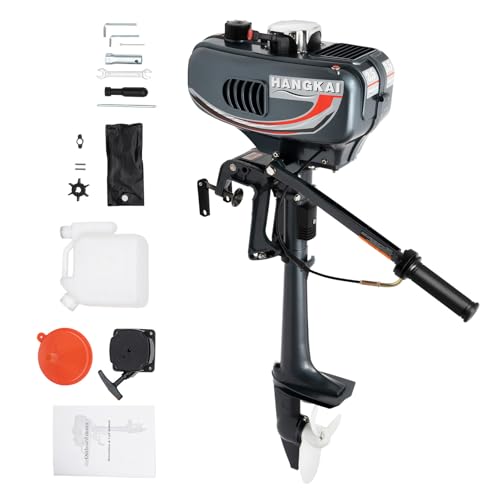
With a CDI ignition system and robust water cooling, this 2-stroke 3.5HP engine aims for quick starts and efficient running. It features a 1.3L internal fuel tank and a 360-degree steering function to simplify maneuvering in tight spaces or shallow water. The design uses high-strength aluminum alloy for the bracket to resist deformation. It supports a tilt or lift function for shallow-water operation. Best for users who need reliable performance with good shallow-water capability. Caution: ensure correct propeller protection and regular prop checks to prevent underwater damage during operation.
Best for: Small craft that require responsive control and easy handling in shallow or congested waters.
What to watch: Regular inspection of the propeller and cooling system is recommended to maintain efficiency and prevent overheating.
LTIGOAW HANGKAI 2-Stroke 3.5HP

This 3.5HP unit from LTIGOAW emphasizes a lightweight, portable profile with half water cooling and a CDI ignition for quick starts. It weighs about 9.8 kg (21.6 lbs) and uses a 49cc engine delivering up to 2.5 kW. A short shaft makes it suitable for shallow water boats and inflatables. Best for budget-conscious buyers needing dependable propulsion with straightforward maintenance. Limitation: the half cooling system may require more attention in hotter climates or during extended runs.
Best for: Lightweight inflatable boats, dinghies, and those prioritizing easy transport and simple maintenance.
What to watch: Confirm compatibility with your mounting hardware and prefer a fresh-water environment if you’re not near saltwater use.
LUPENGSHOP 3.5HP Outboard Motor

Powered by a 2-stroke 3.5HP engine, this unit uses a 6.7-inch three-blade propeller for strong thrust and reduced drag. It employs a lightweight aluminum alloy build with spray paint for corrosion resistance in salt and fresh water. The throttle lever controls both acceleration and steering, and the unit offers step-less speed regulation with a clutch for smoother operation. Best for small boats and inflatables needing straightforward, reliable propulsion. A caveat is that detailed specifications like fuel mix and maintenance intervals should follow manufacturer guidelines to sustain performance.
Best for: Small inflatables, kayaks, and dinghies where a compact, easy-to-operate engine is valued.
What to watch: Use the correct fuel mix and perform regular maintenance to ensure durability and consistent performance.
Buying Guide: Key Considerations For 3.5HP 2-Stroke Outboard Motors
- All five options are 2-stroke; they typically require oil-fuel mixture and offer higher power-to-weight but more emissions and maintenance than 4-stroke engines.
- Short-shaft models suit small boats and dinghies; ensure compatibility with your transom height to avoid cavitation and poor performance.
- Water cooling helps prevent overheating. Some models use half water-heat systems; plan for climate and usage duration.
- CDI (Capacitor Discharge Ignition) provides easier starts and reliability in varying conditions; important for first-time users.
- Lighter units are easier to transport and mount; ideal for kayaks, inflatables, and light boats.
- Carburetor efficiency and fuel mixing ratios affect consumption. Expect costs to scale with usage patterns and trip lengths.
- Check mounting hardware, propeller integrity, and cooling passages; keep spares handy for on-water troubleshooting.
- If you need quick moves in calm water and easy handling, prioritize lighter units with straightforward throttles. For longer trips or saltwater use, corrosion resistance and cooling become more critical.
FAQ
- What is the typical power range of a 3.5HP 2-stroke outboard? Most models provide up to about 2.5 kW (3.5 hp) with speeds around 4,000–5,000 rpm, suitable for small boats and calm waters.
- Is a short shaft appropriate for my boat? Short shafts fit transoms with lower height. Confirm your boat’s transom height and choose accordingly to avoid cavitation and improper steering.
- Do 2-stroke engines require mixed fuel? Yes, many 2-stroke outboards require fuel mixed with oil; follow the manufacturer’s ratio for break-in and long-term use.
- Is CDI ignition better for beginners? CDI ignition typically offers quicker starts and reliable lighting of the spark, which is advantageous to new users.
- What maintenance should I perform regularly? Check cooling passages, inspect the propeller, verify mounting hardware, and replace fuel/oil mixing components as recommended.
- Can these engines be used in saltwater? Several models advertise corrosion resistance suitable for saltwater with proper rinsing and maintenance after use.