Best Electronic Bilge Pump Switches for Safe, Automated Water Control
Answering the buyer’s search, these top picks are electronic bilge pump switches designed to automatically activate pumps when water rises and shut off when levels drop. They’re best for boaters who want reliable, low-maintenance bilge management with clear sensor signals. This guide highlights five strong options, each suited to different boating setups, from single-hensor field sensors to float-based switches. Use the quick comparison table below to skim key differences before diving into detailed product sections.
| Product | Best For | Typical System Voltage | |
|---|---|---|---|
| SEAFLO SFBS-20-06 | Marine systems needing solid-state sensing | Electric field sensing, no moving parts | 12V/24V |
| Johnson Pumps 36303 Ultima | Industrial-grade installations | corrosion resistance, 20A handling | 12V/24V |
| Landhoow Float Switch (2 pack) | Simple, backup redundancy | Two switches, 20A@12V/10A@24V/8A@32V | 12V/24V/32V |
| CHICIRIS Sensor Switch | Small boats, tight spaces | Wide application, high stability | 12V/24V |
| Attwood 4801-7 | Reliable bilge control | S3 electronic sensing | 12V |
SEAFLO Electric Field Bilge Switch

The SEAFLO SFBS-20-06 is a solid-state bilge switch designed for 12V or 24V systems. It supports up to 20A at 12V or 10A at 24V and uses electric field sensing with no moving parts. This makes it less prone to mechanical wear and environmental fouling in bilge conditions. It includes 39-inch/1000 mm wire leads for flexible installation and is protected by a 4-year warranty. Best for boaters seeking durable, maintenance-free operation and automatic pump control in varied marine environments.
Best for: boaters who want a long-life, technology-driven switch with minimal moving parts. Choose this if you value reliability in rough seas and want fewer mechanical failure points. Limitation: higher initial cost than some float-only options, and installation requires careful field-sensing alignment.
Johnson Pumps 36303 Ultima Auto Bilge Switch

The Johnson Pumps 36303 Ultima Auto Bilge Switch emphasizes rugged, corrosion-resistant construction and reliable operation in bilge water environments. It’s designed to handle pumps up to 20 amps at both 12V and 24V, making it suitable for larger pumps or boats with higher discharge needs. Best for: industrial-style installations or vessels that require a robust, corrosion-resistant switch. Limitation: it may be overkill for small craft with lightweight bilge systems.
Landhoow 2 Pcs Automatic Bilge Pump Float Switch

Landhoow offers a two-pack of automatic bilge float switches with automatic control. The set includes two switches for redundancy or multi-zone use, and the design supports automatic activation as water rises and stops at the target level. Best for: boat owners who want a backup switch or need bilge control in multiple compartments. Limitation: float-switch mechanisms can be affected by debris or algae in the bilge, requiring occasional cleaning.
CHICIRIS Marine Bilge Pump Sensor

The CHICIRIS sensor switch focuses on a wide application scope, including aquariums, fishing boats, and ships. It features high stability and automatic water-level detection via induction technology. Best for: smaller boats or mixed-use vessels where a compact, automatic sensor is preferred. Limitation: not all installations clearly specify amperage capacity; verify compatibility with your pump before use.
Attwood 4801-7 Automatic Bilge Switch

The Attwood 4801-7 uses a 12V system and features the S3 electronic sensing technology for precise bilge control. The switch is designed for reliable activation and deactivation with various bilge water mixtures. Best for: boaters seeking precise electronic sensing with proven durability in marine environments. Limitation: 12V operation may limit compatibility with higher-power pumps without additional wiring or relays.
Rule 43 Marine Deluxe Plastic Rocker Panel Switch

The Rule 43 Series 3-way panel is a lighted rocker switch with a built-in fuse. It’s designed for straightforward bilge wiring and simple panel integration. Best for: DIY installations where a visible, easy-to-wire switch is desired. Limitation: not a dedicated automatic bilge sensor; manual control may be required if used outside its intended 3-way panel configuration.
Rule 35A Marine Rule-A-Matic Switch
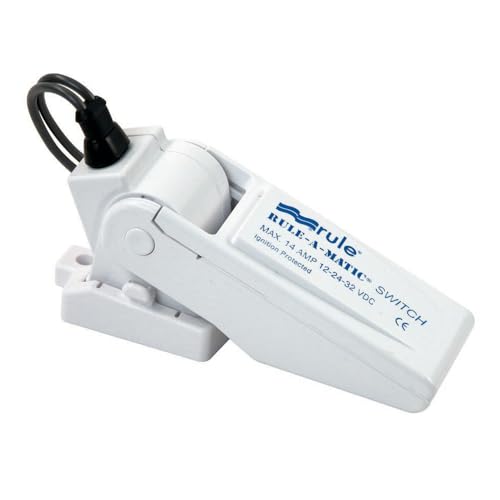
The Rule 35A Marine Rule-A-Matic Switch provides automatic bilge pump activation with water rise. It’s built to be durable and corrosion-resistant for marine environments. Best for: vessels needing a simple, robust automatic switch. Limitation: mercury-free but may require careful wiring to ensure consistent activation in low-water scenarios.
Water Witch WW Bilge Pump Switch

The WW Bilge Pump Switch is mercury-free, with a simple installation that mounts at any angle. Oils or fuels are not supposed to activate the switch, which aids in preventing false activations in contaminated bilge waters. Best for: boaters who need a straightforward, dependable switch with flexible mounting. Limitation: may require additional filtering if bilge fluids frequently contaminate the switch area.
Buying Guide
Key purchase considerations help you match a switch to your boat’s setup:
- Voltage and current requirements: Ensure the switch supports your pump’s amperage and your boat’s electrical system (12V, 24V, or higher).
- Sensor type: Solid-state field sensors avoid moving parts, while float switches rely on buoyancy. Choose based on space, debris risk, and maintenance tolerance.
- Environmental resilience: Look for marine-grade materials, corrosion resistance, and weatherproof wiring for bilge exposure.
- Wiring length and ease of installation: Longer leads offer flexible routing, but verify compatibility with your boat’s wiring harness and fuses.
- Redundancy options: For critical vessels, consider a dual-switch setup or a backup switch for multi-compartment bilges.
Frequently Asked Questions
- What is a bilge switch and how does it work? A bilge switch automatically activates a bilge pump when water rises to a preset level and shuts off once the water drops, protecting the vessel from flooding.
- Should I choose a float switch or solid-state sensor? Float switches are simple and economical but can be affected by debris; solid-state sensors have no moving parts and offer durable, maintenance-light operation.
- Can I install a bilge switch on any boat? Most switches fit standard bilge plumbing, but you should verify voltage, amperage, and mounting space for your specific model and pump.
- Is redundancy worth the extra cost? For boats with significant exposure to bilge water or critical systems, a backup switch improves reliability and reduces risk of pump failure.
- How do I prevent false activations? Ensure clean bilge water, correct sensor placement, and appropriate wiring to avoid signals from waves, oil, or foam triggering the switch.
- What maintenance is required? Periodic inspection for corrosion, debris, and wiring integrity keeps bilge switches operating reliably over time.