Best Marine Paint for Boats: Top Above-Waterline Coatings for Fiberglass, Wood, and Aluminum
Answering the common buyer question: which marine paint should I choose for my boat’s above-waterline areas? This guide highlights five top options that balance durability, ease of application, and surface compatibility. Ideal for different boat materials and use cases, these selections help boaters protect and beautify decks, hulls, trim, and aluminum surfaces. The featured products cover fiberglass, wood, metal, and aluminum, and include finishes suitable for saltwater and freshwater use. Whether you want a high-gloss finish, fast-dry oil-based protection, or aluminum-specific adhesion, this overview clarifies who each option is best for and why.
Summary of selected products:
| Product | Best For | Surface Compatibility | Finish Type |
|---|---|---|---|
| TotalBoat Wet Edge Topside Marine Paint Premium Polyurethane Coating (White, Gallon) | Power boats and sailboats seeking long-lasting gloss | Fiberglass, metal, wood | High-gloss polyurethane |
| TotalBoat Wet Edge Topside Marine Paint Premium Polyurethane Coating (White, Quart) | Smaller hull projects or touch-ups requiring easy application | Fiberglass, metal, wood | High-gloss polyurethane |
| TotalBoat Aluminum Boat Paint (Light Gray, Quart) | Aluminum boats and trailers needing strong adhesion | Aluminum, galvanized metal | Low-sheen polyurethane |
| TotalBoat Aluminum Boat Paint (Olive Drab, Quart) | Aluminum canoes, jon boats, and camo applications | Aluminum, galvanized metal | Low-sheen polyurethane |
| Rust-Oleum 396959 Marine Coatings Topside Paint (White, Quart) | General above-waterline coating on fiberglass, wood, or metal | Fiberglass, wood, metal | Oil-based, flexible enamel |
Rust-Oleum 396959 Marine Coatings Topside Paint (White, Quart)

Features include an oil-based formula that remains flexible and easy to apply with excellent leveling. It’s suitable for fiberglass, wood, or metal surfaces above the waterline and dries to the touch in 1–2 hours, covering up to 100 sq ft. Best for boaters who want a quick-dry, above-waterline option that handles multiple substrates. A potential limitation is the oil-based clean-up requires solvents and ventilation considerations.
- Best for general above-waterline use on multiple substrates
- Quick-dry opportunity for small to mid-size vessels
- Oil-based, easy leveling for a smooth finish
Rust-Oleum 207000 Marine Coatings Topside Paint (White, Quart)

This option mirrors the above-waterline suitability, with an oil-based formula that dries quickly and provides flexible performance with good leveling. It’s designed for fiberglass, wood, or metal surfaces above the waterline and shares a similar coverage profile. Best for boat owners who want a reliable, easy-to-apply oil-based coating with straightforward touch-ups. A caution: ensure proper ventilation and clean-up with appropriate solvents.
- Best for quick-drying above-waterline projects
- Suitable for multiple substrate types
- Oil-based with good leveling
TotalBoat Wet Edge Topside Marine Paint Premium Polyurethane Coating (White, Gallon)

Note: Wet Edge delivers a durable, high-gloss marine-grade finish with scratch and chemical resistance. It’s a one-part formula suitable for above-the-waterline use on fiberglass, wood, metal, and more. It can be applied via roll & tip, brush, or spray for professional results, and is designed to resist fading, cracks, and peels. Best for boats requiring long-lasting color retention and a showroom finish. Caution: color consistency and gloss may vary with temperature and application method.
- Best for high-gloss, long-lasting finish
- One-part formula for user-friendly application
- Resists fading and cracking over multiple seasons
TotalBoat Wet Edge Topside Marine Paint Premium Polyurethane Coating (White, Quart)

The quart size of Wet Edge provides a practical option for smaller boats or touch-up projects. It maintains the same high-gloss, durable finish as the gallon variant, making it a versatile choice for above-waterline surfaces on fiberglass, metal, and wood. Best for seasonal boaters or hobbyists who want a reliable, easy-to-apply topcoat. Limitation: coverage per quart is smaller, so more coats may be needed for larger hull areas.
- Best for spot repairs and small boats
- Same high-gloss polyurethane protection in a smaller can
- Requires multiple coats for best results on larger surfaces
TotalBoat Aluminum Boat Paint (Light Gray, Quart)
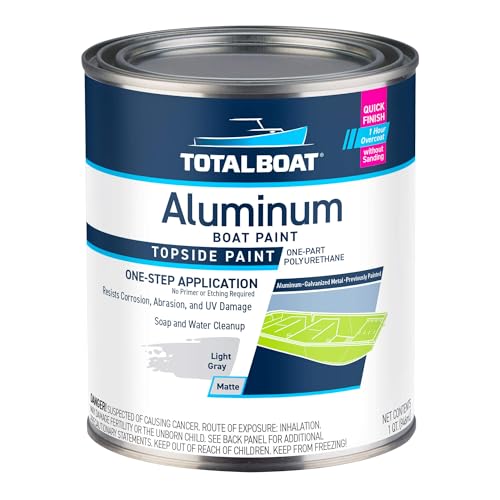
This aluminum-specific paint is reformulated for better finish adhesion on aluminum and galvanized metal. It offers a low-sheen, one-part polyurethane finish and is designed for boats such as aluminum canoes, dinghies, pontoon boats, and trailers. It provides good resistance to chips and chemical exposure and dries quickly to allow rapid overcoating. Best for aluminum-focused projects where a camo-friendly or low-reflective finish is desired. Limitation: primarily designed for aluminum surfaces; other substrates may require different prep or coatings.
- Best for aluminum and galvanized surfaces
- Low-sheen polyurethane with fast overcoat time
- No priming needed on properly prepared aluminum
Buying Guide: Key Considerations For Marine Paint Choices
Surface type: Match the coating to the substrate—fiberglass, wood, metal, or aluminum. Aluminum-specific paints provide better adhesion on non-ferrous metals, while topside paints are formulated for above-waterline environments on multiple surfaces.
Finish and gloss: A high-gloss topcoat looks premium and can resist UV exposure and cleaning, but may show scratches more readily. A low-sheen or satin finish hides imperfections and can be easier to maintain.
Drying time and recoat window: Some products dry to touch within 1–2 hours, enabling quicker project completion. Others require longer curing times or multiple coats. Plan around weather and ventilation.
Application method: Oil-based formulas often level well but require solvents, while one-part polyurethanes offer easier application with brush, roller, or spray. Consider your preferred method and equipment availability.
Durability and chemical resistance: Marine environments demand resistance to salt, sun, abrasion, and detergents. High-gloss polyurethane finishes typically provide stronger color and gloss retention, while aluminum paints emphasize adhesion and chip resistance on metal surfaces.
Coverage: Larger hull areas benefit from gallon-size coatings; smaller projects or touch-ups are well-suited to quart containers. Check the label for coverage per gallon or quart and plan for surface prep and sanding between coats if recommended.
Ventilation and safety: Oil-based marine paints require good ventilation and solvent compatibility. Follow label directions for drying times, ventilation, and cleanup to ensure safe application.
FAQ: Quick Answers For Boat Owners
- Which marine paint is best for aluminum boats? TotalBoat Aluminum Boat Paint is designed for aluminum and galvanized surfaces, offering strong adhesion and a durable, low-sheen finish.
- Can I use topside paint on fiberglass decks? Yes, topside paints like TotalBoat Wet Edge are formulated for fiberglass and other substrates above the waterline and provide a hard, protective coating.
- Do oil-based paints require special cleanup? Yes. Oil-based marine paints require mineral spirits or paint thinners for cleanup and should be used in well-ventilated areas.
- Is a high-gloss finish better for boat hulls? High-gloss finishes offer excellent color and gloss retention and are easier to clean, but can show imperfections more readily than low-sheen finishes.
- Do I need to prime before applying these paints? Some products do not require priming on properly prepared surfaces (especially aluminum). Always follow the product’s prep instructions for best results.
- How many coats should I apply? Most marine paints require 2–3 coats for optimal protection and gloss, with light sanding between coats if recommended by the manufacturer.