Best Lithium Boat Battery Charger Options for Reliable Marine Power
If you need dependable charging for lithium and lead-acid batteries on your boat, these top onboard chargers deliver safe, automatic maintenance and fast charging across 12V systems. They’re suitable for anglers, weekend sailors, and commercial operators who require reliable battery care in harsh marine environments. Below are five strong picks, each with clear best-use notes and practical limitations.
| Product | Bank Configuration | Max Output | Best For |
|---|---|---|---|
| NOCO Genius GEN5X2 | 2 banks | 10A total (5A/bank) | Multi-battery boats requiring independent bank charging |
| NOCO Genius GEN5X1 | 1 bank | 5A | Compact, single-battery setups |
| NOCO GENIUS1 | 1 bank | 1A | Maintenance and trickle charging for smaller systems |
| Haisito 20A Smart Charger | 1 or 2 banks (depending on model) | 20A (12V) or 10A (24V) | Fast charging for larger marine systems |
| NOCO GEN5X3 | 3 banks | 15A total (5A/bank) | Three-bank versatility for bigger boats |
NOCO Genius GEN5X2: 2-Bank 10A Onboard Charger
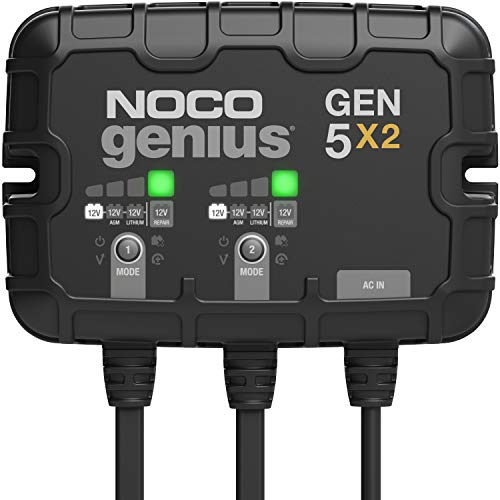
The GEN5X2 provides two independent 5A banks designed for 12V marine batteries, including lead-acid and lithium types. It supports selectable modes for each bank: 12V, 12V AGM, 12V Lithium, and a Repair Mode to recover troubled cells. This unit is notably compact yet powerful, making it well-suited for boats with multiple battery zones or separate starting and deep-cycle packs. Best for boats needing dual-bank management without sacrificing space. A potential limitation is its 10A total output, which may be slower for very large lithium packs in extreme cold or heavy daily use.
NOCO Genius GEN5X1: 1-Bank 5A Onboard Charger
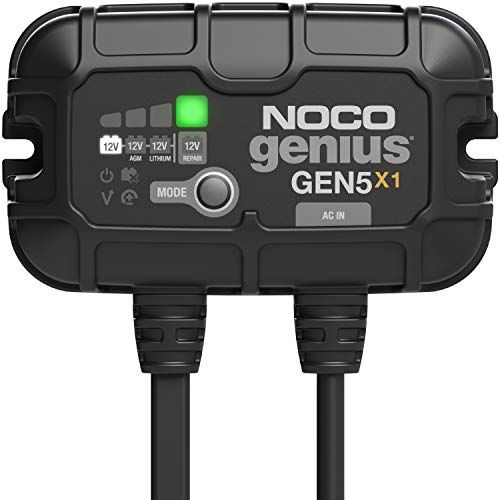
The GEN5X1 offers a single 5A bank with the same selectable modes as multi-bank models. It’s ideal for boats with one main battery setup or smaller vessels that require a compact charger with lithium and lead-acid compatibility. It includes overcharge protection and a temperature-compensation feature to maintain battery health. Better for boats with limited space or fewer battery compartments; avoid this if you need simultaneous charging of multiple banks.
NOCO GENIUS1: 1A Smart Battery Charger

The GENIUS1 is a small-format charger suitable for maintaining and trickle charging 6V and 12V lead-acid and LiFePO4 batteries. It provides precision charging with a thermal sensor to adjust output by ambient temperature. It’s best for seasonal or occasional use, small boats, or as a backup charger. Limitations include lower output and suitability primarily for maintenance rather than bulk recharging.
Haisito 20-Amp Smart Battery Charger
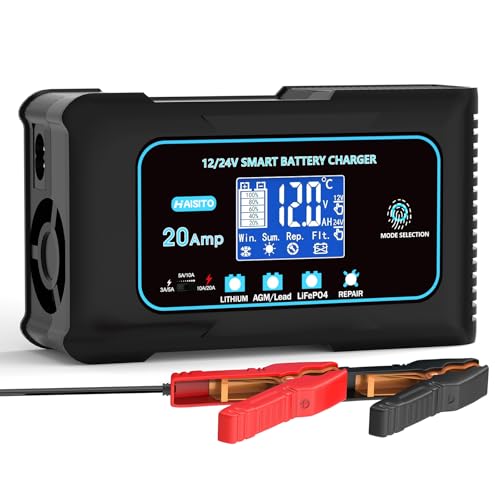
The Haisito charger delivers a 20A continuous current on 12V, or 10A on 24V, enabling significantly faster charging for larger batteries on boats, RVs, and trucks. It includes a dedicated lithium LiFePO4 algorithm to protect BMS systems and supports multiple battery chemistries beyond LiFePO4. It features a large LCD to display real-time charging data, which helps operators monitor progress. Choose this for rapid recovery of dead or deeply discharged marine batteries; be mindful of the higher power draw in small electrical systems requiring robust wiring and fusing.
NOCO GEN5X3: 3-Bank 15A Onboard Charger
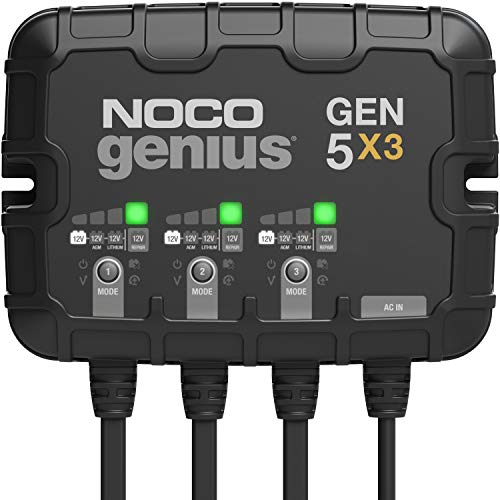
The GEN5X3 provides three independent 5A banks for boats with multiple battery zones. This setup is ideal for larger vessels or commercial boats needing concurrent charging for starting, deep-cycle, and auxiliary banks. It maintains compatibility with lead-acid and lithium batteries while offering a repair mode and temperature compensation. A potential limitation is the need for adequate space and wiring to handle three banks and 15A total output.
Buying Guide: Key Considerations For Lithium Boat Battery Chargers
- System size and bank count: Determine how many battery banks you need and whether you must charge multiple batteries independently or simultaneously.
- Battery chemistry compatibility: Ensure the charger supports both lead-acid variants and lithium LiFePO4 batteries if you plan to use mixed chemistries.
- Charging modes and safety features: Look for selectable modes (12V, AGM, Lithium) and overcharge protection, temperature compensation, and a float/maintenance stage.
- Power requirements and wiring: Match charger amperage to your boat’s electrical capacity and ensure cables and fuses are rated for the charger’s maximum output.
- Size and installation: Consider the footprint, mounting options, and whether a compact model is necessary for tight bilge areas.
- Smart features: Temperature compensation and temperature sensing help optimize charging across climates and seasons.
- Reliability in harsh environments: Marine-rated, waterproof enclosures improve durability in saltwater and spray exposure.
Practical buyer tips
- Choose a charger with multiple independent banks if you want to isolate starting batteries from deep-cycle or house batteries.
- For boats with LiFePO4 packs, confirm lithium charging modes and BMS-friendly charging profiles to minimize battery wear.
- Prefer models with temperature sensing to avoid overcharging in hot weather or undercharging in cold conditions.
Frequently Asked Questions
- What is a lithium boat battery charger?
It is an onboard charger designed to safely charge 12V marine batteries, including lithium LiFePO4, with features like temperature compensation and safe charging modes.
- Do I need multiple banks for my boat?
Not always; a single-bank charger works for a small setup, but larger boats benefit from multiple banks to independently manage different battery types and loads.
- Can these chargers handle lead-acid and lithium batteries simultaneously?
Yes, many models provide selectable modes for both chemistries, allowing safe parallel charging of mixed systems.
- Why is temperature compensation important?
It adjusts charging based on ambient temperature, protecting against overcharging in heat and undercharging in cold conditions.
- Is waterproofing essential for marine chargers?
Yes, marine-rated units endure spray, rain, and damp bilges, increasing reliability in marine environments.
- What should I consider when upgrading to a 3-bank charger?
Evaluate available space, wiring readiness, and whether you need independent charging for several batteries or zones on your boat.