Best Marine Fuel Gauge Sending Unit Options for Boats and RVs
The right marine fuel gauge sending unit helps you monitor fuel and water levels accurately, even in tight engine compartments. This guide highlights five reliable options ideal for boats, RVs, trucks, and marine applications. Each choice is explained for who it’s best for, with practical pros and a clear caveat to help you decide.
Summary table of selected products:
| Product | Best For | Depth Range | Notes |
|---|---|---|---|
| CLLOMAGY Marine Fuel Sending Unit (1st) | Owners replacing damaged senders | 6–12 inches | Flexible, adjustable depth |
| RUPSE Fuel Sender Unit Boat Fuel Tank (6.8″ / 175mm) | High-precision, corrosion-resistant setups | 6.8 inches | Stainless steel, IP67, backlit gauge options |
| Seweder Fuel Tank Sending Unit | Steady electric signaling | 11 inches | Heavy-duty 316 stainless steel |
| Moeller Marine 035722-10 | Original equipment replacements | 6–12 inches | Industry standard 33-240 ohms |
| 100TECH High Resolution Marine Sending Unit | Higher resolution for short tanks | 6 inches | 316 stainless steel, detailed specs |
CLLOMAGY Marine Fuel Sending Unit, 6–12 Inch Depth

Best for flexible tank depths, this CLLOMAGY sending unit is designed to replace damaged boat fuel senders in marine tanks ranging from 6 to 12 inches. It reads fuel and water levels and helps prevent uncertainty about remaining fuel. The unit is easy to trim to fit a specific tank depth, and can be rotated and retightened to align correctly in tight spaces. Choose this if you need a versatile, mid-range sender for a shallow to mid-depth tank.
Best for: Boat owners who need a straightforward replacement with adjustable depth and simple setup. Limitation: It may require minor customization to match exact tank specs.
CLLOMAGY Marine Fuel Tank Sending Unit, 4–28 Inch Depth

This model expands the depth range coverage to 4–28 inches, offering great flexibility for larger tanks or deep beds. It shares the same 33–240 ohm range typical for marine fuel gauges, ensuring compatibility with common gauges. Best for: Larger boats or multi-use vehicles where a broader tank depth capability matters. Limitation: In very deep tanks, precise depth adjustment may require careful trimming.
RUPSE Fuel Sender Unit Boat Fuel Tank Sending Unit
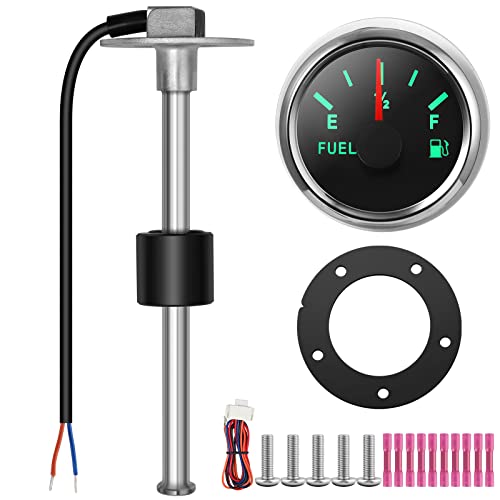
This stainless steel sending unit from RUPSE emphasizes durability and long life with corrosion resistance and a stable output signal. It includes an IP67 waterproof rating and an anti-fog curved glass display, with eight adjustable backlight colors for easy reading. Best for: Demanding marine environments where reliability and readability are critical. Limitation: Installation requires a compatible gauge and mounting pattern (SAE 5-hole) to fit standard configurations.
Moeller Marine 035722-10, Fuel Tank Sending Unit

Moeller’s unit is calibrated to the industry standard of 33–240 ohms and is designed to connect to a dash-mounted gauge. It emphasizes corrosion resistance of interior components, suitable for standard marine gauges. Best for: Original equipment replacements or builders aligning with common gauge systems. Limitation: It assumes a compatible dash gauge and does not include backlighting or extra installation features.
100TECH High Resolution Marine Fuel Sending Unit

The 100TECH sending unit focuses on higher resolution for short tanks, offering a 6″ depth with 240-33 ohm output. Its 316 stainless steel body provides corrosion resistance and durability for marine use. Best for: Boats or vehicles with shorter tanks where precise readings matter more than tank depth range. Limitation: May be more costly than basic models due to enhanced resolution and materials.
Buying Guide
- What depth is your fuel tank? Choose a unit that matches or exceeds your tank depth to avoid over-reach or under-reading.
- What gauge is installed? Ensure the sender’s resistance range (commonly 240-33 ohms) matches your gauge’s input expectations.
- Material matters. For saltwater or frequent exposure, stainless steel bodies (e.g., 316 stainless) offer better corrosion resistance.
- Installation considerations. Look for SAE mounting patterns and gasket compatibility to ease installation and maintain sealing integrity.
- Readability and reliability. Units with backlit displays or anti-fog glass improve readability in low light or rough conditions.
Frequently Asked Questions
- What does 240-33 ohms mean? This is the standard signal range where 240 ohms indicates empty and 33 ohms indicates full. Match this to your gauge wiring.
- Can I install a marine sending unit in a non-marine tank? Yes, if the tank material and dimensions fit the unit’s mounting pattern and environmental exposure is acceptable.
- Do I need a separate fuel gauge to use these senders? Most senders are designed to work with a dash gauge or an accompanying gauge kit; check compatibility with your system.
- Are all senders adjustable for tank depth? Some models offer cutting or rotation to fit different depths; others are fixed and require precise tank matching.
- Is stainless steel better for saltwater use? Yes, 316 stainless steel offers superior corrosion resistance in marine environments compared to lower-grade materials.
- What is the advantage of high-resolution sending units? Higher resolution provides finer fuel level readings, especially important in shorter tanks with rapid level changes.