Best Marine Plywood and Flooring for Pontoon Boats
Answering the question buyers ask most: which marine-grade materials deliver durable, maintenance-friendly surfaces for pontoon boats? This guide focuses on plywood sheets and deck flooring products that are commonly chosen for pontoon projects, including durable plywood cores, water-resistant glues, and slip-resistant flooring. It helps buyers select options for deck construction, repair, and replacement, with guidance on suitability for different boat sizes and conditions.
| Product | What It Is Best For | Key Benefit |
|---|---|---|
| RecPro 3/4″ Marine Grade Plywood Sheet | Pontoon decks and structural panels | 7-ply fir core for strength and water resistance |
| RecPro Gray Woven Marine Vinyl Flooring | Boat and pontoon decking with soft, slip-resistant surface | Slip-resistant, UV stable, easy to clean |
| Fullfire EVA Foam Boat Flooring | Foam deck overlays for comfort and cushioning | Self-adhesive, faux teak look, good drainage |
| OCEANBROAD EVA Foam Flooring (Self-Adhesive) | Custom-fitting deck mats for jon boats and pontoons | Non-slip, UV resistant, closed-cell foam |
| FOCEAN EVA Foam Marine Flooring | DIY decking projects on motorboats and pontoons | Easy installation, durable EVA with non-slip surface |
RecPro 3/4″ Marine Grade Plywood Sheet

Best for pontoon deck construction and structural panels, this 7-ply fir core plywood uses waterproof glue and a near void-free inner layup for stability. It’s treated to a .40 retention level and kiln-dried after treatment for marine environments. Best for buyers seeking durable, marine-grade plywood that resists moisture and warping in pontoon applications.
Who it’s best for: boat builders and serious DIYers needing a strong, moisture-resistant deck base. Why selected: high-ply construction, fir core, and water-resistant treatment provide a robust platform for pontoon decking.
Caution: handling and cutting require proper PPE; ensure you have appropriate sealing and fastening methods to maintain water resistance over time.
Marine Adhesive for Boat Carpet & Pontoon Vinyl Flooring

Best for securing vinyl and carpet-layered decks on pontoons, this 2-gallon adhesive is water-based and suitable for rubber-backed flooring. It adheres well without degrading backings, making it a solid choice for surface upgrades to pontoon flooring. Better for: projects needing a dependable, flexible adhesive that resists harsh marine conditions.
Limitations: ensure ventilation during application and confirm compatibility with all substrate types in use on your pontoon.
RecPro Gray Woven Marine Vinyl Flooring

Best for pontoon decks where slip resistance and UV stability are priorities, this 8.5′ wide vinyl flooring provides a durable, moisture-resistant surface. Its woven PVC construction offers long-term appearance retention, while the felt backing adds comfort and support. Choose this when prioritizing ease of cleaning and traction underfoot.
Limitation: may require careful matching with edge trim and transitions for seamless deck aesthetics.
Fullfire EVA Foam Boat Flooring
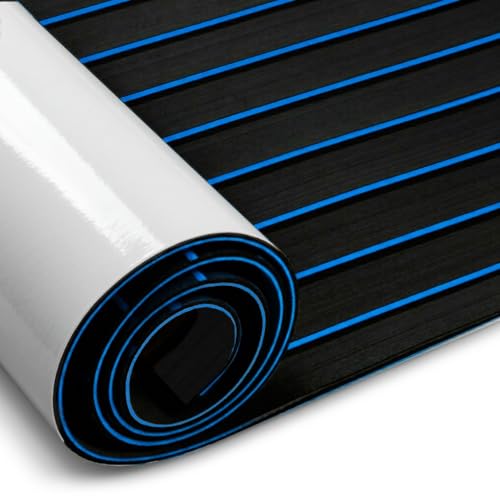
Best for cushioned deck overlays on pontoon boats, this 0.24-inch-thick EVA foam flooring provides comfort underfoot and reduces deck noise. Its faux teak striped surface offers improved drainage and non-slip texture. Better for: applications where a soft, insulating deck layer is desired and DIY installation is anticipated.
Limitation: not a structural substrate; use over a solid base and ensure adhesive compatibility with the underlying surface.
OCEANBROAD EVA Foam Self-Adhesive Decking (48″ x 16.8″)

Best for jon boats and pontoons requiring a durable non-slip surface with easy installation, this 6mm EVA foam sheet uses 3M adhesive backing. It offers closed-cell water resistance and Level 3 UV stability for outdoor durability. Choose this for quick DIY upgrades where weight, cushioning, and traction matter.
Limitation: overlaps and edges need careful alignment to maintain slip resistance across transitions.
OCEANBROAD EVA Foam Self-Adhesive 96″ x 45.6″

Best for large pontoon sections needing a uniform non-slip surface with straightforward installation, this large EVA foam sheet provides same benefits as the smaller variant but covers more area at once. Suitable for DIYers upgrading multiple deck zones. Limitations include the need for a clean, dry surface for best adhesive performance.
Buying Guide: Key Considerations For Pontoon Decking
What materials should you prioritize for pontoon decking and structural work? Consider these practical questions:
- What is the deck’s intended use? Heavy-duty use on larger pontoons may justify marine plywood with a moisture-resistant core, while light-duty or cosmetic decks can rely on EVA foam or vinyl overlays.
- How important is slip resistance? For wet environments, select flooring with non-slip surfaces and good drainage design.
- Do you need a quick DIY solution or a long-term build? EVA foam and vinyl are easier to install; marine plywood cores offer structural longevity when properly sealed.
- What maintenance will be required? Plywood surfaces require sealing and periodic checks for moisture; vinyl and EVA foams are easier to wipe clean and resist moisture.
- What is the installation surface? Ensure the base is clean, dry, and capable of supporting the chosen material without warping or curling.
Frequently Asked Questions
- What is marine plywood best used for on pontoon boats?
– It is typically used for deck bases and structural panels where stiffness and moisture resistance are important. - Can EVA foam flooring replace plywood decking?
– EVA foam is ideal for overlays and comfort surfaces but does not replace structural plywood on load-bearing areas. - Is adhesive required for EVA foam flooring?
– Yes, many EVA foam products use self-adhesive backing, while others may require contact cement or marine-grade adhesives for best bonding. - Will vinyl flooring withstand sun exposure on a pontoon deck?
– Marine vinyl flooring is UV-stable and designed to resist sun exposure with proper maintenance. - How do I maintain plywood decking in a marine environment?
– Keep it sealed, inspect for moisture intrusion, and re-seal as needed to prevent warping or delamination. - Should I mix plywood and flooring materials?
– Yes, for best results you can use plywood as a substrate and apply vinyl or EVA foam overlays on the surface for comfort and traction.