Best Marine CB Radio Antenna Picks for Clearer VHF Communication
Answering the need for reliable, ship-to-ship or ship-to-shore communication, these best-in-class marine VHF antennas optimize reception and transmission across the 156–163 MHz band. They’re well-suited for sailors, small craft operators, fishing boats, and coastal cruisers who require steady performance, easy mounting, and durable construction. The list favors fiberglass and fiberglass-backed designs with low-loss coax and easy RATchet-mount options for diverse decks and masts.
| Product | Best For | Why It Stands Out |
|---|---|---|
| HYS VHF Marine Antenna Waterproof 3DBI | Compact, versatile boats | 3 dBi gain, 43.3 inches, built-in nylon ratchet mount |
| UAYESOK VHF Marine Base Antenna 48 Inch | Sturdy fixed-mount installations | Fiberglass, 44-inch height, 7 m low-loss coax |
| Long Range VHF Marine Radio Antenna 156-163MHz | Longer reach on bigger boats | 2.5 dBi gain, included 16.5 ft coax |
| Tram 1600-HC Pretuned 35-Inch | Compact, all-band coverage | 6 dB gain, 35 inches, RG58 |
| HYS VHF Marine Antenna Low-Profile 156-163MHz | Low-profile decks | 2 dBi gain, 16.4 ft coax, slim design |
HYS VHF Marine Antenna Waterproof 3DBI (43.3 Inch)

Reference: Frequency 156-163 MHz; Bandwidth 5 MHz; Impedance 50 Ω. Gain 3.0 dBi; Vertical polarization; 360° horizontal beam width. VSWR near 1.5:1 at 159.5 MHz. Includes 22.9 ft (7 m) RG58 coax with PL259; built-in nylon ratchet mount for flexible mounting. Best for small to medium crafts needing a compact, all-around VHF antenna with straightforward installation.
Best for: Boats requiring a compact, high-visibility antenna with robust vertical polarization for broad coverage. Better for decks with limited space due to its 43.3-inch length. Caution: No explicit DC ground connection is listed, which may affect certain grounding configurations.
UAYESOK VHF Marine Base Antenna (48 Inch Fiberglass)
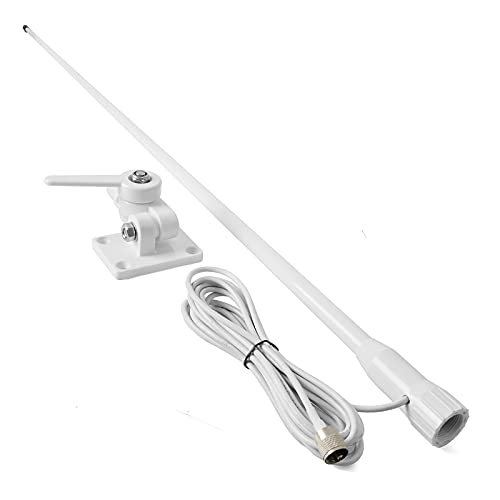
Reference: Frequency 156-163 MHz; Impedance 50 Ohm; VSWR nominally 1.5:1 at 159.5 MHz; Gain 3 dBi. Mechanical: 44 inches tall (110 ± 5 cm); 7 m low-loss RG-58U cable; PL259 termination; anti-corrosion fiberglass construction with a glossy finish. Best for fixed-mount installations on larger boats seeking reliable range and a stable mast-top solution.
Best for: Vessels that prefer a longer, fixed-location antenna with a sturdy base and longer cable for flexible mounting. Better for mast-top or rail-mounted spaces where stability matters. Caution: Weight is modest; ensure mounting hardware supports the boat’s mast structure.
Long Range VHF Marine Antenna (156-163MHz) By eifagur

Reference: Frequency 156-163 MHz; Gain 2.5 dBi; 50 Ω impedance; 50 W max input; VSWR less than 1.8. Coax: 5 m low-loss RG-58 cable with PL259; includes stainless bracket for mast-top mounting. Specifically designed for 156-163 MHz devices to improve receiving and transmitting signals. Best for vessels needing a longer reach with a straightforward installation on a mast or suitable mounting point.
Best for: Boats that require improved signal distance and straightforward, reliable mounting with a standard PL259 setup. Caution: Gain is moderate (2.5 dBi) compared to higher-gain designs, which may affect marginal coverage in very remote areas.
Tram 1600-HC Pretuned 35-Inch VHF Antenna

Reference: 35 inches in length; Pretuned for marine VHF band; 1/2 wave design with DC ground shunt. Gain 6 dB. Includes RG58 cable with PL-259 connectors. Covers all marine band frequencies and uses stainless steel hardware for durability. Best for compact installations where higher gain is desired without a long antenna footprint.
Best for: Boats that need a relatively high gain in a compact form, offering strong performance for close-range and mid-range comms. Caution: Slightly longer than ultra-compact models but shorter than full-size masts; ensure mounting clearance on small decks.
HYS VHF Marine Antenna Low-Profile 156-163MHz

Reference: Frequency 156-163 MHz; 2 dBi gain; 50 W max input; 16.4 ft (5 m) RG58 coax with PL259. Designed as a low-profile option for decks with space or aesthetic constraints. Emphasizes enhanced signal performance in receiving and transmitting across the marine VHF band.
Best for: Vessels needing a discreet, low-profile antenna without sacrificing essential VHF performance. Caution: Lower gain means shorter effective range in very open-water conditions; pairing with a good radio and placement matters.
Buying Guide: Key Considerations for Marine VHF Antennas
- Frequency range and gain: Most marine VHF antennas operate around 156–163 MHz. Higher gain improves range but often requires more space or a longer antenna.
- Impedance and VSWR: 50 Ω is standard; aim for a VSWR near 1.5:1 or better at the target frequency for reliable transmission.
- Mounting style: Ratchet and fixed mounts offer different mounting flexibility. Consider deck space, mast height, and potential wind loading.
- Cable quality and length: Low-loss coax (RG-58 or similar) minimizes signal loss. Cable length should balance mounting options with acceptable attenuation.
- Durability and marine suitability: Fiberglass construction and corrosion-resistant hardware improve longevity in salt air and spray.
- Deck footprint: Low-profile designs reduce snag hazards and wind resistance on smaller boats.
- Installation considerations: Some antennas provide built-in grounding options; ensure proper DC grounding if required by your radio system.
FAQ
- Q: Do I need a high-gain antenna for coastal cruising? A: Higher gain can extend range, but placement and line-of-sight matter more; choose a gain that fits your deck space and typical routes.
- Q: Is fiberglass construction necessary? A: Fiberglass offers durability and easier mounting on many boats, especially in windy, saltwater environments.
- Q: What does VSWR tell me? A: VSWR indicates how well the antenna matches the radio; lower numbers (closer to 1:1) indicate better transmission efficiency.
- Q: Should I worry about grounding? A: Some antennas require DC grounding for safety and performance; follow the manufacturer’s grounding recommendations.
- Q: Can I mix brands for better performance? A: Yes, combining a compatible VHF radio with a suitable antenna from a reputable brand can optimize performance, but verify impedance and mounting compatibility.
- Q: How long should I mount the antenna above the deck? A: Longer antennas can improve range but may encounter more wind resistance; balance with deck space and vessel type.