Best Portable Electric Bilge Pumps for Quick Water Removal
Answering the search need for portable bilge water removal, these compact pumps are designed to move water quickly in tight spaces without relying on shore power. They’re ideal for boaters, RV owners, campers, and property owners dealing with localized flooding or routine water transfer. The top picks below emphasize battery-powered and 12V options for easy use wherever you need it. This guide explains who each pump is best for and why, with practical caveats to help you choose confidently.
| Product | Best For | Why It Stands Out |
|---|---|---|
| Attwood WaterBuster Portable Submersible Pump | Boaters and pool cover managers needing cordfree operation | Battery-powered up to 5 hours; truly portable with no power outlet required |
| MAXZONE Automatic Submersible 12V | Compact on-boat bilge pumping with float switch | Built-in float switch for automatic operation; compact design |
| Lounsweer 12V Bilge Pump Kit | Full kit buyers who want complete installation components | Includes hose, clamps, and fittings; durable materials |
| Sanuke 1100GPH 12V Bilge Pump Kit | High-flow needs with ready-to-install kit | 1100 GPH with complete hose and thru-hull fittings |
| Whale Supersub Smart 650 | Automatic, low-profile bilge needs in tight spaces | Original low-profile auto design with non-return valve |
Attwood WaterBuster Portable Submersible Pump
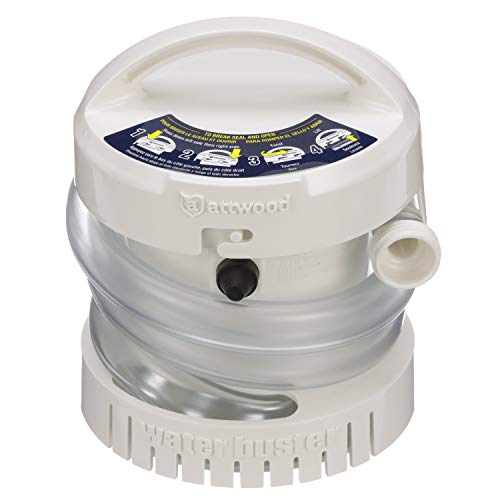
The Attwood WaterBuster is a compact, battery-operated pump designed for water removal where a power outlet isn’t handy. It’s particularly suitable for boaters needing to clear water from decks, pool covers, or inflatable gear. The cordless operation allows use aboard small craft or near shorelines without extension cords. Best for quick, temporary water removal in mobile settings. A potential limitation is runtime, which depends on battery strength and the three D-sized batteries used.
MAXZONE Automatic Submersible 12V Bilge Pump

MAXZONE offers a 12V automatic bilge pump with a built-in float switch. This eliminates the need to monitor the pump manually in auto mode, making it ideal for unattended bilge spaces, small boats, and yachts where continuous monitoring isn’t feasible. It’s best for users who want a ready-to-wire, automatic solution without extra components. A limitation to note is that it relies on a 12V power source and may require wiring and mounting hardware not included in some listings.
Lounsweer 12V Bilge Pump Kit

Lounsweer provides a complete 12V bilge pump kit with a 6-foot hose, clamps, and a thru-hull fitting. The kit-oriented approach is ideal for boaters who prefer a turnkey installation with all required components included. It emphasizes durable construction with a corrosion-resistant thermoplastic body and a stainless steel shaft. Choose this if you want a robust, ready-to-install setup rather than sourcing separate pieces. A caveat is that the hose length and fittings are fixed to this kit, so check compatibility with your vessel before purchase.
Sanuke 1100GPH 12V Bilge Pump Kit

Sanuke’s kit provides a high-flow 1100 GPH bilge pump with a 1-1/8″ outlet and 6-foot kink-free hose, plus thru-hull fittings and clamps. It’s well-suited for boats or RVs requiring fast water removal and easier installation. The included high-quality hose and clamps help prevent leaks. Best for users prioritizing a complete kit with solid flow and straightforward setup. Caution: ensure the thru-hull fitting is compatible with your hull design to avoid mounting challenges.
Whale Supersub Smart 650

The Whale Supersub Smart 650 features an automatic operation mode with a low-profile design, suitable for tight bilge spaces on boats. It’s ideal for users who need a compact, quiet pump that can operate without constant supervision. The integrated autoregulation reduces the need for manual intervention. Limitation: as with many automatic models, ensuring the pump remains free of debris is important to maintain reliable auto function over time.
Buying Guide
What type of buyer should consider a portable bilge pump? Look for cord-free operation if you need reach and flexibility away from electrical outlets. A built-in float switch is valuable for unattended use in boats. For immediate water transfer or heavy drainage, high GPH (gallons per hour) pumps paired with durable hoses matter. Material quality, corrosion resistance, and kit contents influence long-term reliability on marine and outdoor tasks.
- Power source: Battery-powered versus 12V (vehicle/boat power). Choose battery models for true portability; choose 12V for steady on-boat use with automatic or manual control.
- Flow rate: Higher GPH moves more water quickly but can require more power and produce more noise. Match GPH to the anticipated workload and space.
- Durability: Look for corrosion-resistant housings, stainless steel shafts, and rugged thermoplastics for marine environments.
- Kit contents: Hoses, clamps, and thru-hull fittings simplify installation and reduce compatibility risks.
- Automatic features: A built-in float switch enables hands-off operation in bilges or flooded areas.
- Size and fit: Low-profile designs fit tight spaces; ensure outlet size and hose compatibility with your vessel or project.
FAQ
- What is the difference between a battery-powered pump and a 12V pump? Battery-powered pumps are cordless and portable, while 12V pumps connect to a vehicle or boat power source and can include automatic operation.
- Do these pumps handle solids? Some models handle small solids with specific debris-filtering features; always check the max solids tolerance for your application.
- Can I use a bilge pump for water transfer on land? Yes, as long as the pump and hose are rated for the fluids and you have a suitable power source and fittings.
- Is automatic operation reliable? In most cases, a built-in float switch provides dependable auto function, but periodic cleaning and maintenance prevent debris jams.
- What maintenance is recommended? Regularly inspect hoses, clamps, and fittings; clean strainers; replace worn seals; store batteries properly if used in cordless models.
- How do I choose the right GPH? For smaller spaces or daily use, 600–1100 GPH is common; for rapid drainage or larger bilges, opt for 1100–2000 GPH depending on power availability.