Best Class D Marine Amplifiers for Boats and Watercraft
Looking for a reliable Class D marine amplifier to boost your boat’s audio? This guide highlights five top options, focusing on durability, power, and marine suitability. The selected models suit different buyers: compact systems for smaller boats, multi-channel amps for larger setups, and rugged units for saltwater environments. Each section explains who benefits most, why the model was chosen, and any practical caveats to consider when equipping a marine audio system.
Buying summary table
| Product | Power (RMS) | Channels | Best For |
|---|---|---|---|
| Skar Audio RP-800.1DM | 800W RMS @ 1Ω | 1 | Single-sub, compact space, serious bass |
| Skar Audio RP-1500.1DM | 1,500W RMS @ 1Ω | 1 | High-demand subwoofers, larger boats |
| Rockville RXM8BTB | 750W RMS (8 channels) | 8 | Multi-speaker setups, Bluetooth |
| NVX VADM2v2 | 600W RMS (2 channels) | 2 | Compact two-channel marine power |
| KENWOOD KAC-M5001 | 300W RMS @ 2Ω, 200W RMS @ 4Ω | 1 | Compact, rugged subwoofer amp, easy install |
Skar Audio RP-800.1DM 800W Monoblock Marine Amp
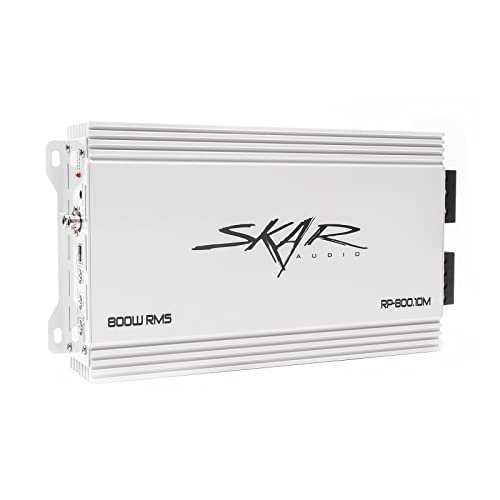
Best for compact boats needing strong sub bass. The RP-800.1DM is a marine Class D MOSFET monoblock with 1,200W peak and 800W RMS at 1Ω. It’s fully marinized with a waterproof coating on the circuit board and rust-proof painting on the case, helping resist salt exposure and humidity. Best for owners who want high bass output in a small package.
Who this is for: boaters with a single subwoofer and limited space who still demand powerful, clean bass. Why selected: it balances size, power, and marine-grade protection. Limitation: higher-impedance flexibility is limited to monoblock sub applications.
Skar Audio RP-1500.1DM 1500W Marine Mono Block

Best for bigger boats or deeper bass demands. This 1,500W RMS at 1Ω class D mono amp powers larger subwoofers with marine protection similar to the smaller model. If you need more headroom for open-water outings or louder bass in a larger space, this option is a strong contender. Best for: larger marine sub systems; Better for: tighter and louder bass performance in open-water environments. Caution: installation space and sub compatibility should be confirmed before purchase.
Rockville RXM8BTB 8-Channel Marine Amplifier

Best for multi-speaker marine systems with Bluetooth streaming. The RXM8BTB delivers 1,500W peak and 750W RMS across eight channels, with flexible configurations (8, 6, or 4 channels) and Bluetooth. Saltwater resistant design and conformal-coated boards support reliability in harsh marine settings. Choose this if you want to run multiple speakers cleanly without a separate head unit. Limitation: eight-channel setup may be more amp than some boats require, adding installation complexity.
NVX VADM2v2 2-Channel Class D Marine Amp

Best for compact two-channel marine power with durable performance. The VADM2v2 offers up to 600W RMS (bridged at 4Ω), with Micro Class D technology for a small footprint. Marine certification includes a conformally coated board to resist moisture and salt. Choose this if you need a space-saving, reliable two-channel amp for a pair of high-quality marine speakers or a single subwoofer. Caution: limited channels mean it’s not ideal for larger multi-speaker setups.
KENWOOD KAC-M5001 Compact Marine Monoblock

Best for rugged, space-limited installations needing solid bass. The KAC-M5001 is IP67/IP66 rated for waterproof and dustproof protection, designed to withstand marine environments. Delivers 600W max, 300W RMS at 2Ω, and 200W RMS at 4Ω. It uses a robust chassis and output circuitry to reduce distortion. Choose this when installation space is tight and you want durable, subwoofer-focused performance. Limitation: the power rating is lower than multi-channel options, so it’s best for one sub or a small system.
Buying Guide
What to consider when choosing a marine Class D amplifier:
- Power needs: Match RMS power to your subwoofers and speaker array. Overbuilt amps may waste space, while underpowered models may underperform.
- Channel configuration: Monoblock amps suit subwoofers; multi-channel amps are ideal for driving several speakers or full-range setups.
- Marine durability: Look for saltwater resistance, conformal coating, waterproof enclosures, and corrosion-resistant hardware.
- Installation space: Consider mounting depth, chassis size, and connectivity options to fit dash or helm layouts.
- Protection features: Thermal protection, short-circuit protection, and moisture seals help longevity in harsh conditions.
- Sound tuning: Subsonic filters, adjustable crossovers, and bass boost can refine performance for your boat’s acoustics.
FAQ
- What is Class D, and why is it good for boats?
Class D amps are efficient, produce less heat, and fit compact marine applications while delivering strong output. - Do marine amplifiers need special coatings?
Marine amps often use conformal coating and rugged housings to resist moisture and salt exposure. - Should I choose a mono block or multi-channel amp?
Mono blocks are ideal for subs and compact spaces; multi-channel amps suit multi-speaker marine setups. - What is RMS power, and why does it matter?
RMS indicates continuous power delivery; it helps predict sustained performance and speaker compatibility. - How do I select the right impedance?
Ensure the amp’s stable impedance matches your speakers (commonly 2Ω or 4Ω) for optimal power and efficiency. - Are Bluetooth-enabled amps useful on boats?
Bluetooth can simplify streaming if a head unit is absent, but wired connections often offer lower latency and reliability.