Best Marine Grade Cable Suppliers for Reliable Wet-Dock Wiring
Finding the right marine grade cables means prioritizing corrosion resistance, flexibility, and compliance with safety standards. This guide highlights five top options ideal for boat owners, shipyards, and marine technicians. It explains who each product is best for, why it stands out, and any limitations to consider. Use this overview to compare options quickly and make informed buying decisions for challenging marine environments.
Summary table of selected products:
| Product | Best For | Key Benefit |
|---|---|---|
| Ancor Marine Grade 121710 Duplex Cable | Bass boats, sailboats, and coastal vessels | Ultra-flexible, tinned copper for harsh environments |
| End Game 4 Gauge Marine Cable | Heavy-duty battery wiring on larger crafts | Sealed lugs, oil/fuel resistant insulation |
| End Game 2 AWG Battery Cable | Battery banks and high-current setups | Fully assembled with heavy duty lugs |
| GS Power 100 Ft Duplex 16 AWG Wire | General marine wiring and electronics | Oxygen-free, tinned copper, durable in marine temps |
| SEAVIEW Multi-Cable Gland | Cable routing and waterproofing | Split-seal design simplifies installation |
Ancor Marine Grade 121710 Duplex Cable, 16/2 AWG

Product overview: This cable uses individual copper strands that are tin-plated to perform in harsh marine environments. It features ultra-flexible Type 3 stranding to resist fatigue from vibration and enhance corrosion protection. It exceeds UL 1426, US Coast Guard Charter boat (CFR title 46), and ABYC standards.
- Best for: Coastal boats, saltwater environments, and installations requiring high flexibility.
- Why selected: Its tinned copper and flexible construction support long-term reliability in vibrating marine systems.
- Limitation: As a duplex 16/2, it is best for lower-current circuits; larger power runs may require thicker gauges.
End Game 4 Gauge Marine Grade Battery Cables

Product overview: 4 gauge marine battery cables with tinned copper and heavy-duty fully sealed lugs designed to withstand harsh marine and outdoor environments. The PVC insulation is oil and fuel resistant. They are USCG approved and meet/exceed ABYC specs.
- Best for: High-current battery connections on boats, RVs, and off-grid setups.
- Why selected: Sealed lugs and oil-resistant insulation improve longevity in damp engine bays and coastal climates.
- Limitation: Larger gauge cables can be stiffer and harder to route in tight compartments.
End Game 2 AWG Marine Grade Battery Cables
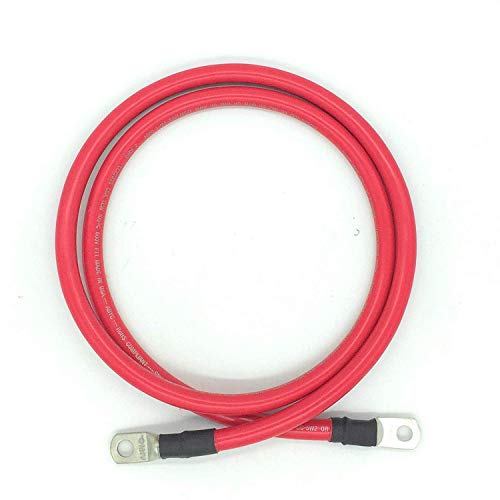
Product overview: Two-gauge battery cables, made in the USA, fully assembled with heavy duty tinned lugs. PVC insulation is oil and fuel resistant and offers superior insulation compared to EPDM. Cable meets and exceeds USCG and ABYC specs.
- Best for: Battery banks and essential electrical runs on mid-size to larger boats.
- Why selected: The combination of full assembly and sealed lugs reduces corrosion risk in marine environments.
- Limitation: Narrower cross-section limits current capacity relative to 0 AWG or 1/0 gauge in extreme loads.
GS Power 100 Ft Duplex 16 GA Marine Wire

Product overview: Oxygen-free, tinned copper 16 AWG duplex wire in a 100 ft roll. It features a white PVC jacket with red and black conductor sheaths, meeting SAE, ABYC, UL, and Coast Guard requirements.
- Best for: General marine wiring, accessory lines, and temporary installations on boats and RVs.
- Why selected: Flexible Type III strand design enhances durability in cold and humid marine environments.
- Limitation: Not designed for high current applications; use thicker gauges for power-heavy circuits.
SEAVIEW Multi-Cable Rectangle Cable Gland

Product overview: A waterproof cable routing solution designed to accommodate a broad spectrum of cables and connectors. It is designed to fit cable diameters up to .5″ (10.6mm) and connectors up to .67″ (17mm). The 4″ x 1.9″ x .8″ footprint features a split seal design for easy installation without removing connectors.
- Best for: Marine installations requiring reliable waterproof pass-throughs and clean routing.
- Why selected: The split-seal design reduces install time and minimizes water ingress risks.
- Limitation: Compatibility is best when cables stay within specified diameters; oversized cables may require a larger gland.
Buying Guide
- Material and corrosion resistance: Prioritize tinned copper and stainless components for saltwater exposure. Tinned copper resists corrosion and improves conductivity in damp environments.
- Flexibility vs. current capacity: Duplex and smaller gauges offer flexibility for tight spaces but lower current capacity. Reserve thicker gauges for high-current runs.
- Insulation and weather resistance: Oil- and fuel-resistant PVC insulation lasts longer around engines and in exposed locations. Verify UV stability for exterior runs.
- Standards and approvals: Look for products meeting USCG, ABYC, SAE, UL standards to ensure compliance and safer installations.
- Installation considerations: Sealed lugs, heat shrink, and gland seals reduce corrosion and water ingress. Consider ease of installation in tight compartments.
- Environmental suitability: For coastal and offshore use, select cables with robust jacket protection and-rated temperature tolerances.
Frequently Asked Questions
- What gauge should I choose for my boat’s main battery cables?
– Choose 2 AWG to 4 AWG for main battery runs on mid-size boats; 0 AWG or 1/0 may be needed for high-current systems on larger boats. - Are marine cables always tinned?
– Not always, but tinned copper is common for enhanced corrosion resistance in saltwater environments. - What is ABYC compliance and why does it matter?
– ABYC compliance aligns with industry standards for safety and reliability in marine wiring. - Do I need special glands or seals for exterior cables?
– Yes; waterproof glands help prevent water intrusion and extend cable life in exposed areas. - Can I mix brands for a single wiring project?
– Mixing is possible, but ensure consistent insulation, temperature ratings, and size compatibility across runs.