Best Marine Starting Battery Group 24 for Reliable Power on the Water
When choosing a marine starting battery in Group 24, look for dual‑purpose models that deliver solid cranking amps and deep‑cycle capacity. This guide highlights five reliable options, explains who they’re best for, and outlines key buying considerations. Ideal buyers include boaters needing dependable engine starts plus extended electronics power, compact RV operators, and those upgrading from AGM to lithium where weight matters.
Shortlist At a Glance
| Product | Type | Approx. Capacity | Best For |
|---|---|---|---|
| Mighty Max Battery MM-G24M | AGM Dual-Purpose | 90Ah / 700 MCA | Small boats and inland cruising |
| Interstate Batteries Marine/RV Battery 24M-AGM | AGM Dual-Purpose | 70Ah / 750CCA | All‑around marine and RV use |
| VEVOR 12V 60Ah LiFePO4 Dual Purpose | LiFePO4 Dual‑Purpose | 60Ah / 800CCA | Lightweight, modern electronics, longer life |
| Interstate Batteries 24M Li24MDP12V100 | LiFePO4 Deep Cycle | 100Ah | Long cycles, lighter weight |
| Mighty Max Battery MM-G27M | AGM Dual-Purpose | 100Ah / 850 MCA | Mid‑sized boats and longer trips |
Mighty Max Battery MM-G24M, 12V 90Ah Group 24M AGM
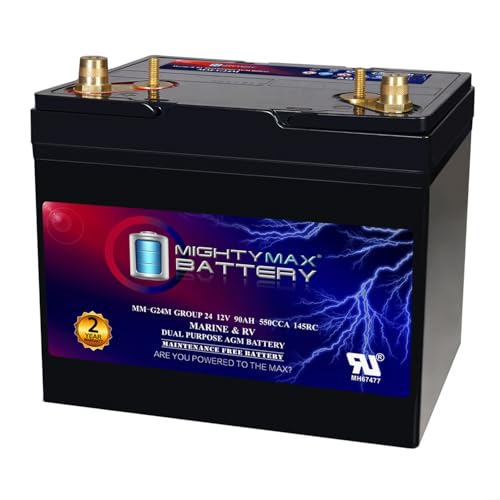
Features: Marine‑Grade endurance, 90 Ah deep‑cycle capacity, 550 CCA and 700 CA. Dual‑purpose design supports starting and long‑run electronics. Spill‑proof and maintenance‑free.
Best for: Small to mid‑sized boats that need reliable starts plus basic onboard power. The 90Ah capacity provides decent runtime for marine accessories while keeping weight manageable.
Limitations: MCA is solid but not 1000 MCA; this is a good balance for moderate cruising rather than heavy trolling or high‑demand systems.
Interstate Batteries Marine/RV Battery 24M-AGM

Features: Dual‑purpose AGM design, suitable for cranking the motor and powering trolling motors and accessories. Built for rugged conditions with extended expected service life compared with conventional AGM batteries.
Best for: Boat owners who want a robust dual‑purpose option performing well on both engine starts and auxiliary loads. The 24M‑AGM classification indicates Group 24 size with AGM benefits.
Limitations: The stated capacity is solid but may be lower than larger 100Ah options; consider if you run many electronics simultaneously.
VEVOR 12V 60Ah LiFePO4 Dual Purpose Battery

Features: 60Ah capacity with 800CCA starting power, built‑in BMS for overcharge/discharge and temperature protection, plus Bluetooth monitoring. Lighter weight and longer cycle life than AGM equivalents.
Best for: Boaters seeking modern lithium power with app monitoring and a compact footprint. Ideal for lightweight vessels and limited battery space.
Limitations: Lithium options require careful charging compatibility and BMS awareness; ensure your charger supports LiFePO4.
Interstate Batteries 24M Li24MDP12V100

Features: 100Ah lithium dual‑purpose marine battery with maintenance‑free operation and significantly lighter weight. Designed for long cycles and faster recharge than many AGM options.
Best for: Boaters who value maximum cycle life and reduced weight, enabling longer trips with more electrical load.
Limitations: Higher upfront cost and the need to verify charging system compatibility with lithium chemistry.
Mighty Max Battery MM-G27M, 12V 100Ah Group 27M

Features: 100 Ah capacity with 850 CA and 80 CCA, deep‑cycle and starting power, spill‑proof AGM design. Suitable for longer runs and brisk engine starts in varied climates.
Best for: Mid‑sized boats requiring a strong, reliable dual‑purpose battery with higher MCA than smaller 24M units.
Limitations: Slightly heavier and larger than Group 24 models; ensure space on board accommodates Group 27 size.
UPLUS BCI Group 24M Dual Purpose Marine Battery

Features: 12V 79Ah, 550CCA, 150RC, space‑saving dual‑purpose design for engine starting and deep cycling. Compact dimensions suit tight compartments.
Best for: Boats needing space efficiency with dual‑purpose performance. This option balances size and power for compact vessels.
Limitations: Slightly lower RC and Ah compared with larger Group 24/27 options; consider expected runtime for electronics.
Buying Guide: How To Choose The Right Marine Group 24 Battery
- Size and compatibility: Confirm group size (24M vs 24) fits your boat’s battery tray and terminal layout. Measure dimensions and verify fit.
- Starting vs. deep‑cycle balance: Dual‑purpose batteries blend starting amps with deep‑cycle capacity. If evenings on the water require long electronics use, prioritize higher Ah and RC.
- Battery chemistry: AGM offers spill‑proof stability and maintenance‑free use; lithium options reduce weight and lengthen life but require compatible charging and BMS awareness.
- Cold‑cranking amps (CCA) and marine cranking amps (MCA): For engine reliability in cold conditions, look for higher MCA/CCA ratings. If you boat in chilly climates, choose models with robust MCA/CCA values.
- Weight and installation: Lithium options are significantly lighter; consider weight limits and mounting orientation for best performance and safety.
- Maintenance and lifecycle: AGM typically requires less maintenance; lithium batteries often provide longer lifecycle but may demand advanced chargers and monitoring.
- Charging compatibility: Ensure your on‑board charger or inverter/charger supports the battery chemistry you select (AGM vs LiFePO4).
Frequently Asked Questions
- What does Group 24 mean for marine batteries?
– It refers to the battery’s physical size and terminal layout, ensuring it fits common marine battery trays and fixtures. - Are dual‑purpose batteries better for boats?
– They can simplify electrical systems by combining starting and deep‑cycle capabilities in one unit, but may not optimize both functions as perfectly as two dedicated batteries. - Is lithium better than AGM for boats?
– Lithium offers lighter weight, longer life, and faster recharge but requires compatible chargers and a higher upfront cost. AGM is simpler and maintenance‑free. - Do I need a higher MCA/CCA for cold climates?
– Yes. Higher MCA or CCA helps ensure reliable engine starts in cold weather and water temps. - Can I mix different battery chemistries on a single boat?
– It’s possible with proper system design, but it can complicate charging and require specific equipment; consult a marine electrician.