Best Galvanic Isolators for Boats
Protect your boat’s underwater metals from electrolytic corrosion with reliable galvanic isolators. This guide highlights five top-rated units, explaining how they prevent stray currents from the shore power system from harming hulls, props, and other critical components. Each product profiles its key features, benefits, and what to consider when choosing a model for your marina setup. Use this overview to compare options, compatibility, and ease of installation for safer, longer-lasting boating experiences.
| Product | Brand | Am I Getting Galvanic Protection? |
|---|---|---|
| ProMariner 22034 ProSafe | ProMariner | Yes |
| ProMariner Prosafe 50/60 | ProMariner | Yes |
| Victron Energy VDI-32 | Victron Energy | Yes |
| Newmar Galvanic Isolator, 30 Amp | Newmar | Yes |
| Boating Accessories Prosafe Fs Series | Boating Accessories | Yes |
ProMariner 22034 ProSafe 30 Amp Galvanic Isolator

ProMariner’s ProSafe 30 Amp model is designed to protect boat hulls and underwater metal components from galvanic corrosion by interrupting stray current flow between a boat and the shore power system. This unit emphasizes dependable protection with straightforward installation suitable for many boat configurations. Its compact form fits where space is critical, and it aligns with common marina electrical practices to maintain bond integrity without compromising safety.
ProMariner Galvanic Isolator, Prosafe 50/60 Amp, 22074
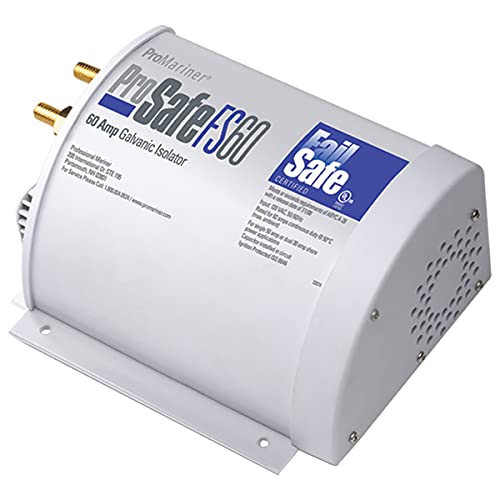
This ProMariner model supports higher amperage requirements, suitable for boats with more extensive shore power connections. The Prosafe line is recognized for providing robust galvanic isolation while maintaining a simple installation process. It helps reduce corrosion risk on hulls, propellers, and other underwater metals by limiting the potential differential between shore power and onboard bonding systems.
Victron Energy Galvanic Isolator VDI-32

Victron Energy’s galvanic isolator uses a dual-diode arrangement to block low-voltage DC currents entering the boat via the shore power earth. It provides isolation while allowing current flow above a threshold, typically around 1.4 Vdc, to prevent corrosion of hull plating, prop shafts, and other critical surfaces. The design supports reliable protection in marinas with multiple vessels sharing shore power.
Newmar Galvanic Isolator, 30 Amp

Newmar’s 30 Amp galvanic isolator balances compact design with effective isolation. It is designed to mitigate galvanic currents from shore power sources, helping to preserve underwater metals while keeping electrical bonding safe. This model is suitable for mid-sized boats that require dependable protection without adding significant installation complexity.
Boating Accessories New Prosafe FS Series Galvanic Isolator

The ProSafe FS Series features FailSafe Technology designed to interrupt galvanic current flow when multiple boats share a marina shore power system. It aims to maintain AC safety ground, address common corrosion forms, and preserve bonding system integrity. UL Certified to ABYC A-28 standards, it offers a robust protection profile for boats that require reliable operation even in complex electrical environments.
Buying Guide
Key considerations help you select the right galvanic isolator for your vessel and marina setup:
- Amplitude Capacity: Match the isolator amperage to your boat’s shore power draw. Higher amperage units are common on larger boats or those with heavy electrical systems.
- FailSafe Features: Some models include fail-safe or protection mechanisms to maintain ground continuity in the event of a failure, important for safety and corrosion prevention.
- Marina Compatibility: If you boat in busy marinas with many vessels, a more robust or FS-series isolator may offer better protection against galvanic currents.
- Installation Simplicity: Look for units with straightforward mounting options, clear wiring diagrams, and compatibility with standard AC shore power connections.
- Certification and Standards: UL and ABYC compatibility can provide additional assurance of safety and performance in American waters.
- Physical Footprint: Consider the space around the battery and power distribution area; compact units can be easier to install in tight bilge spaces.
- Warranty and Support: A solid warranty and accessible customer support can be valuable for ongoing maintenance and potential troubleshooting.
Performance Perspectives
All three primary approaches to galvanic isolation—diode-based blockers, higher-amperage units, and FailSafe designs—offer distinct advantages. Diode-based models provide straightforward protection with predictable behavior but may introduce voltage drop. High-amperage units handle larger shore power loads and more complex systems. FailSafe designs emphasize redundancy and safer behavior during component faults, which can be beneficial for boats operating in busy marinas. When selecting, weigh your boat size, electrical load, marina environment, and maintenance tolerance to choose the best balance of protection and practicality.