Best 12V Submersible Bilge Pumps for Boats, RVs, and Ponds: Top 5 Picks
Answering the question here: for reliable 12V submersible bilge pumps, look for pumps with adequate flow (GPH), correct outlet size, and a design that suits automatic or non-automatic operation. This guide highlights five strong options, with clear guidance on who each pump is best for and why it was chosen. The list prioritizes models that perform well in bilge or water-transfer tasks, including boats, RVs, yachts, and damp environments.
| Product | Best Use | Key Feature |
|---|---|---|
| SEAFLO 01 Series 2000 GPH | High-volume bilge evacuation | Anti-airlock, 4-year warranty |
| MAXZONE Automatic 1100GPH | Automatic bilge when space is limited | Built-in float switch |
| Sanuke 1100GPH | Rugged, harsh marine environments | Anti-Airlock Technology |
| SEAFLO 06 Series 750GPH | Compact, reliable boat bilge | All-in-one with float switch |
| SEAFLO 01 Series 350 GPH | Small craft or tight spaces | Anti-airlock protection |
SEAFLO 01 Series 2000 GPH Bilge Pump

Model: SFBP1-G2000-01 | Voltage: 12V DC | Flow Rate: 2000 GPH | Outlet Diameter: 1-1/8 inch (29 mm) | Current: 8.5A | Max Head: 16.4 ft (5 m) | Wire Lead: 14 AWG, 3 feet (1 meter) | Warranty: 4-Year Limited
Best for: Boats and marine applications needing rapid water evacuation. This unit is designed to move large volumes quickly, making it suitable for larger bilge spaces or boats exposed to heavy rain or rough conditions. The anti-airlock protection helps maintain steady flow in demanding environments. Limitations: higher current draw may demand a robust power source and wiring setup.
MAXZONE Automatic Submersible 1100GPH

Flow Rate: 1100 GPH | Voltage: 12V | Head: 3.0 M | Outlet: 1-1/8″ | Built-in float switch; 1 m wire lead
Best for: Small to mid-sized boats requiring automatic operation with a built-in float switch for unattended bilge management. This model is chosen for its compact size and automatic feature that reduces manual monitoring. Caution: ensure wiring can support the 3.8A draw.
Sanuke 1100GPH Submersible Bilge Pump

Flow Rate: 1100 GPH | Outlet: 1-1/8″ | Max Head: 14.8 ft | Current Draw: 3.0A | Anti-Airlock Technology; non-automatic
Best for: Harsh marine environments and users who prefer a robust, non-automatic option. The anti-airlock feature helps maintain smooth operation in tight bilge spaces. Choose this if you want straightforward on/off control without integrated float mechanisms. Limitation: manual operation means more monitoring is needed.
SEAFLO 06 Series Automatic 750GPH

Flow Rate: 750 GPH | Voltage: 12V DC | Outlet: 3/4 inch | Max Draw: 5.0A | Integrated Float Switch | 4-Year Warranty
Best for: Compact boats or spaces where automatic bilge protection is desired but space is limited. This model blends compact size with a reliable auto-switch system. Limitation: lower max head than larger SEAFLO models, which may matter in deeper bilges.
Subtoy 12V Automatic Bilge Pump Kit
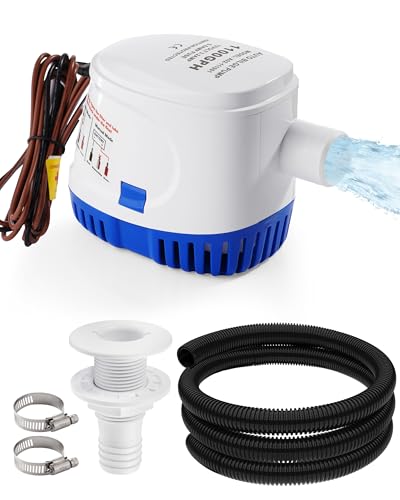
Flow Rate: 1100 GPH | Built-In Float Switch: Auto on/off | Submersible, Sealed Housing | Hose & Thru-Hull Fitting Included
Best for: anglers and small vessel owners who want a complete kit with automatic operation and installation fittings. The kit approach helps ensure quick setup. Limitation: kit contents may require adaptation for specific hull configurations.
Buying Guide
- Flow rate vs. space: Higher GPH moves more water but may require more power and space for installation. For larger bilges, aim for 1100–2000 GPH; for small spaces, 350–750 GPH can suffice.
- Automatic vs. non-automatic: Automatic models with float switches prevent manual monitoring. Non-automatic pumps require direct control but can be simpler to wire and maintain in some setups.
- Outlet size and fittings: Most common is 1-1/8″ (29 mm). Confirm compatible hose or thru-hull fittings for your boat or RV to avoid leaks.
- Power considerations: 12V pumps can draw between ~3 A and ~9 A depending on flow and head. Ensure wiring, fusing, and battery capacity match the load.
- Head (lift) capability: Head indicates the maximum vertical distance water can be pumped. Match head to bilge depth; higher heads are better for deeper spaces but may reduce GPH.
- Durability and warranty: Look for anti-airlock protection and at least a 4-year warranty for reliability in marine environments.
- Maintenance habits: Clean strainers regularly; check for airlocks; ensure float switches operate freely without sticking.
Frequently Asked Questions
- What is a bilge pump’s “GPH” rating?
– GPH stands for gallons per hour and indicates the pump’s water evacuation capacity. Higher GPH means faster water removal, useful in heavy inlets or rough weather. - Do I need an automatic bilge pump?
– If you want unattended operation, an automatic pump with a float switch is recommended for most boats and RVs. - What outlet size should I look for?
– Most 12V bilge pumps use 1-1/8″ outlets. Ensure hoses and fittings match this size for a secure connection. - Can I use a bilge pump for water transfer?
– Some pumps are designed for bilge use and water transfer; verify the model supports your intended fluid and head requirements. - Is a higher head always better?
– A higher head allows pumping water from deeper spaces, but it may reduce flow rate. Balance head with your bilge depth and required speed. - What maintenance is essential?
– Inspect and clean inlet strainers, check for airlocks, verify float switch operation, and inspect wiring for corrosion in marine environments.