Best 2 Bank Battery Chargers for Boats: Reliable Dual-Bank Marine Chargers
If you need a dependable 2-bank battery charger for a boat, this guide analyzes top dual-bank marine chargers to keep your batteries charged, balanced, and ready. These models are suited for anglers, harbor pilots, weekend boaters, and offshore travelers who rely on consistent starting power and deeper-cycle longevity. The selection below highlights versatility, waterproofing, mode options, and compatibility with lead-acid and lithium batteries. Use the quick-reference table to compare key specs at a glance.
| Product | Output (Per Bank) | Battery Types | Best For |
|---|---|---|---|
| NOCO Genius GEN5X2 | 5A/Bank (10A total) | Lead-Acid, Lithium | Boat owners needing compact, high-performance dual-bank charging |
| FirstPower Pro 2 Bank 5X2 | 5A/Bank (10A total) | Lead-Acid, Lithium | Rugged, fully-sealed 2-bank charger for harsh marine environments |
| NOCO Genius GENPRO10X2 | 10A/Bank (20A total) | Lead-Acid, Lithium | Higher-power dual-bank setups with advanced safety |
| ProMariner ProSport HD 8A | 4A/Bank | Lead-Acid, AGM, Lithium | Smaller systems needing balanced two-bank charging |
| ProMariner ProSport HD 20A | 10A/Bank | Lead-Acid, AGM, Lithium | Higher-capacity dual-bank charging for larger boats |
NOCO Genius GEN5X2: 2-Bank, 10A Onboard Battery Charger
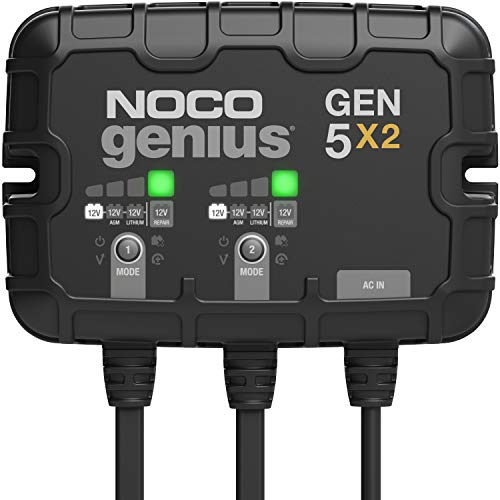
The GEN5X2 offers two independent 5-amp banks in a compact package, delivering a combined 10 amps. It supports 12V lead-acid and lithium options and includes modes for 12V, AGM, Lithium, and a 12V Repair mode. The battery sensor and temperature compensation help prevent overcharging in heat and undercharging in cold. Best for boaters who need a space-efficient, robust charger that can manage multiple battery chemistries without fuss.
Who it’s best for: boat owners with limited space who require reliable dual-bank charging for both starting and deep-cycle batteries. Why selected: advanced temperature compensation and multi-mode per bank provide precise charging in marine conditions. Caution: ensure proper ventilation as with any compact onboard charger in tight compartments.
FirstPower Pro 2 Bank 5X2: 10A 2-Bank Onboard Charger

This charger provides two 5-amp banks in a fully-sealed IP68 waterproof unit, suitable for 12V lead-acid and lithium systems. Each bank can be set to the appropriate mode (12V SLA/AGM, 12V Lithium, 12V Calcium) and can charge two batteries simultaneously. A notable feature is Force Mode, which can revive deeply discharged batteries by initiating charging when voltage is below 1V. Best for: boats with compact electrical spaces that still need reliable, independent bank charging. Limitation: entry-level status may not match higher-power systems.
NOCO Genius GENPRO10X2: 2-Bank, 20A Onboard Charger

The GENPRO10X2 doubles the amperage per bank to 10A with a total of 20A, offering advanced features like per-bank mode selection (12V, AGM, Lithium) and a 12V Repair Mode. It is designed for demanding marine environments and supports both lead-acid and lithium chemistries with temperature compensation. Best for: larger boats or systems where higher charging current is needed per bank. Caution: higher power model may require robust mounting and adequate cooling.
ProMariner ProSport HD 8A Two-Bank Charger

With an 8A total output across two banks (4A per bank), this charger emphasizes distributed-on-demand charging to allocate amps where needed. It highlights LED status indicators for each bank, aiding quick diagnostics. Best for: smaller marine systems that still require balanced dual-bank charging. Limitation: lower total amperage means slower charge for larger batteries or high-usage vessels.
ProMariner ProSport HD 20A 2-Bank Charger

This model provides 10A per bank (20A total) and uses digital technology to distribute unused charging amps where needed. It targets larger boats and systems needing faster, simultaneous charging for two batteries. Best for: boats with higher electrical demands and multiple deep-cycle or starting batteries. Caution: higher capacity may require more space and heat management.
Buying Guide: Key Considerations For Choosing A 2-Bank Boat Charger
How to choose the right two-bank charger for your boat depends on battery type, space, and desired charging speed. Consider:
- Battery compatibility: Ensure the charger supports both lead-acid and lithium batteries you use, including AGM, LiFePO4, and calcium variants.
- Per-bank amperage: Higher amperage per bank charges batteries faster but may require more robust electrical setups.
- Waterproof rating: Look for IP ratings or marine certifications to withstand spray and immersion in open-water use.
- Charging modes: Independent per-bank modes help tailor charging for each battery type and health status.
- Dead-battery recovery: Some models offer a “repair” or “force” mode to reawaken very discharged cells.
- Size and heat management: In compact bilges, compact units with thermal regulation help prevent overheating.
For mixed fleets of batteries, a dual-bank charger with temperature compensation and multiple modes provides the most versatile solution. If space and weight are constraints, prioritize compact models with adequate protection features. For larger boats with heavy use, a higher total amperage per bank improves readiness for starting and auxiliary systems.
Frequently Asked Questions
- What is the advantage of a 2-bank charger on a boat? It charges two batteries independently, enabling simultaneous maintenance of starting and deep-cycle banks without cross-interference.
- Can these chargers handle lithium batteries? Yes, most models list 12V Lithium or LiFePO4 as supported modes, alongside lead-acid chemistries.
- Is waterproofing important for onboard chargers? Yes. Marine environments require IP-rated or marine-certified units to handle splashes and occasional immersion.
- What is “Repair Mode” or “Force Mode”? These modes attempt to revive deeply discharged batteries by initiating charging at very low voltages to overcome initial sulfation or dead states.
- Do I need a dedicated system for a higher-power charger? Higher-amperage units may require better wiring, fusing, and a stable electrical backbone; consult an installer if in doubt.
- How do I choose between 5A per bank and 10A per bank? Choose 5A per bank for smaller arrays or boats with modest usage; 10A per bank is better for larger batteries or higher daily energy needs.