Best Electric Polishers for Boats: Top Picks for Hull Shine and Swirl-Free Finishes
Whether you’re restoring a fiberglass hull, buffing a gel coat, or applying sealant to keep weather and salt spray at bay, the right electric polisher makes the job easier. This guide reviews five top-performing boat-friendly polishers, highlighting who each tool is best for, and why one might fit your setup better than another. It’s ideal for DIY boat owners, professional detailers, and marine enthusiasts aiming for a showroom finish without swirl marks.
| Product | Best For | Why It Stands Out |
|---|---|---|
| AOBEN 6-Inch Dual Action Polisher | Rookies and hobbyists | 6 speeds, ergonomic design, versatile accessories for wax, polish, and sealant |
| Seesii 7″/6″ Variable Speed Polisher | More correction in less time | Powerful 1600W copper motor, 7 speeds, dual-handle for comfort |
| Avhrit Cordless 21V Buffer Polisher | Cord-free convenience | 3,000–6,000 RPM range, 2 batteries, portable for boats without outlets |
| DEWALT 7-Inch/9-Inch Buffer Polisher | Pro-grade control | Durable build, variable speed, trusted brand |
| AUTIWOZ 4/5-Inch Rotary Polisher | Compact, tight access areas | 630W, 2nd-gear wax, 4th buff, 6th deep swirl remove |
AOBEN 6-Inch Dual Action Polisher
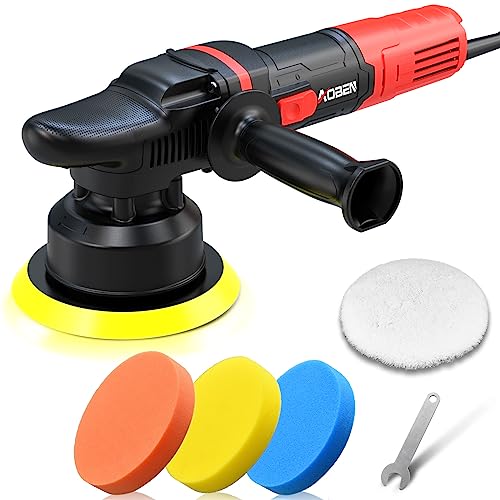
Best for entry-level boat detailing and beginners. This 6-inch dual-action polisher offers six speed settings from 1000 to 4500 rpm, enabling gentle waxing to aggressive defect removal. It includes multiple foam pads and a synthetic wool disc, ideal for applying wax, polishing gel coat, and removing oxidation on smaller boat surfaces. The ergonomic design helps reduce fatigue during longer sessions. A caution: higher speeds require careful control to avoid heat buildup on soft gel coats.
Seesii 7″/6″ Variable Speed Polisher

Best for boat owners seeking heavier correction capability. The 1600W copper motor supports up to seven adjustable speeds, enabling precise control for removing heavy oxidation, scratches, and stains on hulls or decks. The dual-handle layout improves balance during longer sessions. Caution: extended operation may require periodic cool-down to maintain performance and avoid heat buildup on delicate finishes.
Avhrit Cordless Car Buffer Polisher Kit

Best for boaters who want true cord-free operation. This cordless polisher offers a 6,000 rpm top speed with six adjustable settings, suitable for removing swirls, compound work, and finishing on gel coats. It ships with two 2000mAh batteries for extended sessions. Choose this if you need mobility on a large deck or far from outlets. Limitation: cordless tools may require battery swaps during long jobs.
DEWALT 12 Amp Rotary Buffer Polisher

Best for professionals seeking durability and precise speed control. The DEWALT buffer polisher combines a robust 12-amp motor with a variable speed trigger, featuring a soft-start design. It’s well-suited for larger boats or frequent detailing tasks where consistent performance matters. Caution: heavier weight may require steady arms and proper stance during use.
AUTIWOZ 4/5-Inch Rotary Polisher

Best for compact spaces and tight spots on boats. This 4/5-inch polisher provides 2500–4500 rpm with a 630W motor, offering precise control for railings, deck edges, or tight hull contours. Its ergonomic design reduces fatigue during localized detailing. Limitation: smaller pad size means longer time for large hull surfaces compared to 6–7 inch models.
Buying Guide: Key Considerations For Boat Polishing
- Pad size and reach: Larger pads cover more area; smaller pads suit tight spaces and complex contours on boats.
- Power and speed range: Higher wattage and broader rpm ranges enable faster correction but may generate more heat.
- Ergonomics and weight: Long sessions benefit from balanced designs and comfortable handles.
- Corded vs cordless: Corded polishers offer consistent power; cordless models provide mobility on decks and away from outlets.
- Accessories: Look for kits including multiple pads and a carrying case, especially for gel coats and delicate finishes.
- Heat management: Gel coats and paints can overheat; allow cool-down pauses when using high speeds or heavy cuts.
Frequently Asked Questions
- What size polisher is best for boats?
A: Start with a 6-inch pad for general hull polishing; use 7-inch for faster coverage on larger surfaces and 4/5-inch for tight areas. - Is a cordless polisher sufficient for boats?
A: Yes, for small to medium boats and lofted decks; for large hulls, a corded model or extra batteries helps. - Why use a dual-action polisher on boats?
A: Dual-action reduces swirl risk and provides more uniform finishing on gel coats and paint. - Can I use automotive wax on a boat with these polishers?
A: Yes; apply wax or sealant after polishing to boost UV resistance and water beading. - How do I prevent heat damage while polishing?
A: Work in sections, use lower speeds when possible, and pause to cool the surface if it gets warm. - What maintenance is required after use?
A: Clean residue from pads, inspect pads for wear, and store in a dry place to prevent pad degradation.
Table note: The products listed here are selected for their relevance to boat detailing, including hull polishing, gel coat finishing, and deck restoration. They provide a range of power, size, and mobility to suit different boat sizes and user preferences.