Best Marine Fuse Terminal Block Solutions for 12V Systems
Searching for a reliable marine fuse terminal block? This guide highlights five solid options suited for boat, RV, and other 12V or 24V DC setups. It targets boaters needing organized, safe power distribution with clear fault indicators. Best for: compact boats needing multiple fused circuits; larger vessels requiring higher current capacity; and users who want easy wiring, clear fault alerts, and durable housings.
| Product | Key Strength | Best For |
|---|---|---|
| Blue Sea Systems ST Blade Fuse Block 12 Circuit with Ground and Cover (5026) | 12 circuits, ground bus, 100 A max | Higher‑demand DC systems on larger boats |
| DaierTek 12 Way Fuse Block (12V) with LED Indicator | 12 circuits, LED fault indicator, waterproof | Organized wiring with quick fault ID |
| WUPP 12 Volt Fuse Block, 6 Circuits with Negative Bus | 6 circuits, LED indicators, corrosion‑resistant | Compact systems needing tidy wiring |
| DaierTek 6 Way Fuse Block (12V) with LED Indicator | 6 circuits, LED fault indicator, waterproof | Smaller installations needing clear alerts |
| Cyrico 12 Circuits Fuse Block with Negative Bus | 12 circuits, built‑in grounding, LED indicator | Budget‑friendly, multi‑circuit protection |
Blue Sea Systems ST Blade Fuse Block 12 Circuit (5026)

The Blue Sea 5026 provides twelve fused circuits with an integrated negative bus and a clear insulating cover. It accommodates a total maximum capacity of 100 amps and supports up to 30 amps per circuit when used with standard ATO/ATC blade fuses. The protective cover features a push-button latch, spare fuse storage, and recessed label areas for simple circuit identification. This design is best for sailors who need robust protection in mid‑sized electrical systems and easy maintenance in rough marine environments.
Best for: boats with multiple auxiliary systems (lights, pumps, electronics) that require a dedicated fused circuit map. Choose this if you value a secure cover and a spare fuse compartment for quick replacements. Limitation: higher upfront footprint than smaller blocks.
DaierTek 12 Way Fuse Block (12V) with LED Indicator

This 12‑way marine fuse block provides 12 dedicated fuse slots and a positive/negative setup, with a clear LED indicator showing blown fuses. It accepts ATC/ATO fuses and includes a waterproof design suitable for automotive, boat, and RV use. Its universal protection is rated for up to 32V DC and 100A total, with per‑circuit limits around 30A. Best for: boaters needing a large, clearly monitored fuse panel in a weatherproof housing. Caution: verify fuse types compatibility (ATC/ATO) before installation.
WUPP 12 Volt Fuse Block, 6 Circuits
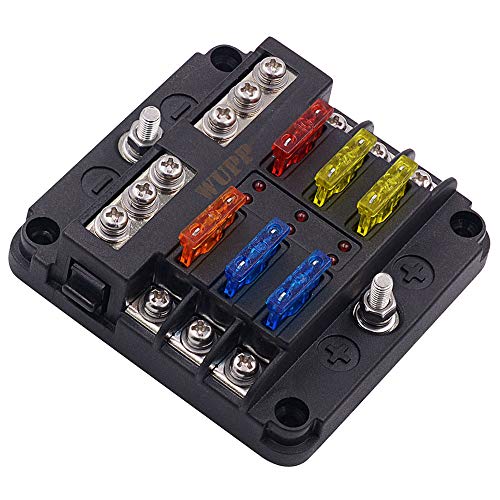
The WUPP block offers six circuits with a negative bus and a damp‑proof cover. It features six dedicated fuses and six grounding points to keep wiring neat and accessible. The unit supports up to 100A total input and 30A per circuit, with nickel‑plated copper busbars for corrosion resistance. Best for: compact boats or vehicles where space is at a premium but you still want organized, clearly indicated protection. Limitation: fewer circuits than larger blocks; plan circuit needs accordingly.
DaierTek 6 Way Fuse Block (12V) with LED Indicator

This six‑way marine fuse block provides LED indication for blown fuses and supports ATC/ATO fuses. It’s designed for 12V operation, with a maximum 100A total and 30A per circuit. The waterproof housing makes it suitable for boating environments where moisture is a concern. Best for: smaller vessel systems that still require reliable fault visibility. Better for: straightforward installations with emphasis on quick fault detection. Caution: ensure compatibility with the fuses included or planned for use.
Cyrico 12 Circuits Fuse Block with Negative Bus

The Cyrico block provides 12 circuits with a negative bus and a built‑in grounding option. It includes an LED indicator for blown fuses and comes with 24 blade inserts. The housing supports up to 100A total with per‑circuit limits around 30A. This option is practical for budget‑conscious boaters who still want organized protection and clear fault alerts. Best for: mid‑size power setups that require many circuits without a premium price. Limitation: ensure the included blade inserts match your preferred fuse types and ratings.
Buying Guide: Key Considerations For Marine Fuse Blocks
- Circuit count: Match the number of circuits to your onboard devices. Larger boats may need 12+ circuits; smaller boats can work with 6 or fewer.
- Total and per‑circuit current: Check maximum panel rating (often 100 A) and per‑circuit limits (typically 30 A). Ensure it fits your system’s loads.
- Grounding: A negative/ground bus improves fault handling and simplifies wiring. Look for integrated negative buses or clear grounding points.
- Waterproof and durability: Marine environments require waterproof or damp‑proof housings and corrosion‑resistant materials (nickel‑plated bus bars recommended).
- LED fault indicators: LEDs help quickly identify blown fuses; consider whether the panel includes LED indicators and the locations of the indicators.
- Fuse compatibility: Confirm support for ATC/ATO fuses and included fuse types. Some blocks ship with fuses; others require you to supply them.
- Cover and labeling: A secure, latchable cover plus recessed labeling areas aids maintenance and circuit identification.
- Size and installation: Ensure the physical footprint fits your helm or bilge space and that mounting options align with your boat’s layout.
- Maintenance: Look for spare fuse storage, labeling stickers, and easy access for quick replacements during trips.
FAQ
- What is a marine fuse block best used for?
A marine fuse block provides protected power distribution across multiple circuits in boats or other 12V/24V systems, with features like ground buses, LED indicators, and weatherproof housings to handle marine conditions. - How many amps per circuit should I expect?
Most panels support up to 30A per circuit, with a total panel rating around 100A. Plan according to the devices on each circuit. - Do I need a ground bus on a fuse block?
A ground bus helps route fault currents and stabilizes the electrical system; it’s generally recommended for larger, multi‑circuit layouts. - Are LED indicators necessary?
LED indicators speed fault diagnosis by showing which circuit has blown, reducing troubleshooting time on the water. - What fuse types are compatible?
ATC/ATO blade fuses are commonly supported; verify compatibility in product specs before purchase.