Best Solar Panels for Boat Power on the Water
If you’re outfitting a boat for reliable onboard electricity, solar panels are a smart, low-maintenance solution. This guide compares five 12V and marine-appropriate panels to help you pick what fits your needs—whether you’re topping up a small battery bank for a weekend cruiser or extending life for a larger marine system. The top picks suit different boat sizes and usage patterns, from trailerable vessels to full-time liveaboards. Below is a quick summary table of the chosen products to aid your quick comparison.
| Product | Best For | Key Benefit |
|---|---|---|
| SOLPERK Solar Panel Kit 20W | Small boats, trickle charging | Smart MPPT controller, durable 25-year lifespan |
| Voltset 12V Solar Battery Charger – 20W | All-purpose maintenance | Advanced MPPT, three-stage charging |
| Renogy 200 Watts 12V Kit | Mid-sized boats, off-grid power | PWM controller, robust for marine use |
| Renogy 100W N-Type Panel | Compact setups, rainproof | 16BB cells, high efficiency |
| Renogy 200W 24V Panel Kit | Larger systems, higher voltage | 16BB, robust for harsh conditions |
SOLPERK Solar Panel Kit 20W for Boats

Best for compact systems on small boats or as a trickle charger. This 20W kit uses monocrystalline A+ cells with 21%-30% efficiency to charge 12V batteries such as LiFePO4, AGM, and GEL. The included smart MPPT controller improves charging efficiency and protects against overcharging. The adjustable mount bracket simplifies installation on rails or cabins. A low-iron tempered glass surface and corrosion-resistant aluminum frame deliver water resistance and a potential lifespan up to 25 years. Cautions include its limited wattage, which may require parallel panels for larger battery banks.
Voltset 12V Solar Battery Charger – 20W

Best for all-purpose maintenance on a variety of vessels. The Voltset system claims 99% MPPT tracking efficiency and 98% peak conversion, delivering faster charging than older controllers. It supports 12V batteries including LiFePO4, Lithium Ion, AGM, SLA, and flooded types. The built-in protections guard against overcharge, over-discharge, short circuits, and reverse polarity, while a 3-stage charging algorithm (Bulk, Absorption, Float) optimizes performance. A limitation is that its higher efficiency depends on good sun exposure; poor weather will reduce output.
Renogy 200 Watts 12V Kit

Best for mid-sized boats needing more sustained power. This kit emphasizes reliability with a 12V system, mounting brackets, and a PWM controller. The 200W rating supports higher energy draw than tiny kits, suitable for longer trips or more demanding electronics. While PWM controllers are budget-friendly, they may be less efficient than MPPT in variable sunlight. Ensure your battery bank can absorb the higher current during peak sun.
Renogy 100W N-Type Panel

Best for compact setups and hot, sunny conditions. The N-type 100W panel uses 16BB cells to boost efficiency and reduce hotspot risk, delivering stable output in high temperatures. It pairs well with a mid-sized onboard battery bank. A limitation is that 100W may be insufficient for larger systems or households onboard; pairing with additional panels will be needed for extended cruising.
Renogy 200W 24V Panel Kit
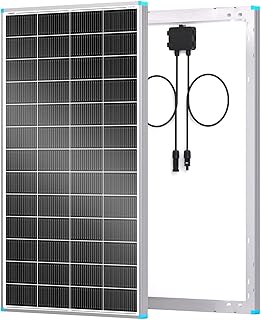
Best for larger boats with higher voltage needs. This 200W kit operates at 24V, delivering robust power for bigger battery banks and more demanding equipment. The 16BB N-type cells offer improved efficiency and durability, suitable for off-grid marine setups. A potential trade-off is the higher wiring and system complexity required for 24V configurations, which may demand more planning during installation.
Buying Guide: Key Purchase Considerations
- Boat size and electrical demand: Smaller boats benefit from 20W–100W panels for trickle charging, while mid-sized to larger boats may require 200W kits or multiple panels to meet daily energy needs.
- Controller type: MPPT controllers maximize efficiency in variable sunlight and shading; PWM controllers are cost-effective but generally best for smaller systems.
- Voltage and battery compatibility: Choose 12V panels for standard 12-volt battery banks; 24V panels suit higher-voltage layouts. Verify compatibility with LiFePO4, Lithium Ion, AGM, SLA, and GEL batteries.
- Durability and marine suitability: Look for corrosion-resistant frames, sealed junction boxes, and waterproof construction to withstand salt air and spray.
- Installation and mounting: Consider adjustable brackets for optimal sun exposure and ease of maintenance. Ensure mounting hardware suits hull or rails on your vessel.
- Weather and climate: In hot climates, panels with high-temperature tolerance and low temperature coefficients perform better, maintaining output under heat.
Additional Buying Tips
- Plan for expansion: If you expect your boating setup to grow, choose panels and controllers that scale with additional modules.
- Wiring and protection: Use proper gauge wiring and fuses, and ensure safe routing away from moving parts and heat sources.
- Maintenance: Regularly inspect for loose connections, dirt, and salt buildup. Clean panels with a soft cloth and water as needed.
FAQ
- Q: Do I need an MPPT controller for a small boat setup?
- Q: Can a single 20W panel run a boat battery charger?
- Q: Is a 24V solar kit better for boats?
- Q: Are marine panels weatherproof?
- Q: How many panels should I install on a boat?
- Q: Can solar panels damage boat batteries?
A: While not mandatory, an MPPT controller improves charging efficiency, especially in fluctuating sunlight or when solar exposure changes with your boat’s orientation.
A: It can maintain a small battery or top up between trips, but it will not fully recharge a large battery bank during peak usage periods.
A: For larger boats with higher electrical demands, a 24V configuration can be more efficient and reduces current for the same power, though it requires compatible components.
A: Most marine panels feature waterproof and corrosion-resistant construction, but always verify IP ratings and installation conditions for your location.
A: It depends on battery capacity, daily energy use, and travel duration. Start with a modest setup and plan for future expansion if needed.
A: Properly sized panels with a charge controller prevent overcharging; mismatched systems without controllers can risk battery damage.