Best Guest Boat Battery Chargers for Dual-Bank Marine Power
Answering the need for reliable, dual-bank charging on boats, these Guest and compatible onboard chargers are designed to keep marine electrical systems ready. This guide helps boaters choose by battery type, voltage, and installation needs. The top picks here are best for anglers, sport boats, and larger vessels with multiple battery setups. Each option is evaluated for ease of installation, water resistance, and battery compatibility to help you match your boat’s electrical demands.
| Product | Best For | Key Benefit |
|---|---|---|
| Guest 2707A | Two-bank boats needing 12V | Independent charging with IP67 seal |
| Guest 2720A | 12V or 24V systems | Flexible dual-voltage operation |
| Guest 2711A | Two-bank 12V setups | Reliable 10A capacity |
| NOCO GEN5X2 | Marine systems with lithium support | Two banks, 12V with lithium modes |
| NOCO GEN5X3 | Three-bank needs | High-capacity 15A total, versatile modes |
Guest 2707A On-Board Battery Charger 8A / 12V

The Guest 2707A delivers a dual-bank charging system for independent battery charging in a marine setting. It operates at 8A per battery bank with 12V output, suitable for boats that rely on two separate battery banks. A primary advantage is its IP67 waterproof rating, making it well-suited for exposed installations on deck or near the engine compartment. It includes safety protections for reverse polarity, over-current, over-voltage, over-temperature, and ignition protection. This model is best for boaters who need solid, weather-resistant charging for two 12V lead-acid or AGM batteries and want straightforward installation. A potential limitation is that total charging power is lower than higher-capacity units, which may be less ideal for larger starter or deep-cycle configurations.
Best for: Small to midsize boats needing two independent 12V banks and robust water sealing. Better for: Boats with harsh exposure; where separate banks simplify battery management. Choose this if: you want a rugged dual-bank charger with strong protection features and simple 120V input.
Guest 2720A On-Board Battery Charger 20A / 12/24V

The 2720A provides dual-voltage support (12V and 24V) with independent charging per bank, making it ideal for boats that operate both systems or upgrade to higher capacity. Its IP67 waterproof rating ensures reliability in wet environments. This unit is best for larger boats or fleets that need flexibility to charge different battery configurations without swapping equipment. A caveat: the higher 20A total output means a larger installation space and more robust wiring requirements, which may not suit very compact installations.
Best for: Boats using 12V or 24V systems with two independent banks. Better for: Vessels that occasionally switch between 12V and 24V or need higher charging current. Choose this if: you require versatile voltage support and strong bank autonomy.
Guest 2711A On-Board Battery Charger 10A / 12V

The 2711A is a 10A, two-bank onboard charger designed specifically for 12V systems. It emphasizes ease of use and dependable dual-bank charging for boats with multiple 12V batteries required for starting and deep-cycle needs. The device is a practical pick for sport fishing boats and similar vessels where consistent, straightforward charging is desired. A limitation is that it does not offer 24V or lithium-specific modes, so it’s most compatible with traditional lead-acid or AGM batteries.
Best for: Boats relying on two 12V banks with moderate charging needs. Better for: Users prioritizing simplicity and reliability over multi-chemistry support. Choose this if: you want a dedicated two-bank 12V charger without extra features.
Guest Maintainer 2701A, 1.5A
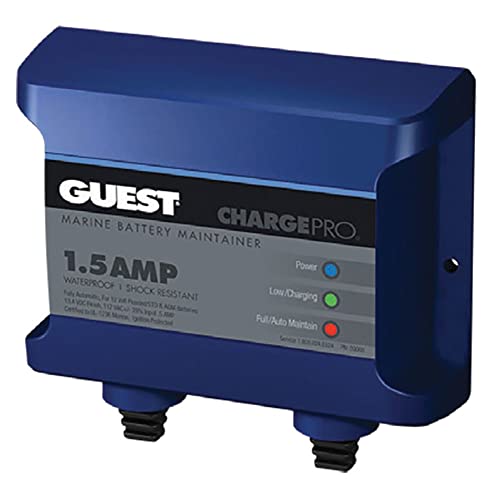
TheGuest 2701A Maintainer provides a low-amperage maintenance charging option for small batteries and extended idle periods. It is highlighted for wet, gel, and AGM batteries and can handle a broad range from 1.2 Ah up to 40 Ah. This makes it ideal for portable or auxiliary applications on small boats, PWCs, or seasonal vessels where the main engine charging isn’t required year-round. A limitation is its single-bank design and lower current, making it unsuitable for keeping large starter or deep-cycle banks fully charged during heavy draw periods.
Best for: Small boats or as a maintenance charger for mixed battery types. Better for: Keeping a single battery in top condition when not in heavy use. Choose this if: you need a lightweight, flexible maintainer rather than a full two-bank charger.
NOCO Genius GEN5X2: 2-Bank, 10A Onboard Battery Charger
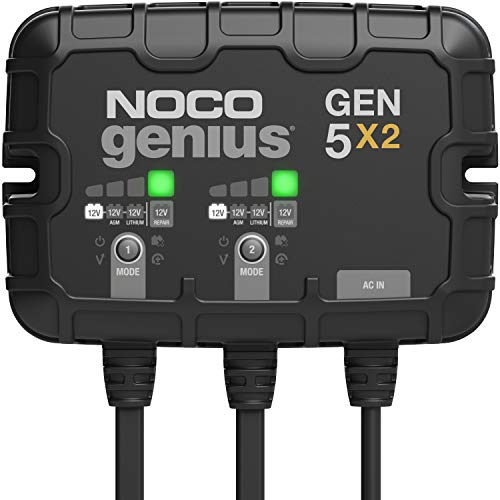
The GEN5X2 combines compact design with robust capability: a two-bank charger delivering 10A total, 5A per bank. It supports multiple charging modes including 12V, 12V AGM, and 12V Lithium, plus a Repair Mode for maintenance. Its waterproof construction suits marine settings, and independent bank operation ensures each battery gets tailored charging. A limit to consider is potential config complexity if you need more than two banks or specific lithium battery protections beyond the standard modes.
Best for: Boats needing two independent charging paths with lithium compatibility. Better for: Mixed battery chemistries and compact installations. Choose this if: you require lithium support and flexible charging per bank.
NOCO Genius GEN5X3: 3-Bank, 15A Onboard Battery Charger
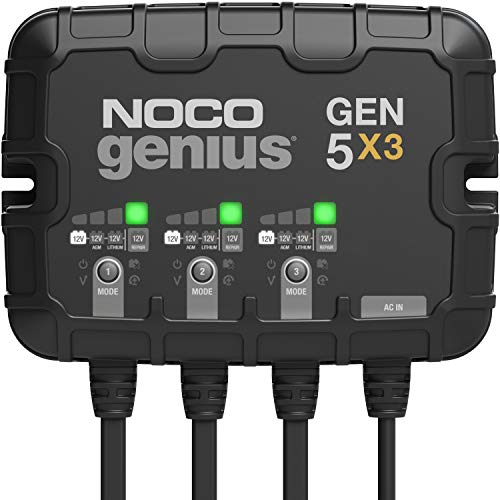
The GEN5X3 offers three banks with a total of 15A, averaging 5A per bank. It provides independent charging modes per bank (12V, 12V AGM, 12V Lithium, and a Repair Mode) and is designed for marine environments. This option is well-suited for larger boats with multiple battery banks, or fleets needing robust support for diverse battery chemistries. A potential downside is installation complexity due to wiring and space requirements for three banks, especially on smaller vessels.
Best for: Boats with three separate battery banks or higher power needs. Better for: Complex marine electrical systems with mixed chemistries. Choose this if: you want maximum bank count and adaptability across chemistries.
Buying Guide
- Battery type compatibility: Look for chargers that explicitly support lead-acid, AGM, gel, and lithium options if your boat uses mixed chemistries.
- Voltage and bank count: Match the charger to your system voltage (12V vs 24V) and required number of independent banks.
- Water exposure: For exposed installations, choose units with IP67 or higher waterproof ratings.
- Charging current per bank: Higher banks (e.g., 5A per bank) charge faster but require adequate wiring and space.
- Installation considerations: Consider space, terminal accessibility, and whether surface mounting or in-cabin installation is needed.
- Safety features: Reverse polarity, over-current, over-voltage, and temperature protection reduce risk in marine environments.
- Maintenance mode: Chargers with a repair or maintenance mode help preserve battery life during idle periods.
- Future-proofing: If you anticipate adding batteries or switching to lithium, choose models with lithium-compatible modes.
FAQ
- What is a dual-bank charger? A charger that independently powers two battery banks, allowing each to be charged separately for redundancy or different battery roles.
- Can I use a 12V charger on a 24V system? Some chargers support 24V setups or dual-voltage operation; verify model specifications before use.
- Are marine chargers waterproof? Many are rated IP67 or higher, but confirm protection ratings to match installation location on the boat.
- Is lithium support necessary? If you use lithium batteries or plan to in the future, select a charger with lithium mode support for proper charging profiles.
- Do chargers require special wiring? Higher-current dual-bank units typically need appropriately rated wires and fusing according to the installation guidelines.
- What maintenance benefits do these chargers provide? Maintainers and repair modes help prolong battery life by preventing sulfation and keeping voltage within optimal ranges when not in use.