Best Flat Bottom Boat Motors for Small Watercraft
If you’re powering a flat bottom boat, you need reliable, compact outboard options or electric trolling motors that fit shallow, calm waters. This guide highlights five well-suited choices, clarifying who each is best for and why. It’s ideal for anglers, recreational boaters, and float-tleet enthusiasts seeking steady speed, easy control, and corrosion resistance on flat boats.
Summary of chosen products (quick reference):
| Product | Best For | Key Benefit | Notes |
|---|---|---|---|
| BJTDLLX 6HP Outboard Motor | Small fishing boats, inflatables | 360° steering, water cooling | Short shaft, built-in tank |
| Gosangom 3.5HP Outboard Motor | Rubber boats, kayaks, inflatables | Lightweight, efficient | Very portable, economical |
| COFECO Hangkai 12HP Outboard | Med-sized flat boats, inland water | Three gears, CDI ignition | Water cooling, strong thrust |
| NAZEAOB 18HP Outboard | Heavier loads, faster travel | High thrust, robust build | Long shaft option |
| GrfceVue 6HP 4-Stroke | Shallow-water cruising | Air cooling, safety features | Short shaft, easy reverse |
BJTDLLX 6HP Outboard Motor

Best for small fishing boats and inflatables, this 2-stroke 6HP unit emphasizes a robust water cooling system to manage engine heat in shallow, churning waters. The 360° steering rotation supports tight maneuvering and reverse navigation without gear shifting, a plus for dockside tacking and back-channel retrieval. Constructed from cast aluminum, the motor balances durability with corrosion protection, making it suitable for mixed freshwater and brackish environments. The built-in fuel tank and optional external tank offer flexible fuel arrangements for short trips.
Who it’s for: anglers and casual boaters who need reliable, compact power with immediate steering control and straightforward maintenance. Why selected: it combines compact size, effective cooling, and a versatile steering approach that helps in tight spaces. Caution: as a 2-stroke design, fuel efficiency and emissions may be higher than some modern 4-stroke options.
Gosangom 3.5HP Outboard Motor

Best for rubber boats, inflatables, and kayaks, this light 3.5HP outboard balances portability with adequate power. It uses a two-stroke engine with a water-cooled CDI system, providing reliable ignition and simple maintenance. Notable is its lightweight design—around 21.6 pounds—making it easy to transport and swap between small watercraft. The aluminum alloy build delivers corrosion resistance for both freshwater and saltwater use, and the 6.7-inch three-blade propeller helps reduce drag for steadier acceleration.
Who it’s for: paddlers and casual boaters who need a portable, fuel-efficient option for short outings. Why selected: the combination of compact size, strong fuel economy, and robust materials suits frequent, lightweight trips. Caution: may feel underpowered on larger or fully loaded boats.
COFECO Hangkai 12HP Outboard Motor
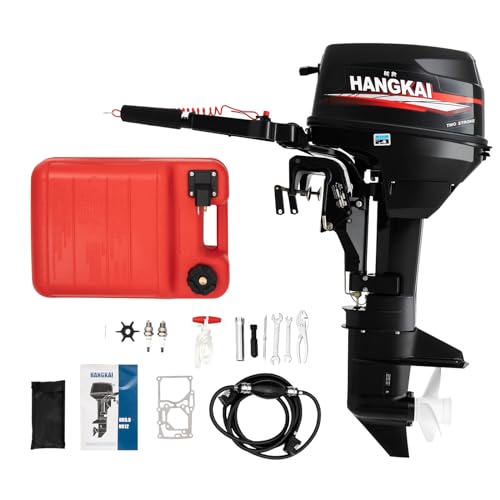
Best for mid-sized flat boats that require stronger thrust and reliable performance, this 12HP two-stroke engine delivers 5500 RPM and substantial thrust—enabling speeds around 15–30 km/h. It includes a CDI ignition system and a water cooling network to manage heat during longer runs. With three forward gears and a reverse option, cruising at constant speeds becomes feasible for different trips, including trolling or drifting scenarios. The design includes tilt resistance features to reduce cavitation and improve stability in swifter conditions.
Who it’s for: boaters needing higher horsepower without stepping up to a heavy, professional-grade engine. Why selected: the engine balance of power, heat management, and cruising control fits family outings and mid-range fishing trips. Caution: heavier and more fuel-consuming than smaller models; ensure your boat frame supports the added weight and thrust.
NAZEAOB 18HP Outboard Motor

Best for heavier loads and faster travel on flat bottom boats, this 18HP two-stroke engine promises strong performance with a robust aluminum alloy construction for corrosion resistance. Operating within 4,500–5,500 RPM, it supplies notable thrust capabilities suitable for larger inflatables or small work boats. The unit’s long shaft option provides added prop clearance in deeper hull-water interactions and saltwater environments. CDI ignition assists quick starts along with water cooling to protect the engine from overheating during longer runs.
Who it’s for: boaters needing more power for higher payloads or faster cruising on flat-bottom platforms. Why selected: combined power and durability address scenarios with heavier gear and longer trips. Caution: heavier engines demand more careful mounting and boat capacity checks to maintain stability and efficiency.
GrfceVue 4-Stroke 6HP Outboard

This 4-stroke 6HP engine combines efficient air cooling with a TC ignition system for reliable starts in varied conditions. Its forward and neutral gears simplify operation, and the throttle control allows precise speed changes for flat-bottom cruising or river detours. A three-blade propeller and streamlined body reduce water resistance, contributing to smoother acceleration. Safety features include an anti-swirl plate and an emergency shutoff rope for quick deactivation in unexpected situations.
Who it’s for: boaters who prefer smoother, quieter operation and straightforward engagement in shallow-water environments. Why selected: 4-stroke efficiency and safety-oriented design make it a strong all-around option for casual outings and frequent use on flat-bottom craft. Caution: limiters on max RPM should be observed to protect downstream components and fuel economy.
Buying Guide: Flat Bottom Boat Motor Considerations
- Engine type: Two-stroke vs. four-stroke. Two-stroke units are generally lighter and more powerful for their size but require mixed fuel and can emit more emissions. Four-stroke engines tend to run cleaner, with smoother operation and better fuel economy.
- Shaft length: Short shaft motors fit shallow-water boats; long shafts offer better prop clearance in wakes or deeper water. Match shaft length to your hull height and the waterline.
- Power needs: Weigh boat size, payload, and typical cruising speed. Heavier boats often benefit from higher horsepower or trolling-motor assistance for fine control.
- Cooling system: Water-cooled engines help maintain performance on longer runs. Air cooling can suffice for casual use but may be less consistent in hot conditions.
- Ignition and reliability: CDI ignition systems aid quick starts. Look for corrosion resistance if you operate in saltwater or brackish environments.
- Propeller design: A three-blade propeller tends to offer better thrust in compact motors, while blade count and pitch influence acceleration and top speed.
- Maintenance and weight: Lighter units are easier to transport; ensure mounting hardware and weight distribution align with your boat’s capacity and hull design.
Practical tips for choosing
- Prioritize models with built-in cooling and overload protection for durability in inconsistent water conditions.
- Consider a model with easy reverse or neutral gear if you frequently maneuver in tight spots or around docks.
- Evaluate total load and balance on the boat to avoid instability when adding a motor, fuel, and gear.
Frequently Asked Questions
- What is the best motor type for a flat bottom boat? – It depends on usage: light inflatables benefit from portable two-stroke or electric options, while larger, heavier flat boats may benefit from four-stroke or higher-horsepower engines for performance and reliability.
- Do I need a long shaft or short shaft for a flat bottom boat? – Short shafts suit shallow-water boats; long shafts help with prop clearance in deeper water or higher bow classes.
- Are electric trolling motors suitable for flat bottom boats? – Yes, for small, lightweight setups and precise station-keeping, but they provide less raw thrust than gas engines for heavier loads.
- Is a higher horsepower always better? – Not always. Choose horsepower to match vessel weight, payload, and cruising speed, avoiding under- or over-powered configurations.
- What maintenance should I perform on an outboard motor? – Regularly check fuel lines, air filters, and cooling components; inspect mounting bolts; follow seasonal storage guidelines and run engines in fresh water after saltwater use.
- Can I mix gas for two-stroke engines? – Yes, but follow the manufacturer’s fuel ratio and use fresh fuel to avoid performance issues.