Best 3-Gallon Outboard Tank Guide: Top Portable Fuel Tanks for Boats
Finding the right 3-gallon outboard tank hinges on compatibility, durability, and ease of use. This guide highlights five portable marine fuel tanks ideal for small boats, inflatables, and as spare fuel storage. The top picks are best for compact spaces, frequent travelers, or anyone prioritizing simple venting, long hoses, or built-in gauges. Read on to see who each tank is best for and why.
| Product | Capacity | Best For |
|---|---|---|
| PeakPursuit Portable Boat Tank 3 Gal | 3 gallons | Boat owners seeking long hose and level gauge |
| attwood 8803LP2 | 3 gallons | Rugged, automotive-grade construction for harsh environments |
| AloneGoer 3 Gallon Tank | 3 gallons | Durable, corrosion-resistant reservoir with EVOH barrier |
| Scepter 3 Gallon Portable Tank | 3 gallons | Under-seat storage with built-in gauge and vented cap |
| VEVOR 3.17-Gallon Tank | 3.17 gallons | High-durability tank with long hose and compatibility |
Buyer note: If your outboard motor requires a specific connection or hose length, verify hose inner diameter and coupling type before purchasing. The following sections compare five strong options to help you choose based on your setup, space, and maintenance preferences.
PeakPursuit 3 Gal Marine Tank With Hose

The PeakPursuit 3-gallon tank uses a dual venting system with a sealed or vented cap. It includes a long 9.8 ft hose and a level gauge for easy monitoring. Made from impact-resistant HDPE, it is designed for longevity on yachts and deck boats. Best for boaters needing a long hose and straightforward venting to ensure smooth fuel flow. Limitations include relying on compatible connectors for your engine’s fuel line.
Attwood 8803LP2 EPA/CARB 3-Gallon Tank

Attwood’s 3-gallon tank features automotive-grade multi-layer construction for long-lasting performance in extreme environments. An automatic vacuum valve promotes consistent fuel flow without manual venting. Best for users who prioritize durability and a built-in vent mechanism. A limitation is that it focuses on sturdy construction rather than explicit emphasis on long hose length beyond standard fittings.
AloneGoer 3 Gallon Marine Gas Tank
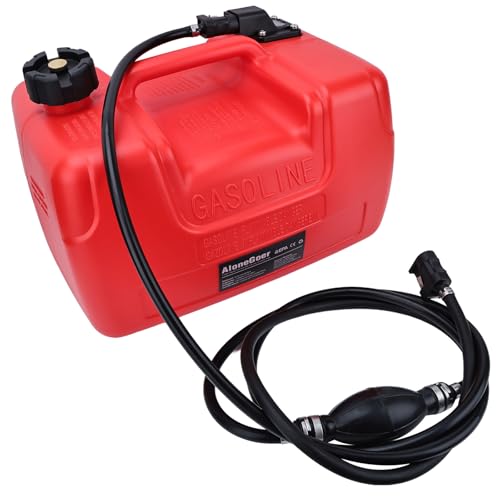
AloneGoer’s 3-gallon tank integrates HDPE-EVOH-HDPE multi-layer co-extrusion barrier to minimize fuel permeation and reduce evaporation by up to 98%. It supports Yamaha 6YL-24201-24-00 connections and emphasizes UV stabilization with salt spray resistance. Choose this if you want a corrosion-resistant, low-evaporation design. Limitation: high-end barrier tech may come at a cost relative to simpler tanks.
PeakPursuit Marine Tank With Line

This PeakPursuit 3-gallon tank emphasizes a premium construction and an ergonomic I-shaped handle for easy transport. It includes a fuel line, a level indicator, and an integrated filter to ensure air inlet filtration for cleaner fuel. Best for boaters who travel with fuel on the go and want convenient monitoring and portability. Limitation: some users may prefer a separate fuel line accessory rather than any included line.
Scepter 3 Gallon Portable Marine Tank

The Scepter 3-gallon tank features a 2-way vented cap that releases pressure automatically above 5 PSI, preventing vapor buildup. A built-in fuel gauge and a side-attached fuel line make level checks convenient. Best for users who want a compact can with reliable venting and an integrated gauge. Caution: ensure compatibility with your boat’s fittings, especially if using alternative hoses or adapters.
EliteEdge 6L/3 Gal Tank With Hose

The EliteEdge tank uses a dual venting system with a 9.8 ft hose suited for larger boats or deck-friendlier setups. It offers an HDPE build that resists aging and impact. Best for boaters needing a long hose and sealed ventilation for smooth refueling. Limitation: long hose length can add maneuvering considerations aboard very small vessels.
VEVOR 3.17-Gallon Tank

VEVOR’s 3.17-gallon tank features a 9.8 ft hose and a 0.24″ inner diameter hose compatible with common Yamaha connectors. It is constructed from high-density polyethylene to resist aging, impact, and corrosion, with molded top handle for carrying and compact storage. Best for users needing a tough, compact unit with a lengthy hose for flexible fueling. Limitation: avoid prolonged direct sunlight exposure to minimize aging and expansion risk.
Buying Guide: Key Factors to Consider
What capacity is right for you? While all options are around 3 gallons, some models are 3.0, others 3.17 or 3.17 gallons. Consider your typical trip length and reserve fuel needs.
Hose length and compatibility matter. A longer hose (8–10 feet) helps reach the boat’s fueling area but may require more storage space. Confirm hose inner diameter and connector compatibility with your engine model.
Ventilation and vented caps reduce vapor buildup. Dual venting or automatic vacuum valves help ensure smooth flow and safer operation, especially in enclosed spaces or warm climates.
Durability and materials. HDPE is common for durability and UV resistance, but EVOH barriers can reduce fuel evaporation. UV stabilization lowers aging from sun exposure in outdoor settings.
Built-in gauges and filters improve usability. A clear fuel gauge lets you monitor levels at a glance, while an integrated filter maintains fuel quality before engine delivery.
Portability vs. storage. If you haul fuel often, consider ergonomic handles and compact shapes that fit under seats or in cargo holds. For stationary setups, visibility and gauge readability may be more important than portability.
FAQ
- Q: Do all 3-gallon tanks fit every outboard motor? A: No. Check hose diameter, connector type, and mounting compatibility with your engine’s fuel system.
- Q: Is a built-in gauge necessary? A: It helps monitor fuel levels easily, but some tanks rely on external indicators or manual checks.
- Q: Are these tanks suitable for diesel? A: Some models support diesel blends, but verify fuel compatibility on the product page before use.
- Q: Can I store these under seats? A: Yes, several models are designed for compact under-seat storage while maintaining safe ventilation.
- Q: Will sunlight age the tank? A: Prolonged sun exposure can accelerate aging; many tanks include UV stabilization to mitigate this.
- Q: Which tank is best for frequent travelers? A: Tanks with long hoses, built-in gauges, and durable materials tend to be more portable and reliable on the water.