Best Battery Tender for Boat: Top 5 Marine Battery Chargers and Maintainers
Answered: For boat owners seeking reliable, auto-maintaining power, a smart battery tender is the best choice. This guide highlights five top options that work well for boats, including lead-acid, AGM, and LiFePO4 cells. Each selection is suited to specific needs—whether you want compact single-bank charging, robust dual-bank maintenance, or a model that handles harsh marine environments. Use the quick comparison table to pick the right fit for your vessel, and read each product section for exact benefits and limitations. The buying guide below helps you align features with your boat’s electrical setup.
| Product | |||
|---|---|---|---|
| Battery Tender Plus 12V 1.25A | 1 Bank | 1.25 A | Small boats, motorcycles, ATVs |
| NOCO GENIUS2D | Single Onboard | 2 A | Under-hood installation, cars, boats |
| NOCO GEN5X2 | 2 Banks | 10 A total | Marine vessels with multiple batteries |
| NOCO GENIUS1 | Single Bank | 1 A | Compact, versatile lead-acid or lithium |
| FirstPower Pro 2 Bank 5X2 | 2 Banks | 10 A total | All 12V batteries, IP68 marine use |
The following sections present five top options. Each entry includes who it’s best for, why it was selected, and a practical caution. All information is drawn directly from product features to help buyers compare quickly and confidently.
Battery Tender Plus 12V 1.25A Charger and Maintainer

This 12V, 1.25A charger uses an adaptive smart charging program to suit automotive, motorcycle, and lawn equipment batteries. It offers a 4-step charging cycle and includes necessary cables and a fused ring terminal. Best for: boat owners with a single battery and limited space who want a simple, automatic maintainer. Caution: Limited to 1.25A, so slower charging for larger boat batteries.
NOCO GENIUS2D: 2A Onboard Charger
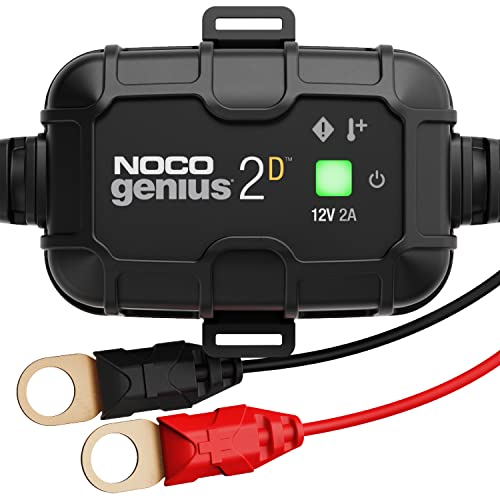
The GENIUS2D is a direct-mount, 12V onboard charger designed for lead-acid, AGM, Gel, VRLA, and deep-cycle marine batteries. It acts as a charger, maintainer, trickle charger, and desulfator in one unit. Best for: boats with one battery bank that needs reliable 2A charging directly near the battery. Caution: Mounting requires space and secure installation, which may be a task for DIY boat projects.
NOCO GEN5X2: 2-Bank 10A Onboard Charger
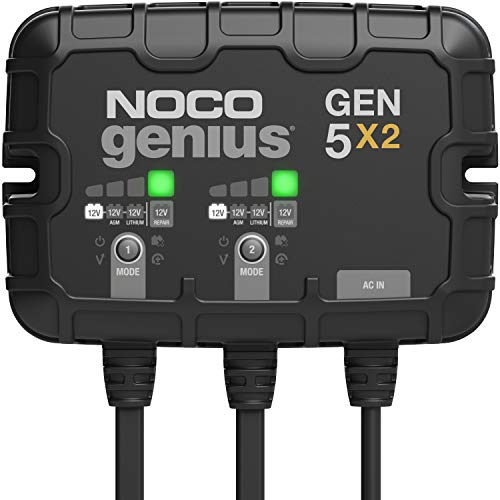
The GEN5X2 delivers 10A total with two independent banks, making it capable of handling marine, boat, starter, and deep-cycle batteries. It features selectable modes for 12V, 12V AGM, 12V Lithium, and Repair Mode. Best for: boats with multiple battery types or larger systems. Caution: More complex setup than single-bank units; ensure proper wiring and mounting for marine use.
Battery Tender Junior 12V 750mA

The Battery Tender Junior provides a full charge and then floats to maintain 12V across powersports batteries. It supports a 4-step charging program and includes a 12-foot output cord, fused-ring harness, and standard accessories. Best for: motorcycles, ATVs, and small boats with limited space seeking a compact maintainer. Caution: 750mA output is modest for larger marine batteries or high-demand cycles.
Battery Tender Plus 2 Bank Multibank Charger
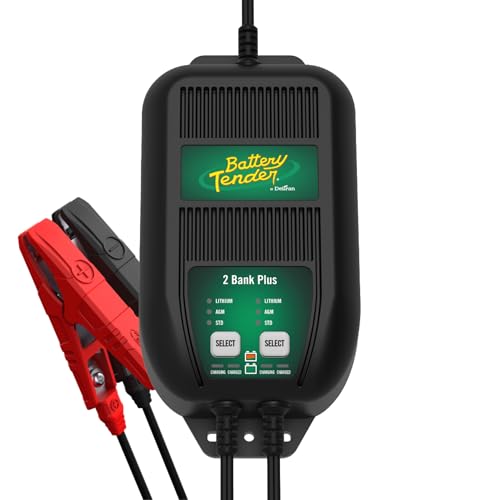
This two-bank charger provides two independent charging stations at 1.25A per bank, with temperature compensation and a complete 3-step charging program. Best for: boats with two common battery banks needing synchronized maintenance. Caution: Limited to 1.25A per bank; may be slower for large or deeply discharged batteries.
Buying Guide
Key questions to choose the right marine battery tender:
- How many battery banks does your boat have? If one, a single-bank unit like GENIUS2D or GENIUS1 may suffice. For two banks, consider GEN5X2 or Battery Tender Plus 2 Bank.
- What battery chemistries do you use? Most NOCO units support lead-acid variants and lithium, but verify compatibility with LiFePO4 if applicable.
- What is the expected charging speed? Higher amperage per bank charges faster but may require more installation space and a sturdier mounting solution.
- Where will the charger be mounted? Direct-mount onboard units save space but require secure installation in a vibration-prone marine environment.
- Is IP rating or water exposure a concern? Marine use often benefits from sealed, weather-resistant designs like IP68-rated models.
- What accessories are included? Look for fused connections, ring terminals, and long output cords to reach hard-to-access batteries.
Practical considerations
- Thermal management: Temperature compensation helps prevent overcharging in heat and undercharging in cold weather.
- Desulfation and maintenance modes: Useful for extending the life of lead-acid batteries.
- Mounting and wiring: Ensure there is clearance and that the mounting surface can support a marine-grade charger.
- Warranty and support: Longer warranties and robust customer support add value for boat owners with 24/7 reliance on electrical systems.
FAQ
- Q: Do I need a multi-bank charger for a small boat? A: If you have two or more batteries that you want to maintain independently, a multi-bank charger offers synchronization and individual management. For a single battery, a compact single-bank unit is usually sufficient.
- Q: Can I use a 12V battery tender on LiFePO4 batteries? A: Yes, many modern tenders support LiFePO4, but confirm battery type compatibility in the product specs before use.
- Q: What is “Float Mode” and why is it important? A: Float Mode maintains the battery at a safe, full charge without overcharging, which is essential for long-term storage on boats.
- Q: Is mounting near the engine a problem? A: Mount away from heat sources and moisture, and ensure proper insulation and vibration resistance for marine environments.
- Q: How do I know which amperage to choose? A: Larger batteries or frequent disconnections may benefit from higher amperage; smaller, lightweight systems may be fine with 1A–2A units.
- Q: Are these chargers safe for marine use? A: All listed models are designed for vehicles or boats and include safety features like reverse polarity protection and overcharge protection.