Best Yacht Battery Management System Options for Safe, Reliable Power
When choosing a yacht battery management system, the goal is reliable, automatic control that protects batteries and ensures you have essential power on deck and in the cabin. The top selections below are built for boaters who want dependable dual-battery or multi-battery management with automatic charging, easy isolation, and emergency parallel capabilities. This guide highlights who each product is best for, why it was selected, and practical limits to know before purchasing.
| Product | Best For | Key Benefit |
|---|---|---|
| Blue Sea Systems Mini Add-A-Battery Kit 65A Dual Circuit Battery Management System, 7649 | Compact dual-bank setups on smaller boats | Automatic charging relay and emergency parallel function |
| Blue Sea Systems Add-A-Battery Kit 120A Dual Circuit System, 7650 | More robust power management for larger yachts | Higher current capacity, maintains distribution with emergency parallel |
| Blue Sea Systems 8690 e-Series Dual Battery Bank Management Panel | Integrated panel control for established boat electricals | Streamlined dual-bank monitoring with compact packaging |
| Blue Sea Systems Traditional Metal Dual Bank Battery Management Panel | Durable, retro-style installations on classic boats | Isolates engine from house circuit with durable switches |
| Blue Sea Systems 8686 Panel DC Battery Management | Versatile DC panel for DIY upgrades | Clear DIY-friendly DC battery management interface |
Blue Sea Systems Mini Add-A-Battery Kit 65A

Best for compact dual-bank installations on smaller boats or sailboats. This kit includes an Automatic Charging Relay that senses charge voltage, combining batteries during charging and isolating at rest for better battery longevity. The MINI DUAL CIRCUIT PLUS SWITCH allows independent control of starter and house banks, making it suitable for tight engine rooms where space is at a premium. The emergency parallel function links batteries when needed, enabling engine starting if one battery is discharged. A limitation is lower current capacity, which may not suit high-draw systems or larger vessels.
Blue Sea Systems Add-A-Battery Kit 120A Dual Circuit

Best for larger boats or systems with higher amp draw, offering a 120A automatic charging relay and dual-circuit management. It maintains power distribution between starter and house banks while protecting reserve capacity. The emergency parallel function can supply engine starting if a battery is discharged. This is a solid pick when you need more output and robust switching, but it’s larger and may require more installation planning than lighter-duty kits.
Blue Sea Systems 8690 e-Series Dual Battery Bank Management Panel
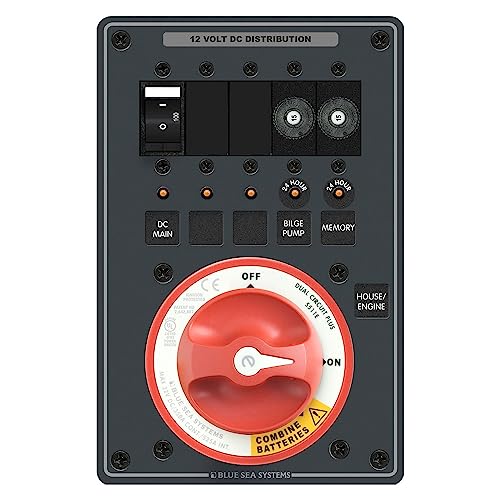
Best for integrated onboard monitoring with a compact footprint. The e-Series panel provides a streamlined solution for dual-battery management in modern boats, focusing on easy readability and convenient control. It’s suitable for boaters seeking a clean, modern interface. A potential limitation is that it requires compatible accessories and wiring layouts, so plan for an appropriate installation environment.
Blue Sea Systems Traditional Metal Dual Bank Panel

Best for durability and rugged installations on classic yachts. This metal dual-bank panel isolates the engine circuit from the house circuit and uses ON-OFF Contura switches for reliable performance in demanding environments. Its traditional build suits boats where a proven, heavy-duty interface is preferred. A caveat is that it may require more manual operation and does not include advanced digital monitoring features found in newer models.
Blue Sea Systems 8686 Panel DC Battery Management

Best for versatile DC panel upgrades on a wide range of boats. The 8686 panel provides a straightforward DC battery management interface, making it a practical choice for DIY upgrades or retrofits. It’s important to verify compatibility with existing wiring and battery configurations, as some installations may require adapters or additional components. A potential limitation is that it may rely on separate indicators or meters for full visibility, depending on the setup.
Buying Guide: Key Considerations for Yacht Battery Management
- Current capacity vs. vessel size: Match kit amperage to your boat’s total electrical load and engine starting requirements.
- Relay behavior: Look for Automatic Charging Relay features that automatically link and isolate banks to optimize charging.
- Emergency parallel function: Essential for engine starting if a primary battery fails; confirm how it engages and any safety interlocks.
- Physical footprint and mounting: Consider space in the electrical locker and the ease of wiring, especially for retrofits on older boats.
- Monitoring and control: Decide between integrated panels (e-Series, traditional metal) and more basic setups based on how much visibility you want into battery status.
- Compatibility: Check if the system supports your battery type (lead-acid, AGM, gel) and your boat’s electrical configuration (starter vs. house banks).
- Installation complexity: Some kits require professional installation; others suit confident DIY boat owners with standard wiring skills.
Frequently Asked Questions
- What is a Dual Circuit Battery Management System?
It manages two separate battery banks (starter and house) using a common charging source, with independent switching and, often, an emergency parallel feature. - What does an Automatic Charging Relay do on a yacht system?
It senses charging voltage and automatically connects or isolates battery banks to optimize charging and prevent unnecessary discharge. - Why would I need an emergency parallel function?
It provides a way to start the engine if one battery is discharged, improving reliability during emergencies or long trips. - Is a higher current kit always better?
Not necessarily. It should match your boat’s load, including inverters, pumps, and electronics. Oversizing can add unnecessary complexity and cost. - Can I retrofit any panel to my existing system?
Retrofit feasibility depends on wiring, space, and battery type; some panels integrate easily, while others require planning and additional components. - Do these systems support solar charging?
Some setups can be integrated with solar controllers; verify compatibility with your battery management kit and solar charges.