Best Water Separator for Boat Fuel Systems: Top Marine Fuel Water Separators of 2026
Direct answer: for reliable protection of your boat’s fuel system, choose a 10-micron or similar high-efficiency fuel water separator designed for universal marine use, with 3/8″ NPT ports or compatible fittings. This guide highlights five proven options and explains which boat owners should choose each one. Ideal buyers include outboard motor owners, sailboats, and small to mid-size powerboats seeking water protection, easy installation, and straightforward maintenance.
Summary table of selected products
| Product | Best For | Key Benefit | Port Fit |
|---|---|---|---|
| TRSCJXN S3213 Marine Fuel Water Separator Kit | General outdoor powerboats seeking universal compatibility | 10-micron filtration with water separation; compatible across multiple brands | 3/8″ NPT |
| Quicksilver 802893Q01 Water Separator | Mercury/Mariner engines requiring OEM-style filtration | 25-micron element with OEM-spec construction | Standard fuel line fittings |
| R12T Marine Fuel Water Separator Kit | Gasoline and diesel outboards needing easy draining | Spin-on design with self-draining valve | M18×1.5 center thread / NPT options |
| CARMOCAR Replacement Water Separator | Mercury-and-Yamaha compatible engines on a budget | 10-micron filtration with broad compatibility | 3/8″ NPT ports |
| Attwood 11840-7 Universal Kit | All 2/4-cycle marine engines needing a complete kit | Includes bracket and brass fittings | 3/8″ NPT ports |
TRSCJXN S3213 Marine Fuel Water Separator Kit

Best for universal compatibility and broad engine support. This kit lists fitment with Yamaha, Mercury, Racor, Sierra, and Suzuki outboards, plus other unleaded marine engines. The 3/8″ NPT ports enable smooth fuel flow with reduced pressure drop, while the 10-micron filter captures fine particulates and water. It replaces Mercury part numbers and several Mercury/Yamaha references, making it a versatile replacement option for many systems.
- Best for: boaters with mixed-brand engines or when a single kit must fit multiple units.
- Limitations: Some users may prefer a dedicated OEM filter for a single engine brand.
Quicksilver 802893Q01 Water Separator Filter
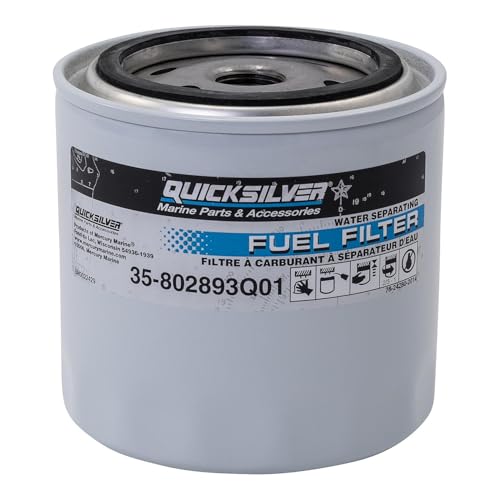
Best for Mercury and Mariner engines that require OEM-aligned filtration. This filter uses a 25-micron element designed to remove fuel-borne contaminants and meet Mercury Marine OEM specifications. It is particularly suitable for engines where OEM compatibility is prioritized, helping protect fuel injectors and pumps from damage caused by contaminants.
- Limitations: 25-micron rating may be less protective against very fine contaminants compared with 10-micron options.
R12T Marine Fuel Water Separator Kit

Best for easy draining and quick check of fuel condition. The R12T kit uses a spin-on design with a reusable clear nylon bowl and self-draining valve, enabling quick water drainage without full disassembly. This design helps boaters monitor moisture and sediment at a glance and maintain efficient fuel flow.
- Limitations: Some installations may require additional adapters depending on existing plumbing.
CARMOCAR Replacement Water Separator

Best for a broad compatibility range at a reasonable price. This replacement targets Mercury and Yamaha references and includes 3/8″ NPT ports. The 10-micron filtration captures small particles and emulsified water, helping maintain cleaner fuel and reduce potential engine damage over time.
- Limitations: The product listing emphasizes replacement parts; verify exact fit for your model before purchasing.
Attwood 11840-7 Universal Kit
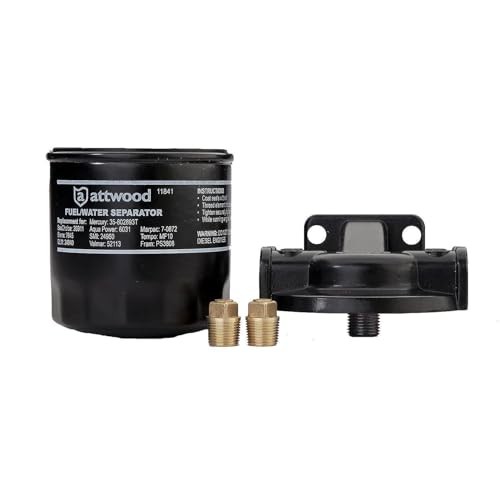
Best for a complete installation package. This Attwood kit includes a 10-micron filter, a corrosion-resistant mounting bracket, and brass fittings. It is designed to work across many two- and four-cycle engines, including outboards and inboards, making it a straightforward option for builders seeking a plug-and-play solution.
- Limitations: Universal kits may require additional adapters for specific engine brands or configurations.
Buying Guide: How To Choose The Right Fuel Water Separator
Key considerations help buyers select a separator that fits their boat and engine needs. Use these practical questions to compare options.
- What engine type do I own? Outboard, inboard, diesel, or gasoline? Some filters are tuned for certain brands; others are universal.
- What micron rating do I need? A 10-micron element provides stronger filtration but may slightly reduce flow; a 25-micron element offers higher flow with lighter filtration.
- What port size is required? Common configurations use 3/8″ NPT or 1/4″ NPT; verify compatibility with your fuel line fittings.
- Is a drain or clear bowl important? A spin-on design with a drain or a clear bowl helps you inspect water content and drain water when needed.
- Do you need an all-in-one kit? Some options include brackets and brass fittings for easier installation; others are bare filters requiring separate mounting hardware.
- Maintenance considerations: How easy is it to replace the filter element, and how available are replacement parts for your engine brand?
- Price-to-protection balance: Higher micron filtration provides cleaner fuel but may incur a slight pressure drop; balance with engine sensitivity to fuel contaminants.
Frequently Asked Questions
- What does a fuel water separator do? It removes water and particulates from fuel to protect engines and fuel systems from corrosion and damage.
- Are universal separators compatible with all engines? Many universal models fit multiple brands, but always confirm port sizes and thread types before purchasing.
- Is a 10-micron separator better than a 25-micron one? Generally, 10 microns offer finer filtration and better protection, but may slightly reduce fuel flow; 25 microns allow faster flow with less filtration.
- Can I drain water without removing the filter? Some designs feature a self-draining valve or a clear bowl for quick water removal.
- Do I need a mounting bracket? Several kits include brackets, which simplifies installation; if not, you may need a separate bracket that fits your mounting space.
- How often should I change the filter element? Replace according to engine manufacturer guidance or when you notice water separation, reduced fuel flow, or contaminated fuel signals.