Best VHF Marine Radios With Built-in GPS for Safe Coastal Navigation
If you need a VHF marine radio with built-in GPS, you’re looking for reliable, location-aware communication on the water. These devices combine standard VHF channels, distress capabilities, and GPS for rapid location sharing. This guide highlights five top options suitable for different boaters—from weekend anglers to coastal cruisers—explaining who each is best for and why. A quick buyer’s table follows to help you compare at a glance.
Product Comparison Table
| Product | Best For | Key Benefit | Limitations |
|---|---|---|---|
| Uniden UM725GBT Marine VHF Radio | All-around maritime use with smartphone Bluetooth | Built-in GPS, Bluetooth to connect smartphone, NOAA weather | Some users may prefer handheld for portability |
| Cobra MR F77W GPS Fixed Mount VHF Marine Radio | Coastal cruisers needing broad coverage | Built-in GPS, dual 1/25W output, weather and signal meter | Fixed-mount design; less portable than handhelds |
| Uniden UM725G Marine VHF Radio | US/Canada/intl channel access with GPS features | Largest LCD, built-in GPS, SMS-style text messaging | Higher feature set may be overkill for some users |
| Uniden MHS338BT Floating Handheld Marine VHF Radio | Kayakers, dinghies, or small craft needing portability | IPX8 submersible, GPS, Bluetooth, emergency strobe | Limited power compared to fixed mounts |
| Retevis RM40 Marine Radio with GPS | Budget-friendly GPS-enabled handheld | IP67, built-in GPS, DSC, NOAA Alerts | May have fewer premium features than top brands |
Uniden UM725GBT Marine VHF Radio

The Uniden UM725GBT offers built-in GPS for location sharing and DSC distress. It also includes Bluetooth to connect a smartphone, IPX8 waterproofing, NOAA weather channels with alerts, and a speaker microphone. This model supports NMEA0183/NMEA2000 input and output for GPS and DSC data sharing. Best for boaters who want phone integration and robust weather updates alongside reliable VHF capability.
Who it’s best for: Averse to missing emergency signals and who wants smartphone connectivity for quick messages. Why selected: Combines modern connectivity with strong safety features and broad channel coverage.
Caution: Advanced features rely on proper wiring and compatible accessories; verify NMEA networks before deployment.
Cobra MR F77W GPS Fixed Mount VHF Marine Radio
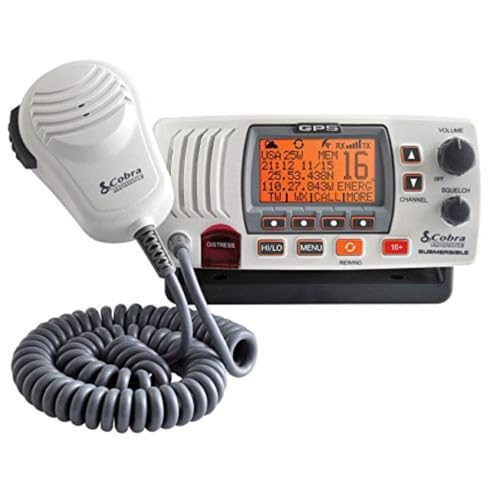
This fixed-mount radio includes a built-in GPS receiver and operates on US, Canada, and international channels, with optional 1W or 25W output for flexible range. It features a noise-cancelling microphone, NOAA weather, and a signal strength meter. The rewind feature stores the last 20 seconds of audio, helping you capture important transmissions in noisy conditions.
Who it’s best for: Coastal sailors and cruisers needing dependable international coverage and easy-to-read status indicators. Why selected: Strong safety tools and clear display suit mid- to long-range communication needs.
Caution: Fixed-mount installation requires proper space and mounting hardware; plan routing of power and antenna cabling carefully.
Uniden UM725G Marine VHF Radio

The UM725G emphasizes GPS integration and a large LCD screen for easy status reading. It supports all major US/Canada/intl channels with dual 1/25W output. Notable features include IPX8 submersible protection and DSC distress functions. It’s notable for text-messaging-style boat-to-boat private messages in addition to standard voice calls.
Who it’s best for: Crew seeking enhanced navigation visibility and private communication. Why selected: Combines large display with GPS and modern message capabilities for clear situational awareness.
Caution: Private messaging feature requires compatible devices; ensure other radios support this protocol in your area.
Uniden MHS338BT Floating Handheld Marine VHF Radio

This floating handheld packs GPS, Bluetooth, and NOAA weather alerts into a compact, rugged, IPX8-rated shell. It includes a charging cradle and Li-ion battery, plus a water-activated emergency strobe and flashlight. It supports multiple power settings from 1W to 6W to balance range and battery life.
Who it’s best for: Small boats, kayaks, or as a backup on larger vessels. Why selected: Versatile, portable, and highly visible in emergencies; excellent for mobile setups.
Caution: Handheld radios generally have shorter range than fixed-mount units; rely on GPS and DSC for critical distress signaling if far from shore.
Retevis RM40 Marine Radio With GPS

The RM40 offers built-in GPS, DSC distress, and NOAA weather alerts in a compact handheld form with IP67 waterproofing. It supports international channels and includes a 1500mAh battery. It emphasizes real-time GPS positioning and MOB features for quick rescue coordination.
Who it’s best for: Budget-conscious boaters who still want GPS-enabled DSC and weather alerts. Why selected: Strong feature set at a competitive price with robust durability.
Caution: Cheaper models may lack some advanced integrations; verify DSC and GPS accuracy in your operating waters.
Buying Guide: VHF Radios With Built-In GPS
What to consider when choosing
- GPS integration: Look for built-in GPS with reliable positioning and data sharing (NMEA) capability to coordinate distress and location updates.
- Power and output: Fixed-mount units often offer 25W for longer range; handhelds provide 1W–6W with lower range but higher portability.
- Waterproofing and durability: IP ratings matter for saltwater environments; IPX8 is fully submersible for handheld models.
- Weather features: NOAA weather channels and alerts help with proactive storm planning and safety.
- DSC and emergency features: DSC allows distress signaling and automated location sharing; verify compatibility with other vessels and coast guard systems.
- Display readability: Large LCDs improve readability in bright sunlight; consider backlighting and font size.
- Connectivity: Bluetooth or smartphone integration adds convenience for text-like messaging or app-based configuration, but ensure it doesn’t interfere with critical radio functions.
- Power source and battery life: For handhelds, assess battery capacity and charging options; fixed mounts rely on vessel power systems.
- Channel coverage: Ensure the radio covers US, Canada, and international channels if you cruise abroad.—or prioritize the regions you frequent.
Which type suits your boating style?
Fixed-mount radios with GPS deliver robust range and long-term reliability for coastal and offshore sailors who favor permanent installation. Handheld models with GPS are ideal as backups or for small craft and dinghies where mobility is critical. For multi-boat crew operations, radios with Bluetooth and text-style messaging offer practical communication enhancements without broadcasting to all nearby boats.
Important setup reminders
- Mounting: Ensure secure installation away from engine heat and vibration zones; route antenna and power cables properly.
- Antenna: A higher antenna improves range; consult your dealer about optimal height for local waters.
- Power: Use proper fuses and marine-grade wiring; verify on-deck power sources to avoid drain during long trips.
Frequently asked questions
- What is DSC and why is it important? DSC provides distress signaling and positional data for rapid rescue coordination.
- Do I need GPS on a VHF radio? Built-in GPS speeds distress signaling and enables location sharing for emergencies and navigation features.
- Are handheld VHF radios reliable for offshore use? Handhelds are excellent backups with GPS and weather alerts, but fixed-mount units typically offer greater range and battery life.
- Can I use Bluetooth with a VHF radio? Bluetooth can enable phone integration and app-based setup, but ensure it doesn’t interfere with essential communications.
- Which radios cover international channels? Some models explicitly offer US/Canada/intl channel coverage—check channel lists for your cruising regions.
- What should I consider for weather alerts? NOAA weather alerts keep you informed about storms and warnings, improving onboard safety planning.