Best Trickling Chargers for Marine Batteries: Reliable Boatside Power Maintenance
Answering the common question “which trickle charger marine battery should I buy?” this guide highlights five dependable options that keep 12V and 6V marine batteries topped off without overcharging. Each choice suits different setups—from small maintenance-only units to multi-bank onboard chargers. For boaters, anglers, and RVers who store craft for extended periods, these chargers offer temperature compensation, desulfation, and safe, automatic maintenance. The summary table below helps you compare core features at a glance.

| Product | Best For | Voltage/Banks | Key Benefit |
|---|---|---|---|
| NOCO GENIUS1 | Small boats, maintenance for single battery | 6V/12V | Compact, versatile maintainer with desulfator |
| NOCO GENIUS2 | Portable on-board use or garage setups | 6V/12V | Newest generation, efficient and flexible |
| NOCO GENIUS2D | Direct-mount onboard charging | 12V | Direct-mount design for easy installation |
| NOCO GENIUS5 | Two-battery or larger 12V systems | 6V/12V | Higher power in a compact package |
| NEXPEAK NC201 | All-purpose maintainer with display | 12V | LCD feedback and versatile 7-stage charging |
NOCO GENIUS1: 1A 6V/12V Smart Charger
Best for small craft and tight spaces. The GENIUS1 combines a battery charger, maintainer, trickle charger, and desulfator in one unit. It supports 6V and 12V lead-acid chemistries plus LiFePO4 batteries, making it suitable for boats with mixed battery types. Its integrated thermal sensor adjusts charging to ambient temperature, helping prevent overcharge in hot weather and undercharge in cold weather. This model is ideal for tense winter storage or summer boat use where a lightweight, all-in-one solution is preferred.
Who it’s best for: boat owners with one or two batteries, space-constrained engine bays, or those who want a single device handling charging and maintenance. Why selected: compact, versatile, and designed to protect batteries from common maintenance risks.
Limitation: as a 1A charger, charging speed is slow for larger deep-cycle batteries or when reviving very discharged packs.
NOCO GENIUS2D: 2A 12V Onboard Charger
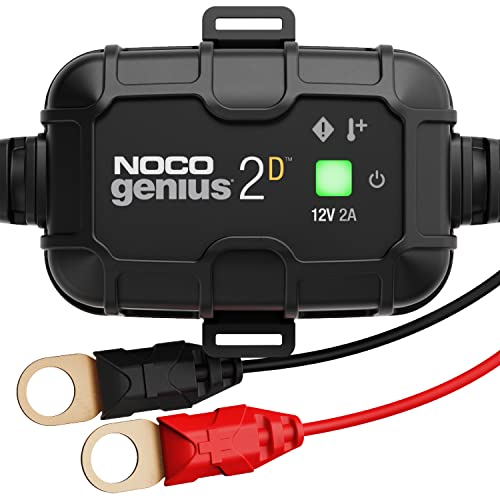
Best for integrated marine installations requiring a direct-mount solution. The GENIUS2D is designed to mount near the battery with a durable bracket, making it a practical onboard charger for boats with accessible mounting surfaces. It supports 12-volt lead-acid batteries, including flooded, maintenance-free, deep-cycle, marine, and RV systems. The direct-mount design reduces clutter and provides a tidy, reliable charging setup. Choose this if you want a dedicated onboard unit that stays close to the battery bank.
Who it’s best for: boat owners seeking an easy-to-install, near-battery charger. Why selected: robust onboard mounting and straightforward operation for marine applications.
Limitation: installation requires appropriate mounting space and hardware; not ideal for temporary or portable charging needs.
NOCO GEN5X2: 2-Bank 10A Onboard Charger
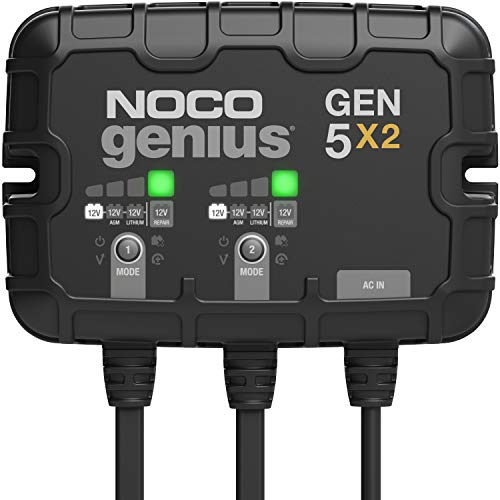
Best for bigger systems or multiple battery banks. The GEN5X2 provides two independently controlled banks at a total of 10 amps (5A per bank). It is designed for 12V lead-acid and lithium batteries and includes selectable modes for 12V, 12V AGM, 12V Lithium, and a Repair Mode. This unit suits boats with separate starting and deep-cycle batteries or multi-bank configurations where precise management is required. It is compact for a two-bank solution and engineered to cope with harsh marine environments.
Who it’s best for: boats with two separate battery banks or needing individualized charging per bank. Why selected: higher power with independent control helps maximize battery life and performance.
Limitation: higher cost and a bit more complex installation compared to single-bank models.
NEXPEAK NC201: 10-Amp Battery Charger and Maintainer

Best for a versatile, all-around maintainer with a user-friendly display. The NC201 delivers 10 amps total in a single device with 7-stage charging and a Desulfation function. It supports 12V lead-acid and lithium batteries, including marine and deep-cycle variants. The LCD screen clearly shows charging status, percentage, voltage, and current. This model offers a balance of speed, intelligence, and feedback—helpful for users who want transparency during charging.
Who it’s best for: users who value visible charging progress and a multi-stage program. Why selected: includes LCD feedback and comprehensive protections to safeguard batteries during long-term maintenance.
Limitation: may be overkill for very small battery banks or minimal maintenance needs.
Buying Guide
What to consider when choosing a marine battery trickle charger
- Battery type compatibility: Ensure the charger supports lead-acid variants (AGM, Gel, Flooded) and LiFePO4 if you use lithium batteries.
- Bank configuration: Single-bank vs multi-bank units; match to the number of batteries and whether you need independent charging per bank.
- Charge current: For small batteries, 1-2A may suffice; for deep-cycle or larger systems, 5-10A is more efficient.
- Temperature compensation: Prevents overcharge in heat and undercharge in cold, protecting battery health.
- Onboard mounting vs portable: Onboard units save space but require installation; portable units are flexible for different boats.
- Desulfation and maintenance features: Helpful for extending cycle life, especially for boats stored or seldom used.
- Protection features: Look for overcharge, short-circuit, reverse polarity, and fireproof protections for safety.
Frequently Asked Questions
- What is a trickle charger for marine batteries?
A trickle charger is a low-current charger designed to maintain a battery at full charge over extended periods, especially useful when a boat is stored between seasons.
- Can I use a car battery charger on a boat battery?
Yes, if the charger supports the same voltage (12V or 6V) and appropriate battery chemistries. Confirm compatibility with marine and deep-cycle batteries.
- Should I choose a single-bank or two-bank charger for a boat?
Choose a single-bank unit for a single battery or simple setup. A two-bank charger is better for boats with separate starting and deep-cycle batteries or multiple banks needing independent control.
- Is temperature compensation necessary?
Yes. Temperature compensation reduces the risk of battery damage by adjusting charge based on ambient temperature, improving long-term health.
- What maintenance features matter most?
Desulfation, float charging, and automatic shutoff prevent overcharging while maintaining readiness for next voyage.
- Do onboard chargers require professional installation?
Some onboard models may require basic electrical work and mounting hardware. Follow manufacturer guidelines or hire a qualified technician if unsure.