Best Trickle Charge Boat Battery Solutions for 12V and 6V Systems
Looking for a reliable trickle charger to maintain a boat battery without overcharging? This guide highlights five top options that are well-suited for marine use, including lead-acid variants (AGM, Gel, SLA, VRLA) and some compatible lithium packs. Each product is chosen for ease of use, safety features, and effectiveness in marine environments. Best for boat owners who store boats seasonally or need a simple maintenance charger while afloat or ashore.
Buyer’s quick reference table
| Product | Best For | Key Feature | Limitations |
|---|---|---|---|
| NOCO GENIUS1 | Small craft and shore-side maintenance | 1A, temperature compensation, desulfator | Limited for larger depleted batteries |
| NOCO GENIUS2D | Onboard charging near the battery | Direct-mount design, 2A | Requires mounting space |
| Unocho 6V/12V | General boats, lawn equipment, and ATVs | 5-stage smart charging | Manual placement needs |
| MOTOPOWER MP00205A | All-weather maintenance | Desulfator, automatic detection | Limited to 12V |
| POWOXI Solar Charger | Solar-powered maintenance | 7.5W solar with smart protection | Dependence on sun availability |
NOCO GENIUS1: 1A 6V/12V Smart Battery Charger

The GENIUS1 is a compact, all-in-one charging solution designed for 6-volt and 12-volt lead-acid and lithium-ion batteries, including AGM, Gel, and LiFePO4 varieties. It acts as a battery charger, maintainer, trickle charger, and desulfator, with overcharge protection and a temperature sensor for precise charging. Best for small boats or shore-side battery upkeep where space is limited and a simple, automatic routine is preferred.
- Best for: Boat owners needing a compact, automatic maintainer for shore storage or gullwing deckside setups.
- Why selected: 1A charging profile is gentle, reducing risk of overcharging on smaller batteries common in trolling motors and marine accessories.
- Caution: Slower charging rate may not rapidly recover deeply discharged batteries.
NOCO GENIUS2D: 2A 12V Smart Onboard Charger
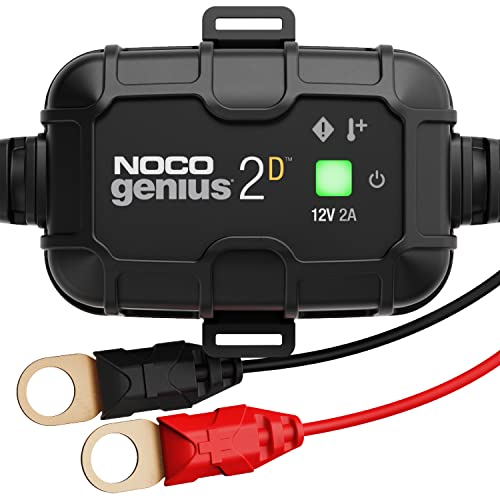
The GENIUS2D is intended for direct-mount installation near the boat battery, delivering a higher 2A charging solution for 12-volt lead-acid batteries. It combines charger, maintainer, trickle charger, and desulfator into a single unit with temperature compensation and overcharge protection. Best for boats with accessible engine bays or interior compartments where an onboard charger is preferred.
- Best for: Boats that can accommodate a fixed charger near the battery bay and require faster maintenance charging.
- Why selected: Direct-mount design reduces cabling clutter and ensures consistent charging for one or two marine batteries.
- Caution: Onboard installation requires proper mounting and weatherproofing in harsher marine environments.
Unocho 6V/12V Battery Charger Maintainer

Unocho offers a 1.5A automatic trickle charger with 6V/12V compatibility and a five-stage charging cycle. It supports a wide range of lead-acid chemistries and is designed for cars, boats, motorcycles, and lawn equipment. Best for owners who need a versatile charger that can serve multiple small- to mid-sized marine batteries at a time.
- Best for: Multi-vehicle or multi-battery setups on boats without swapping chargers.
- Why selected: Five-stage charging helps prevent overcharging and extends battery life with regular use.
- Caution: Some users may require longer cables for reach on larger boats.
MOTOPOWER MP00205A 12V 800mA Charger

The MP00205A functions as a charger, maintainer, trickle charger, and desulfator for 12-volt lead-acid batteries, with automatic sulfation detection and a desulfation cycle. It’s suitable for marine batteries that often sit idle for extended periods. Best for boats needing a standalone, weather-resistant maintenance device.
- Best for: Boats that require a robust desulfation cycle to recover aging batteries.
- Why selected: Automatic sulfation detection helps optimize battery performance during maintenance.
- Caution: Limited to 12V, so users with 6V systems should choose a different model.
POWOXI Upgraded Solar Trickle Charger
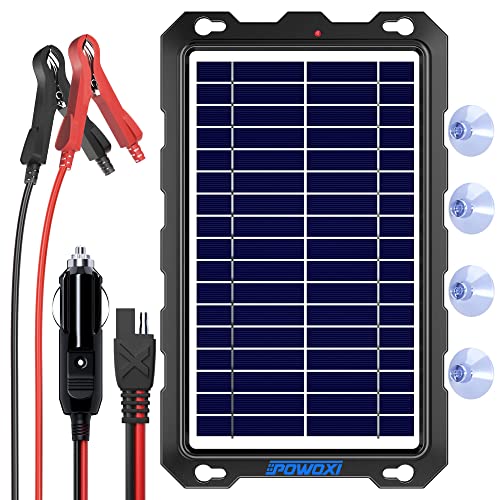
The POWOXI 7.5W solar charger provides solar-based trickle charging with a built-in protection system and MPPT-like smart behavior. It’s designed for boats, cars, and marine applications where sunlight is the primary charging source. Best for long-term marina storage or remote docking where shore power isn’t readily available.
- Best for: Solar-powered maintenance in sunny marinas or off-grid conditions.
- Why selected: High energy conversion efficiency and protective features help avoid overcharging in bright conditions.
- Caution: Solar charging depends on weather and sun exposure; plan for limited charging on cloudy days.
2-Bank, 4A Trickle Charger (FirstPower Pro)

This compact two-bank charger delivers a total of 4A with 2A per bank, allowing simultaneous charging of multiple 6V or 12V batteries. It also supports a wide range of chemistries, including lithium, and includes a battery restoration mode for aging packs. Best for boaters with multiple batteries or seasonal storage needs.
- Best for: Boats with two batteries that require independent maintenance cycles.
- Why selected: Dual-bank capability helps manage separate circuits or trolling motor/bilge batteries efficiently.
- Caution: Check compatibility with lithium packs in advance; verify bank isolation for maintenance tasks.
Buying Guide: Key Considerations for Trickle Chargers on Boats
- Battery chemistry compatibility: Ensure the charger supports your battery type (lead-acid variants or LiFePO4). Marine batteries vary significantly in chemistry, and using the wrong charger can damage cells.
- Voltage support: Most marine setups use 12V, but some require 6V. Choose a charger that matches your system to avoid overvoltage or undercharge.
- Charge rate and cycle complexity: For maintenance while storing a boat, a low-rate charger (1-2A) is common. If you need faster replenishment after a discharge, a higher-rate model with smart cycling can help.
- Desulfation and optimization: Desulfator features can extend the life of flooded lead-acid batteries by breaking down sulfates, but the benefit varies with battery age and type.
- Temperature compensation: Chargers with temperature sensors adjust charging based on ambient temperature, reducing overcharge risk in hot climates and undercharge risk in cold environments.
- Onboard vs. shore-based use: Onboard (direct-mount) solutions minimize cabling but require secure mounting. Shore-based keep-it-simple maintainers are portable and versatile.
- Safety and protections: Look for overcharge protection, short-circuit protection, reverse polarity, and spark-free connections to minimize risks during maintenance.
- Weather and durability: Marine environments demand moisture resistance and robust housings. Check IP ratings or waterproofing specs if exposed to spray or rain.
FAQ
- What is the difference between a trickle charger and a maintainer?
Answer: A trickle charger delivers a small, continuous current to maintain a battery, while a maintainer manages the charging cycle to keep the battery fully and safely charged over extended periods. - Can I use a car battery charger on a boat battery?
Answer: Yes, if the charger supports the same voltage and battery chemistry; verify marine compatibility and avoid high-rate charging on small or sensitive marine packs. - Is temperature compensation important for marine charging?
Answer: Yes, it helps prevent overcharging in heat and undercharging in cold, preserving battery life and performance in varying climates. - Should I install an onboard charger on my boat?
Answer: Onboard chargers are convenient for boats with accessible wiring and space near the battery; secure mounting and proper insulation are essential for durability. - What maintenance is required for solar trickle chargers?
Answer: Keep lenses clean, ensure connectors are dry, and confirm the panel is oriented for optimal sun exposure; solar chargers provide maintenance charging when sunlight is available. - Can one charger serve multiple batteries?
Answer: Some models offer multi-bank outputs; ensure the charger supports the total combined capacity and compatible chemistry for all connected batteries.