Best Topsides Paint for Fiberglass Boats: Durable Marine Coatings
For fiberglass boats, choosing the right topside paint means prioritizing adhesion, weather resistance, and an easy application. This guide highlights five top options that are well-suited for above-waterline use on fiberglass, wood, or metal surfaces. Best for DIY boat owners, pros applying quick touch-ups, and sailors maintaining hulls, these selections balance durability with ease of use. Read on to compare finishes, application methods, and practical limitations to help you decide which is right for your craft.
| Product | Material Note | Best For |
|---|---|---|
| Rust-Oleum Marine Coatings Topside Paint (Quart, White) | Oil-based, flexible, fast-drying | Everyday ledges and decks; above-waterline surfaces |
| TotalBoat Wet Edge Topside (Quart, White) | Polyurethane, high-gloss, durable | High-visibility hull work; multi-season gloss retention |
| TotalBoat Marine Topside Primer (White) | One-part primer for undercoat | Foundation for 1-part and 2-part paints |
| TotalBoat Wet Edge Topside (Gallon, White) | Polyurethane, high-gloss, durable | Larger projects; superior gloss and scratch resistance |
| Rust-Oleum Marine Coatings Topside Paint (Quart, Semi-Gloss White) | Oil-based, flexible, quick-dry | Bilges and transoms; quick repair jobs |
Rust-Oleum Marine Coatings Topside Paint, Quart, White

Best for: DIY boaters seeking a versatile, above-waterline finish on fiberglass, wood, or metal surfaces. The oil-based formula offers good leveling and flexibility, helping to resist cracking with movement. The finish dries to the touch quickly, typically within 1–2 hours, and covers up to 100 sq ft per quart. Choose this for straightforward touch-ups or when a simple, reliable white topside is needed. Caution: oil-based paints require proper ventilation and cleanup with mineral spirits; ensure compatibility with existing coatings on the hull.
TotalBoat Wet Edge Topside Marine Paint Premium (Quart, White)

Best for: Boat owners who want a durable, high-gloss marine finish with strong color and gloss retention. Wet Edge is a 1-part polyurethane designed for above-waterline use, and it can be rolled, brushed, or sprayed for flexibility. It resists fading, cracks, and peeling, making it suitable for multi-season hulls, doors, and trim. Limitation: as a premium coating, include proper surface preparation and ventilation during application.
TotalBoat Marine Topside Primer for Fiberglass and Wood (White)

Best for: Priming bare fiberglass or wood before applying topside paint. This one-part primer provides a durable, flexible undercoat compatible with 1-part and 2-part polyurethane and enamel marine topside paints. It covers in a single thin coat, with a second coat only if higher build is needed. Choose this primer to seal surfaces and smooth imperfections before topcoating. Caution: avoid applying over severely degraded surfaces without fairing or repair first.
TotalBoat Marine Topside Primer for Fiberglass and Wood (White, Quart)
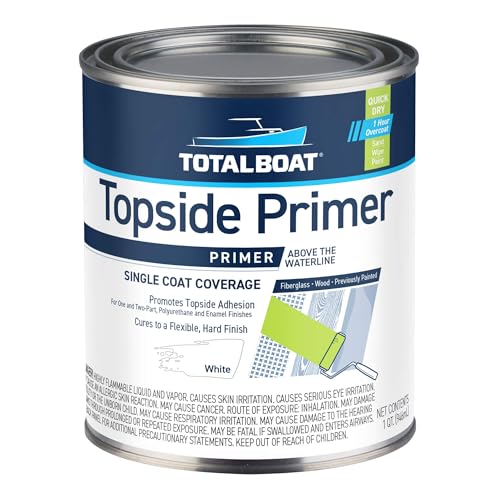
Best for: Small to medium projects that require a solid undercoat on fiberglass, wood, gelcoat, or previously painted surfaces in good condition. This one-part primer is designed for easy brushing, rolling, or spraying, and it seals with one thin coat. It is chromate-free and lead-free, making it a practical choice for frequent maintenance. Limitation: ensure the substrate is clean and sound before applying to avoid bond failures.
TotalBoat Wet Edge Topside Marine Paint (Gallon, White)

Best for: Large-scale topside jobs where a high-gloss, durable finish is desired. Wet Edge in gallon form provides the same scratch- and chemical-resistance as the quart version, with more coverage per can and fewer seams. Choose this if you are refinishing a larger hull or multiple panels. Caution: larger containers require careful handling during mixing and application to avoid uneven results.
Rust-Oleum Marine Coatings Topside Paint, Quart, Semi-Gloss White

Best for: Quick repairs or projects where a semi-gloss finish is preferred. The oil-based formula remains flexible and easy to level, with a rapid 1–2 hour dry time and coverage up to 100 sq ft per quart. Best for smaller touch-ups or parts of the boat where a bit more sheen helps highlight fittings. Limitation: semi-gloss sheen may show imperfections more readily than a high-gloss finish.
Buying Guide
- Surface compatibility: Confirm the coating works above the waterline on fiberglass, wood, or metal, and identify whether a primer is necessary.
- Finish preference: Choose between high-gloss (wet edge) for aesthetics and scratch resistance, or a more subdued gloss for easier touch-ups.
- Application method: Consider whether you plan to brush, roll, or spray. Some products are easy to apply in multiple ways, while others are optimized for one method.
- Cure and maintenance: Look for paints that cure quickly, resist UV and chemicals, and maintain color with minimal cracking or fading.
- Project scale: Larger boats benefit from gallon quantities; smaller projects may be cost-efficient with quart cans.
- Safety and cleanup: Oil-based paints require solvents for cleanup and adequate ventilation. Water-based options may be easier to handle but vary in durability.
Frequently Asked Questions
- What is topside paint best used for on fiberglass boats? Above-waterline surfaces to protect against UV, water exposure, and abrasion.
- Should I use a primer with topside paint? Primers improve adhesion, seal imperfections, and create a uniform base for coatings, especially on uneven surfaces.
- What type of finish lasts longest on a fiberglass hull? High-gloss polyurethane finishes typically offer durable color and gloss retention, especially when properly applied and maintained.
- Can I repaint without sanding? Light cleaning and scuffing help improve adhesion; heavy or glossy finishes may require sanding or a specialized bonding agent.
- Is oil-based or water-based topside paint better? Oil-based paints often cure faster and level well but require solvents for cleanup; water-based options are easier to clean and generally lower in odor but may have different durability profiles.
- Do I need a clear topcoat after painting topsides? A clear topcoat can add UV protection and gloss retention for certain systems, but follow product recommendations for compatibility.