Best Thru-Hull Depth Sounders for Boats: Top Picks for Clear Depth Readings
Best thru-hull depth sounders provide reliable, continuous depth data for safety-minded boaters and anglers. This guide highlights five top options, explaining who each product is best for and why you might choose it. Whether you sail in deep waters or fish near rocky shoals, these devices help you navigate confidently. The table below offers a quick snapshot of the featured models to compare key traits at a glance.
| Product | Best For | Key Benefit |
|---|---|---|
| DepthTrax 2B Boat Mount in Dash Digital Depth Finder | All-around boaters needing a large display | Wide depth range with 2.5–600 ft readings |
| Faria 13795 Chesapeake Depth Sounder Thru-Hull | Users prioritizing readability | Oversized back-lit display |
| Faria 13751 Chesapeake Black Depth Sounder | Traditional in-hull installations | Standard gauge hole fitment |
| HawkEye DT2BX-TM In-Dash Depth Sounder | Integrated temp sensors & alarms | Transom mount transducer included |
| HawkEye DT2BX-TH In-Dash Depth Sounder (Thru Hull) | Thru-hull transducer users | Includes thru-hull transducer |
DepthTrax 2B Boat Mount In-Dash Digital Depth Finder

The DepthTrax 2B provides continuous depth readings from 2.5 to 600 feet. It features the largest display available on an in-dash depth sounder and supports readings at speeds up to 60 mph. The transducer options include a dual-mount transom setup or a glue-in transducer capable of shooting through solid fiberglass hulls and up to 1/8-inch aluminum hulls. A three-stage Advanced Warning System signals alarm conditions with an audible alert, a bright red LED, and LCD indicators for quick status checks. This model is best for boaters who want a bright, easily readable display and flexible mounting, especially on faster vessels or boats with varying hull materials. A notable limitation is that setup may require precise hull compatibility to maximize transducer performance.
- Depth range: 2.5–600 ft
- Transducer options: Dual Mount Transom or Glue-In Transducer
- Alarms: Audible, LED, and LCD indicators
Best for: Boaters needing a high-contrast, large display with versatile transducer options. Choose this if you want fast, clear depth data at higher speeds and on hulls with different construction.
Faria Beede Chesapeake Depth Sounder Thru-Hull

This model emphasizes readability with an oversized back-lit display, designed for easy viewing in various lighting conditions. It provides elevation alarms through both audio and visual cues, ensuring you’re aware of depth changes even in low-visibility scenarios. It’s a practical choice for anglers or small craft operators who value quick readability over a wide feature set. A potential limitation is that it may not include temperature sensing or more advanced transducer options found in higher-end models.
- Display: Oversized Back-lit
- Alarms: Audio and visual for depth changes
Best for: Users who prioritize a clear, easy-to-read display and reliable alerting. Avoid this if you need integrated temperature readouts or expansive transducer configurations.
Faria 13751 Chesapeake Black Depth Sounder With In-Hull Transducer

This depth sounder delivers a 1-year, 199-foot (61 m) depth capability and is designed to fit a standard 22-1/16″ gauge hole. In-hull transducer installation offers a neat, low-profile setup that minimizes snag hazards on deck. It is well-suited for boats that want a clean interior appearance and a straightforward installation. The main limitation is the shallower depth capability relative to some thru-hull or higher-end units, which may be less ideal for deep-ocean routes.
- Depth capability: 199 ft (61 m)
- Gauge hole fitting: Standard 22-1/16″
Best for: Boat owners seeking a conventional, cost-conscious in-hull installation. Choose this if you operate in moderate depths and want a simple installation with a standard gauge hole.
HawkEye DT2BX-TM In-Dash Depth Sounder With Temperature (Includes Transom Transducer)
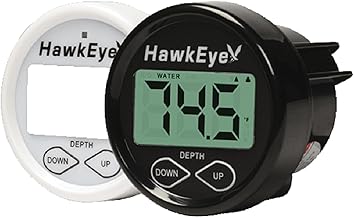
This unit offers uninterrupted depth readings from 2.5 to 600 feet on a large display, with a three-stage Advanced Warning System that includes an audible alarm, an LED indicator, and LCD readouts. It includes a transom mount temperature transducer with 30 feet of cable, providing both depth and temperature data essential for weather awareness and engine cooling considerations. Best for: boaters who need integrated temperature data and a robust alarm system. Limitation: may require careful routing of the transducer cable and secure mounting to maintain signal integrity at higher speeds.
- Depth range: 2.5–600 ft
- Includes transom temperature transducer with 30 ft cable
Best for: Users who want depth plus temperature information with strong alarm features. Choose this if you need environmental context alongside depth data.
HawkEye DT2BX-TH In-Dash Depth Sounder With Thru Hull Transducer
This model includes a through-hull transducer and provides instant depth updates, along with air and water temperature readings. The transducer requires drilling a 2″ hole in the hull, which is a consideration for installation planning and potential hull integrity checks. Best for: deeper-water operations where a through-hull installation is preferred for better signal transmission. Limitation: requires modification to hull and may be less suitable for boats that avoid penetrating the hull.
- Transducer type: Thru-Hull
- Data: Depth plus air and water temperature
Best for: Individuals ready for a thru-hull setup that prioritizes immediate depth updates and temperature sensing. Avoid this if hull modification is a constraint or if easier installation is required.
Buying Guide
What should you consider when choosing a thru-hull depth sounder? Start with depth range and transducer type. Thru-hull and transom-mounted options offer different signal strengths depending on hull material and boat speed. Display readability matters; a larger, back-lit screen reduces eye strain in low light or rough seas. Alarm capabilities help you react quickly to changing depths, especially in unfamiliar waters. Temperature sensing adds environmental context that is valuable for weather planning and engine cooling considerations. Compatibility with your boat’s hull and the available dashboard space should drive installation decisions.
Key Purchase Considerations
- Depth range and update speed: Higher speeds may require faster updates to avoid lag.
- Transducer type: Thru-hull for solid fiberglass or metal hulls; transom mount for easier installation on many boats; in-hull for a neat interior fit.
- Display size and readability: Large, back-lit displays help in rough seas or low light.
- Alarm features: Audible, LED, and LCD indicators improve situational awareness.
- Additional sensors: Temperature data (air and water) adds environmental insight.
Frequently Asked Questions
- What is a thru-hull depth sounder?
A depth sounder that uses a transducer mounted through the hull to measure water depth directly below the boat. - Do these devices require professional installation?
Some models are suitable for DIY installation, especially transom-mounted units, while thru-hull units may require drilling and sealing for hull integrity. - Can I use a depth sounder at high speeds?
Yes, many models are designed for up to 60 mph or more, but ensure your transducer and mounting are appropriate for your boat’s speed and hull type. - Is temperature data necessary for depth sounders?
Temperature readings can enhance navigation and engine cooling planning, but some models focus solely on depth. - What maintenance is needed for depth sounders?
Regularly inspect transducer seals, ensure clean transducer faces, and check connections for corrosion or wear. - Are there limitations with in-hull transducers?
In-hull installations may offer a cleaner look but can limit signal strength compared to thru-hull or transom-mount options, depending on hull construction.