Best Temperature Gauge for Outboard Motor: Top Coastal and Marine Options for Accurate Readings
The best temperature gauge for outboard motors helps boaters monitor engine coolant or water temperature to prevent overheating and maintain peak performance. This guide highlights five reliable options, explains who they’re best for, and notes practical considerations for installation and use. Ideal buyers include boat owners seeking clear nighttime visibility, multi-function monitoring, or durable marine-grade construction. Below is a quick summary table of the selected products to compare at a glance.
| Product | Best For | Notes |
|---|---|---|
| LAGWIUY Universal 2″ Water Temp Gauge | All-in-one 12V marine gauge | LED backlight for night viewing |
| Runleader Digital LCD Engine Temp Gauge | Multi-function engine monitoring | Double channel options |
| BYYOUIV 2-in-1 Water Temp & Voltage Gauge Kit | Space-saving dual sensors | Alarm function for temp and voltage |
| BREADEEP Universal 2″/52mm Water Temp Gauge | Durable marine-ready unit | LED illumination and 12V DC |
| POCREATION 52mm Water Temperature Gauge with LED Display | IP67 marine reliability | Wide voltage compatibility |
LAGWIUY Universal 2″ Water Temp Gauge
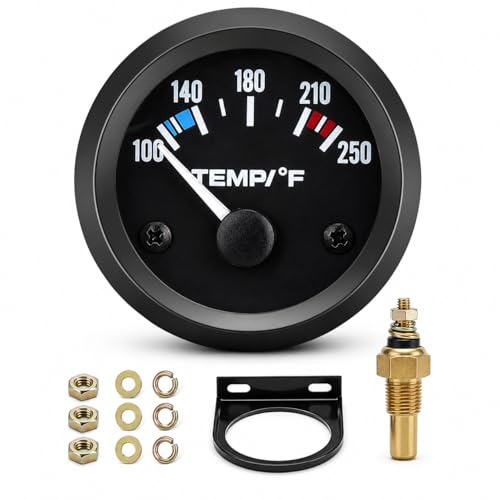
Best for: boaters seeking a straightforward, single-sensor water temperature gauge with clear night visibility. This 12V unit measures 100-250°F and uses a white LED backlight for easy readings from any angle. The ABS and stainless steel exterior provides corrosion resistance for marine environments, and the 2-inch dial fits standard gauge housings. Caution: verify sensor fitment on your water line and ensure proper sealing to prevent leaks.
Runleader Digital LCD Engine Temp Gauge

Best for: operators needing dual-channel monitoring and a real-time temperature readout with max history. This gauge supports multiple sensors, displays real-time temperature from -20°C to 220°C, and can operate on internal battery or external power. It also offers a maximum temperature record and a resettable memory. Caution: ensure sensor placement allows accurate readings and avoid bending the probe to prevent damage.
BYYOUIV 2-in-1 Water Temperature & Voltage Gauge Kit

Best for: users who want space-saving installation with both water temperature and voltage monitoring in one unit. It features LCD display with sunshade, an alarm function, and clear readability in bright sun. Caution: verify the voltage compatibility with your boat’s electrical system to avoid mismatched power supply.
BREADEEP Universal 2″/52mm Water Temperature Gauge

Best for: mariners needing a robust 12V DC gauge with a 1/8″ NPT sensor thread and 100-250°F measurement range. It has an ABS/stainless steel housing for durability and LED-backlit display for night viewing. Caution: ensure thread compatibility with your engine’s sensor port to avoid sealing issues.
POCREATION 52mm Water Temperature Gauge With LED

Best for: boaters seeking marine-grade protection with IP67 rating and wide 9-32V operating range. The silver frame and white dial offer clear legibility, and the unit is designed to withstand harsh marine conditions. Caution: temporary voltage spikes beyond the listed range may affect accuracy; ensure your system voltage remains within limits.
Buying Guide
What should I consider when choosing a marine temperature gauge?
Durability and materials matter. Look for ABS or stainless steel housings and corrosion resistance for saltwater use. A clear LED backlight improves readability at night. Consider sensor type and mounting style (NPT threads, 2″ or 52mm size) to ensure compatibility with your boat’s cooling system.
Do I need a single- or multi-channel gauge?
A single-channel gauge tracks one coolant or water temperature, which is sufficient for most outboards. A dual-channel setup suits boats with dual engines or multiple cooling lines, allowing simultaneous monitoring of different temperatures.
What about voltage and display features?
Most marine gauges run on 12V DC, which aligns with many boat electrical systems. LED backlighting aids night visibility, and some models include alarms or max-record features to help schedule maintenance before issues arise.
Are there installation limitations to expect?
Sensor threading and mounting depth can affect readings. Ensure the sensor fits the port size (often 1/8″ NPT) and that the gauge dial fits your dash opening. Some gauges support wider voltage ranges, valuable for various marine electrical configurations.
What maintenance considerations exist?
Periodic inspection of sensor seals and wiring reduces the risk of leaks or corrosion. For gauges with alarms, test alert functions to confirm they trigger accurately at set thresholds.
Which gauge suits a small open fisherman vs. a larger cruising vessel?
Small craft may prioritize a simple, easy-to-read single gauge such as the LAGWIUY orBREADEEP units. Larger boats with dual engines or more complex electrical systems may benefit from multi-function or dual-channel models like Runleader or BYYOUIV’s 2-in-1 kit.
FAQ
- What does a temperature gauge measure on a boat?
It displays the engine cooling or water temperature to help prevent overheating. - Can these gauges work with 24V systems?
Some models have wide voltage ranges; verify manufacturer specs for 24V compatibility. - Do gauges include sensors?
Yes, most entry models include a sensing probe suitable for marine water cooling lines. - Is backlighting necessary?
Backlighting improves readability at night or in low light conditions, making it a common feature. - Can I retrofit a gauge into an existing dash?
Most 2″ or 52mm gauges fit standard dashboards, but check mounting dimensions and connector types before purchasing. - What maintenance schedule is recommended?
Inspect seals and wiring annually, and test alarm functions periodically to ensure reliability.