Best Stainless Steel Thru Hull Fittings for Boats: Durable Marine Connections
Answering the need for reliable, corrosion-resistant boat fittings, this guide highlights top stainless steel thru-hull options. These fittings suit boaters installing water intakes, bilge pumps, livewells, or other hull-penetrating connections. Best for DIY installers and professional boat maintenance alike, each pick emphasizes durability, compatibility with common hose sizes, and ease of installation.
| Product | ||
|---|---|---|
| Boltigen Thru Hull Fittings — 1″ ID | 1 inch | Versatile for larger marine hose runs |
| Boltigen Thru Hull Fittings — 3/4″ ID | 3/4 inch | Compact option with strong corrosion resistance |
| Keehui 316 Stainless Steel Combo Thru-Hull (3/4″ ID) | 3/4 inch | Includes gasket and easy install design |
| NRC&XRC Marine Grade Thru-Hull (1-1/2″ ID) | 1-1/2 inch | Heavy-duty for larger water systems |
| Attwood 66547-3 Straight Thru-Hull (3/4″ ID) | 3/4 inch | Standard length, durable corrosion-free performance |
Boltigen 1″ Thru Hull Fitting
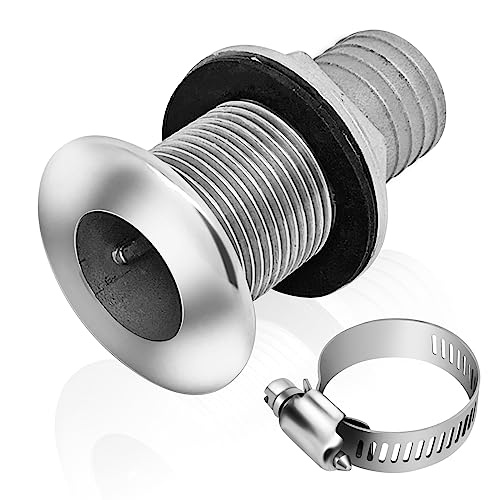
This 316 stainless steel thru-hull barb is designed for a 1″ inside diameter hose. It provides excellent durability in saltwater environments and is suitable for water intakes, bilge pumps, or livewell systems. Best for boats with larger hose runs and those prioritizing corrosion resistance. The straight barb design helps create a secure hose connection and reduces leakage risk.
Best for: boat owners needing a robust, larger-diameter through-hull connection that maintains hull integrity. Choose this if your system requires a 1″ ID hose and you value long-term corrosion resistance.
Caution: confirm the hose ID precisely before ordering to ensure a proper fit and seal. Some installations may benefit from a compatible gasket or O-ring seal not included in the listing.
Boltigen 3/4″ Thru Hull Fitting

This 316 stainless steel thru-hull barb is intended for a 3/4″ ID hose. It delivers durable performance in marine environments and supports a wide range of systems such as water intakes and bilge lines. Best for: smaller-diameter hose runs where space is limited but reliability is essential. Better for compact installations than a larger 1″ model.
Limitation: ensure compatible hose ID and clamp size; mis-sizing can cause leaks or hose failure under pressure.
Keehui 316 Stainless Steel Combo (3/4″ ID)

Material: heavy-duty 316 stainless steel. This combo includes a gasket for straightforward installation and a flange outer diameter of about 1.9 inches. Thread length around 1-1/2 inches. Barb length is 1 inch. Best for: installations where a gasket is helpful for sealing and where a slightly larger flange improves mounting stability.
Choose this if you need a ready-to-install kit with gasket for a 3/4″ ID line and want a durable, corrosion-resistant assembly. Caution: verify flange diameter to ensure the mounting hole on your hull matches.
NRC&XRC 1-1/2″ Thru-Hull With Nut

Material: Marine Grade 316 Stainless Steel, built as a solid metal slab for strength and durability. Includes a custom gasket for easier installation and a 2-3/4 inch flange outer diameter with a 1.9 inch thread length. Barb length is 1-1/8 inch. Best for: high-flow applications or larger system connections requiring a sturdy through-hull with a secure seal.
Limitation: heavier, may require larger hull cutout and careful sealing during installation to prevent leaks.
Attwood 66547-3 Straight Thru-Hull Fitting

Material: Stainless steel, with corrosion-free performance. This straight barb fitting is designed for a 3/4-inch interior diameter hose, featuring a flange diameter of 1 7/8 inches, a 1-inch thread outside diameter, and a 2-inch thread length. Best for: standard-sized hull penetrations where a simple, reliable installation is needed and space around the fitting is limited.
Tip: ensure hose clamps are compatible with the 3/4″ ID hose and the barb profile to prevent leaks under pressure.
Buying Guide
What to consider when selecting a thru-hull fitting
Material: Stainless steel 316 is the standard for saltwater durability, offering strong corrosion resistance and longevity in marine environments. If you expect heavy use or exposure to harsh conditions, prioritize 316 stainless steel with a robust gasket option.
Size compatibility: match the hose ID precisely. Using the wrong size can cause leaks, hose collapse, or insufficient flow. Measure the existing hose or system inlet before ordering.
Barb design: straight barbs tend to provide straightforward, secure connections, but some installations benefit from threaded fittings or gasketed options for a tighter seal.
Installation considerations: check flange diameter and thread length to ensure a proper hull cutout and a tight seal. Some fittings come with gaskets or nuts to simplify mounting; others may require separate hardware.
Maintenance: inspect fittings for signs of corrosion or wear, especially in harsh marine environments. Regularly reseal and retighten fittings as part of routine hull and system maintenance.
Which fitting is right for you?
- Best for larger hose runs: 1″ ID options offer higher flow and are well-suited for main water inlets or bigger bilge lines.
- Best for compact installations: 3/4″ ID fittings save space while still delivering reliable performance.
- Best with gasket included: combos from Keehui simplify installation and reduce sealing steps.
- Best for heavy-duty use: NRC&XRC’s 1-1/2″ ID through-hull is ideal for high-demand marine systems.
Installation steps at a glance
- Identify the correct hole size and fitment type for your hull material.
- Prepare the hull surface and install the nut, gasket, or flange as required by the model.
- Insert the fitting, tighten securely, and attach the hose with clamps.
- Check for leaks by running water through the system and inspecting the joint.
Maintenance and monitoring tips
- Regularly inspect for signs of corrosion, especially in saltwater systems.
- Re-tighten fittings if you notice any movement or minor leaks.
- Replace gaskets if they show wear or deformation.
FAQ
Q: What is the typical life expectancy of a stainless steel thru-hull? A: With proper maintenance in a marine environment, through-hulls made from 316 stainless steel can last many years, though seals and gaskets should be inspected regularly.
Q: Can I install a thru-hull fitting without professional help? A: For standard hull materials and sizes, a confident DIY boat owner can install with careful measurements and proper sealing compounds; complex hulls or high-pressure systems may require professional assistance.
Q: How do I choose between 3/4″ and 1″ ID fittings? A: Choose based on required flow rate and hose availability. Larger IDs support higher flow but require bigger hull openings and hardware.
Q: Are gasketed options necessary? A: Gasketed fittings simplify sealing and reduce the risk of leaks, especially on hull materials that are uneven or porous.
Q: What should I inspect during maintenance? A: Look for corrosion, cracks, loose clamps, and gasket integrity. Replace worn components promptly to maintain hull integrity.