Best Solar System for Boats: Practical 12V Solutions for Marine Power
If you’re outfitting a boat with reliable 12V power, you want components that are compact, durable, and easy to install. This guide highlights five top solar kits and batteries that sailors and boatowners rely on for trickle charging, maintaining battery health, and powering small electronics on the water. The selections favor compact panels, smart MPPT controllers, and rugged 12V batteries suitable for marine environments. Each product is described with ideal buyers in mind, along with practical tradeoffs to consider for marine use.
| Product | Best For | Key Benefit |
|---|---|---|
| SOLPERK Solar Panel Kit 20W | Small boats, kayaks, and dinghies | Smart MPPT controller, waterproof build |
| Voltset 20W Solar Charger | RVs, boats, and trailers | Fast MPPT charging, multi-battery protection |
| Renogy 200W Starter Kit | Boat owners needing expansion | High output, PWM controller, expandability |
| HRBEENERGY 100Ah LiFePO4 | Off-grid boats needing depth of discharge and reliability | Long cycle life, built-in BMS |
| ECO-WORTHY 260W Kit | Owners needing more daily energy | Two 130W panels, lightweight flexibility |
SOLPERK 20W Solar Panel Kit With MPPT Controller
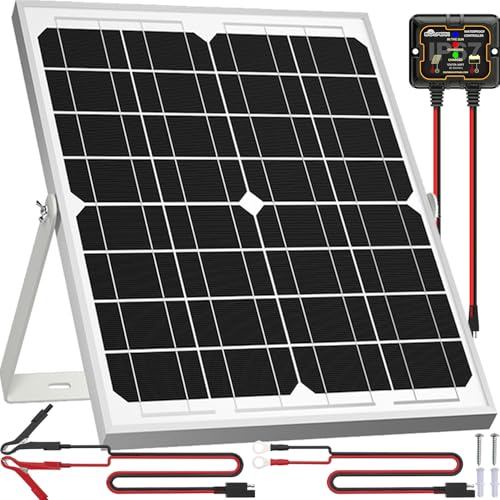
The SOLPERK kit is a compact 12V solution ideal for small boats, motorcycles, and marine trailers. It uses a monocrystalline A+ cell with 21%-30% efficiency, helping maintain 12V batteries like LiFePO4, Lithium Ion, and AGM. The 8A smart charge controller provides a three-stage charging cycle to prevent overcharging and protect the system. The aluminum frame and low-iron tempered glass deliver weather resistance and longevity, up to 25 years. Best for sailors needing a lightweight, waterproof trickle charger with clear charge indicators. Limitations include moderate power output, so it’s best for maintaining rather than charging high-demand loads on larger vessels.
- Best for: small craft, backup power, battery maintenance
- Why selected: reliable 20W output with smart MPPT and marine-grade construction
- Caution: not ideal for high-powered loads or long overcast days
Voltset 12V 20W Solar Charger With MPPT Controller

The Voltset kit pairs an efficient MPPT controller with a universal 12V panel array. It targets cars, RVs, boats, and trailers, delivering faster charging and battery health protection. The built-in safeguards guard against overcharge, over-discharge, short circuits, and reverse polarity. A key advantage is its ability to stop draining power at night, supporting long-term battery life. Best for boaters seeking a versatile, all-purpose 12V solar charger that can also support a trailer or RV setup. A potential limitation is that the system’s 20W output may fall short on overcast days or larger boat electrical needs.
- Best for: multi-vehicle setups, marine trailers, and RVs
- Why selected: strong protection features and reliable MPPT performance
- Caution: may require additional panels for higher energy demand
Renogy 200W Starter Kit for Boats and RVs

The Renogy 200W Starter Kit is designed for customers who want substantial solar capacity with easy expandability. It includes two 100W panels and a PWM charge controller, making it suitable for RVs, boats, trailers, and off-grid use. Its efficiency, heat management, and bypass diodes help maintain performance in varying light conditions. Best for boaters who plan to expand their solar array and want a straightforward path to higher output. Limitations include the PWM controller’s slower charging under some conditions compared to MPPT equivalents, which can matter in limited sunlight windows.
- Best for: moderate to high energy needs with future expansion
- Why selected: strong expandability and complete mounting options
- Caution: PWM controller may be less efficient than MPPT in dim light
HRBEENERGY 100Ah LiFePO4 Deep Cycle Battery

This LiFePO4 deep cycle battery delivers long life for marine use, with 8000+ cycles and 1280Wh capacity. A built-in 100A BMS provides overcharge, over-discharge, current, and short-circuit protection, with temperature cut-offs for safety. It’s designed as a direct replacement for AGM or lead-acid batteries in wet marine environments. Best for boaters needing reliable, long-life energy storage with strong protection. Caution: ensure compatible charging profiles with existing solar controllers to optimize BMS settings.
- Best for: long-term off-grid boating and trolling motor needs
- Why selected: high cycle life, rugged marine suitability, built-in BMS
- Caution: installation should observe BMS charging limits and temperature ranges
ECO-WORTHY 260W Flexible Solar Kit

The ECO-WORTHY kit bundles two 130W flexible monocrystalline panels with a 30A 12V controller. Its flexible, lightweight design suits uneven or curved boat surfaces, and it’s capable of delivering around 1040Wh per day under favorable sunlight. Best for boaters who need a higher daily energy yield on tricky hull surfaces. A limitation is the dependence on sun availability; cloudy days reduce output more noticeably than rigid glass panels.
- Best for: boats with curved or irregular surfaces
- Why selected: higher daily energy with flexible installation
- Caution: performance depends on sun and mounting quality
SUNER POWER 12W Smart MPPT Solar Kit
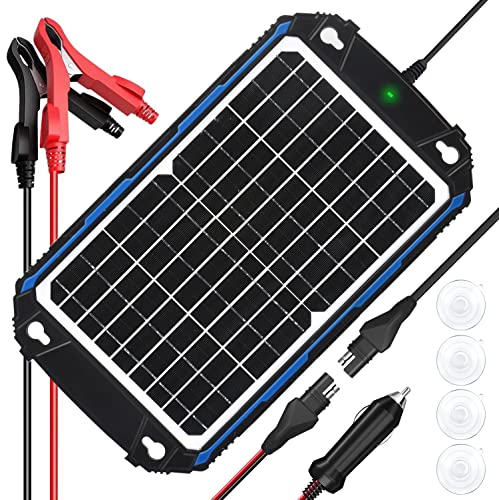
The SUNER POWER kit emphasizes Ultra-Smart MPPT and a three-stage charging profile. It’s designed for boats, cars, and RVs, with a 12V rating suitable for trickle charging and maintaining 12V batteries. It stops charging when the battery is full and resumes when discharge occurs. Best for sailors wanting a highly intelligent, low-maintenance charger for shore power or intermittent sun. A caveat is its modest 12W rating, which is suited for maintenance rather than primary charging on larger systems.
- Best for: maintenance charging on boats with small electrical loads
- Why selected: advanced MPPT and low maintenance
- Caution: too small for rapid charging of large battery banks
Buying Guide: Key Considerations For Marine Solar Installations
- Power needs: estimate daily energy consumption and match panel wattage to charging requirements for a typical outing on your boat.
- Weather and mounting: choose panels with corrosion-resistant frames and water protection for marine exposure. Flexible panels suit curved decks; rigid panels are durable and often easier to mount securely.
- Charge controller: MPPT controllers extract more energy, especially in variable sunlight; PWM controllers are simpler and cheaper but may be less efficient on boats with variable angles.
- Battery compatibility: ensure battery chemistry (LiFePO4, AGM, Gel, Flooded) matches the charging profile and BMS protections of the solar kit.
- Expandability: consider future growth. Kits that allow adding more panels and compatible controllers can scale with your power needs.
- Maintenance and safety: look for waterproof housings, temperature protection, and safe shutoff when batteries are full to preserve battery life.
FAQ
- What size solar panel is best for a small boat?
Answer: A compact 10–20W panel with a smart MPPT controller for maintenance of a modest battery bank is a good starting point on small boats. - Do I need MPPT or PWM for marine use?
Answer: MPPT generally yields higher efficiency, particularly in variable sunlight and with longer cable runs; PWM is simpler and cheaper. - Can I use a standard car battery with a marine solar kit?
Answer: Yes, but ensure the battery type matches the kit’s charging profile (LiFePO4, AGM, Gel, Flooded) and that protections are appropriate for marine use. - Is a large flexible panel better than a rigid panel on a boat?
Answer: Flexible panels are easier to install on curved surfaces; rigid panels often provide higher durability and easier mounting. - What maintenance does a marine solar system require?
Answer: Regularly inspect for corrosion, clean dust or salt deposits, verify connections, and monitor battery health and charge controller indicators. - Can I run high-demand devices with these kits?
Answer: For high-draw devices, combine panels and a larger battery bank or consider higher-wattage kits with MPPT controllers to avoid overloading a small system.