Best Solar Panels for Boats and Caravans: Durable Off-Grid Charging Solutions
Answering the top question: which solar panels perform best for boats and caravans, balancing space, durability, and efficiency? This guide highlights five models well-suited for marine and RV use, including compact kits for tight spaces and higher-wap panels for larger setups. Ideal buyers include first-time RVers needing quick installs, boat owners seeking reliable marine-grade modules, and campers building off-grid power systems. The table below compares the chosen products at a glance.
| Product | Type | Watts | Best For | Notes |
|---|---|---|---|---|
| HQST Solar Panel 4pcs 100W | Monocrystalline Panel (4-Pack) | 100W x4 | Boat and RV battery charging, larger arrays | High efficiency, good for multi-panel setups |
| ECO-WORTHY 100W Panel | Monocrystalline Panel | 100W | Independent panel for modest systems | 25% efficiency, DIY-friendly |
| Voltset 100W 12V Kit | Panel + Controller | 100W | Ready-to-use RV/marine charging | Includes LCD display and safety protections |
| HQST-100W 2-Pack 12V Panel | Monocrystalline Panel (2-Pack) | 100W | Compact, portable off-grid setups | Up to 25% efficiency, bifacial potential |
| JJN 200W Panels (2x100W) | Monocrystalline Panel Pair | 200W total | Higher power arrays on boats/ RVs | 10BB cells, robust and weather-ready |
HQST Solar Panel 4pcs 100 Watt 12V Kit

This 4-pack delivers 4 x 100W modules designed for off-grid battery charging in marine and RV environments. The system uses Grade A+ large monocrystalline cells and a 9-busbar design to reduce microcracks and heat buildup. It is best for boat or caravan installations where multiple panels can be mounted in sequence to reach higher total wattage. Best for buyers planning a larger, scalable solar array.
- Best for: caravans or boats needing a larger energy reserve
- Why selected: higher total output with modular repeatability
- Caution: installation requires space for multiple panels and appropriate mounting hardware
ECO-WORTHY 100 Watt Solar Panel

This 100W monocrystalline panel offers a 25% efficiency rate via N-Type technology, aimed at maximizing light capture and overall energy generation. It suits RVs, boats, and remote cabins as a stand-alone panel or part of a small array. It’s a practical choice for DIY installations due to straightforward mounting.
- Best for: single-panel setups where space is manageable
- Why selected: good efficiency and broad compatibility with 12V systems
- Caution: may require a separate charge controller for full system safety
Voltset 100W 12V Solar Panel Kit

This kit combines a 100W monocrystalline panel with a 20A controller, offering real-time charging data via an LCD display. It includes memory and USB-C/USB interfaces, making it versatile for RV, marine, and off-grid projects. Choose this if you want integrated monitoring and broader charging options in one package.
- Best for: buyers who want built-in monitoring
- Why selected: real-time status and broader charging options
- Caution: verify compatibility with your battery chemistry and load
HQST-100W 2-Pack 12V Panels

Designed for off-grid applications, this two-pack offers compatible 9-busbar technology with up to 25% efficiency. Front and rear-side exposure can boost output in reflective environments. It’s well suited for compact boats or RV roofs where space is limited but more power is needed.
- Best for: small to mid-sized roof installations
- Why selected: efficient design and bifacial potential
- Caution: rear-side gains depend on mounting surface reflectivity
JJN 200W Panels (Twin 100W Modules)
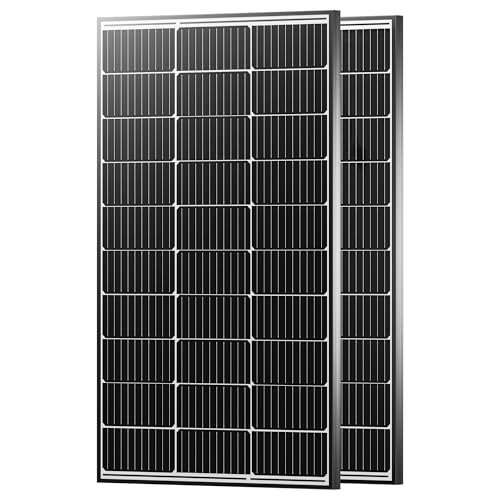
This pairing delivers 200W total from two 100W monocrystalline panels using a 10BB cell design for improved efficiency up to 23%. The half-cut cell design reduces shading losses and the IP65/IP68-rated connections provide robust protection for outdoor use on boats or RVs. Best for buyers needing higher power within a compact footprint.
- Best for: higher wattage needs in limited space
- Why selected: strong efficiency, robust weather resistance
- Caution: ensure mounting area supports the combined weight
Buying Guide: Key Considerations for Boat and Caravan Solar Systems
Power needs and space are the primary drivers when selecting panels for boats and caravans. Consider these practical questions:
- What is my daily energy consumption, and how many amp-hours will I require from solar?
- Is space on the roof or deck enough to mount multiple panels, or should I prioritize higher-watt modules?
- Do I need a charge controller or a kit that includes one, and what type (PWM vs MPPT) suits my battery bank?
- How durable must the panels be against wind, salt spray, and vibrations?
- Will I need monitoring features to track charging status and performance?
- Are bifacial or half-cut cell designs advantageous for my mounting situation?
Durability, weather resistance, and mounting compatibility are critical for marine and RV environments. If space allows, a modular approach with several 100W panels can offer flexibility and easier maintenance. For smaller roofs, compact 100W modules or panel kits with included controllers streamline installation and reliability.
Frequently Asked Questions
- How many watts should I install on a boat or caravan roof?
Answer: It depends on energy needs and available space; common setups range from 100W to 400W or more for larger rigs. - Do these panels work in partial shade?
Answer: Modern designs with bypass diodes help reduce power loss in shade, but full sun yields the best output. - Is a separate charge controller necessary?
Answer: Yes, for most systems a charge controller protects batteries and optimizes charging. Kits with controllers simplify setup. - Which panel technology is preferable for marine use?
Answer: Monocrystalline panels with robust frames and waterproof junctions are typically favored for durability and efficiency. - What maintenance is required?
Answer: Clean the surface periodically, inspect mounting hardware, and ensure wiring remains sealed against moisture. - Can I mix different panels in one system?
Answer: It’s best to match panels in a single array or use a controller compatible with mixed configurations to avoid imbalanced charging.