Best Solar Battery Chargers for Boats and Marine Use
For boat owners, a reliable solar battery charger can extend sailing time and reduce maintenance on marine batteries. This guide highlights five strong options, emphasizing durability, efficiency, and safety features essential for coastal and offshore use. Each product is evaluated on charging efficiency, protection systems, water resistance, and ease of installation, helping you pick a solution that fits your boat’s electrical needs and travel plans.
| Product | Brand | Wattage | Key Feature |
|---|---|---|---|
| SUNER POWER Waterproof 12W | SUNER POWER | 12W | Ultra-Smart MPPT charging |
| SUNER POWER Waterproof 20W | SUNER POWER | 20W | High-efficiency MPPT with 3-stage charging |
| SOLPERK Solar Panel Kit 20W | SOLPERK | 20W | Durable build with adjustable mount |
| SUNER POWER 30W | SUNER POWER | 30W | Advanced MPPT with full protection |
| Voltset Solar Panel Kit 20W | Voltset | 20W | IP67 PWM controller, waterproof design |
SUNER POWER Waterproof 12W Solar Charger

The 12W SUNER POWER unit is designed for compact use aboard smaller boats or as a supplementary charger for larger vessels. It uses Ultra-Smart MPPT technology to optimize power point tracking, achieving tracking efficiency up to 99% and peak conversion up to 98%. This capability is particularly beneficial when sun exposure is limited or variable, helping to maximize charging during short day trips. The charger implements a three-stage charging algorithm—Bulk, Absorption, Float—to support safe, effective replenishment of 12-volt batteries, extending battery life and performance. It features a fully automatic, maintenance-free operation, automatically pausing when the battery is full and resuming as discharge occurs. A protective design reduces the risk of overcharge and thermal stress on marine batteries, while its waterproof construction supports outdoor installation on decks or in-monocoque compartments. The compact size makes mounting convenient on smaller craft or as a panel add-on for larger systems.
Key features include Ultra-Smart MPPT, a three-stage charging profile, and automatic maintenance mode. The device is designed to operate with minimal attention, producing a reliable trickle charge that complements engine-based charging systems during extended trips or when the vessel is stored in coastal climates. For boaters who prioritize efficiency in shaded or partially sunny conditions, this unit offers a balance of performance and simplicity.
POWOXI Upgraded 7.5W Solar Battery Trickle Charger
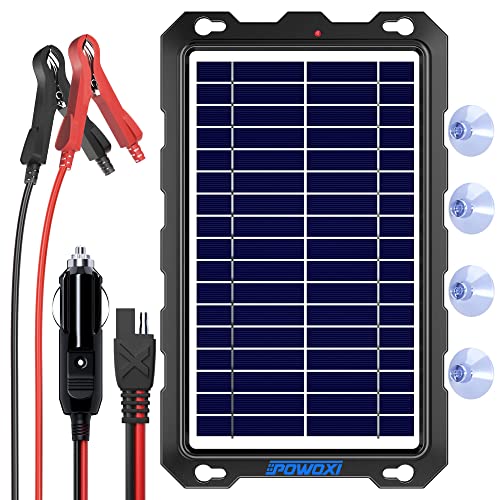
This POWOXI model is a compact, 7.5W solar trickle charger suited for smaller marine batteries or as a supplementary charging option for boats with limited space. It integrates an intelligent charge controller and a smart protection system designed to prevent overcharging and electrical faults. The cooler, robust construction uses high-transparency glass and a tempered frame to withstand marine environments, including wind and spray. The device requires minimal maintenance and is designed to maintain battery health during long periods of boat storage or trips where shore power is not available. It can be installed on deck rails or cabin tops where exposure to sunlight is more consistent, offering a cost-effective option for sailors with modest charging needs.
Users benefit from built-in safety features such as overvoltage and short-circuit protection, which help safeguard batteries against common marine charging risks. The design emphasizes reliability and durability, making it a practical choice for dinghies, sailboats, or as a precautionary add-on for larger vessels requiring extra float charging capacity during extended voyages.
SUNER POWER 30W Solar Charger And Maintainer

The 30W SUNER POWER unit is a higher-capacity option designed for boats with larger electrical demands or for maintaining multiple batteries. It features Ultra-Smart MPPT technology to optimize power extraction under varying sun conditions, with efficiency levels approaching 99% tracking and 98% conversion. The improved three-stage charging (Bulk, Absorption, Float) supports rapid, safe replenishment and long-term battery health. Like other models in the same family, it includes automatic maintenance capabilities—charging halts when the battery is full and resumes when needed—reducing the need for manual intervention during extended trips. The robust protection suite helps mitigate risks of overcharging, overheating, and short circuits, while the panel’s waterproof construction is suited for exposed deck mounting or cabin top installation.
For boaters running larger lead-acid or lithium-based marine batteries, this 30W option provides a meaningful boost in daily recharging capacity. It pairs well with panels or arrays that experience moderate sun exposure, enabling steady battery maintenance even on days with intermittent cloud cover. The unit’s durability and full protection features support reliability in a marine environment where power management is critical for navigation electronics and comfort systems.
Voltset Solar Panel Kit 20W For Boats

The Voltset 20W kit combines a water-resistant solar panel with an IP67 PWM controller and adjustable mounting hardware. The PWM controller uses a three-stage charging approach (direct, float, trickle) to optimize compatibility with a variety of 12V batteries, including LiFePO4, lead-acid, AGM, and GEL formats. The kit emphasizes durability with an IP67-rated full-potting controller and a rugged panel frame designed to withstand marine conditions, including spray and humidity. Its LED indicators deliver real-time charging status, helping boat operators monitor performance at a glance. The collapsible design and included mounting options enhance versatility for boats with limited space or variable sun exposure along coastlines and lakes.
From a safety perspective, the Voltset kit reduces the risk of overcharge and vampire drain after sunset, which is valuable for boats left unattended for extended periods. The system is well-suited for recreational boats, sailboats, or small to mid-size powerboats that require a dependable, outdoor-ready charging solution without heavy installation complexity. It offers a balance of efficiency, protection, and practicality for on-deck installation and portable use.
Buying Guide: Key Purchase Considerations
- Power needs: Match wattage to your battery bank and typical cruising duration. Higher wattage panels (20–30W) suit larger systems; smaller boats may prefer 12W or 7.5W as supplementary charging.
- Charging technology: MPPT controllers optimize energy capture, especially under varied sun exposure. PWM controllers are simpler and affordable but may be less efficient in shaded conditions.
- Durability and outdoor design: Look for waterproof ratings (IP67 or higher), tempered glass, and corrosion-resistant frames to endure salt air and spray.
- Battery compatibility: Ensure the charger supports your battery chemistry (lead-acid, AGM, GEL, LiFePO4, etc.).
- Protection features: Overcharge, over-discharge, short circuit, reverse polarity, and temperature protections are critical for marine safety and battery longevity.
- Installation and maintenance: Consider panel size, mounting options, and whether the unit requires professional installation or can be mounted on deck rails or cabin tops.
- Portability and expansion: If you plan to upgrade, choose modules with compatible connectors and an easy path for adding panels or upgrading controllers in the future.
- Weather suitability: For boats stored outdoors, ensure components resist wind, hail, dust, and UV exposure. A modular kit can be swapped as needs grow.
Overall, the best solar battery charger for a boat balances efficiency, protection, and endurance in a marine environment. For compact vessels, a 12W to 20W MPPT-based charger can maintain essential systems with minimal footprint. For larger boats or boats with high electrical demand, a 30W MPPT solution provides substantial daily charging and better resilience during long trips. Always verify that the kit’s controller, wiring, and casing suit your specific battery type, gel or liquid, and your boat’s charging architecture.