Best Smart Battery Chargers for Boats
Whether you’re maintaining a marine battery bank or keeping a cranking amp battery ready after a weekend on the water, a smart battery charger tailored for boats can prevent sulfation, extend cycle life, and simplify maintenance. This guide highlights five top options, clarifies who each is best for, and shows why they stand out for boaters and marine enthusiasts.
| Product | Best For | Key Benefit |
|---|---|---|
| NOCO GENIUS1 (1A) | Smaller boats, maintenance of lead-acid and LiFePO4 | Precision charging with temperature compensation |
| NOCO GEN5X2 (10A, 2 Bank) | Two-bank setups, larger boats, mixed battery types | Independent bank charging with multiple modes |
| NEXPEAK NC201 (10A) | All-around auto maintenance for boats and gear | 6-stage charging with desulfation and temp compensation |
| NOCO GENIUS10 (10A) | Medium to large boats needing quicker cycle relief | High power in a compact form with advanced features |
| NOCO GEN2D (2A, onboard) | Under-hood or in-situ installation on boats | Direct-mount, simple integration with 12V lead-acid |
NOCO GENIUS1: 1A 6V/12V Smart Battery Charger

Designed for 6V and 12V lead-acid and lithium batteries, GENIUS1 combines charging, maintenance, trickle charging, and desulfation. It includes an integrated thermal sensor that adjusts charging with ambient temperature, reducing overcharge risk in heat and undercharge in cold. Best for compact boats or as a portable dockside maintainer for small vessels. Caution: not the fastest option for large battery banks; consider higher amperage if you need rapid cycling.
NOCO Genius GEN5X2: 2-Bank 10A Onboard Charger
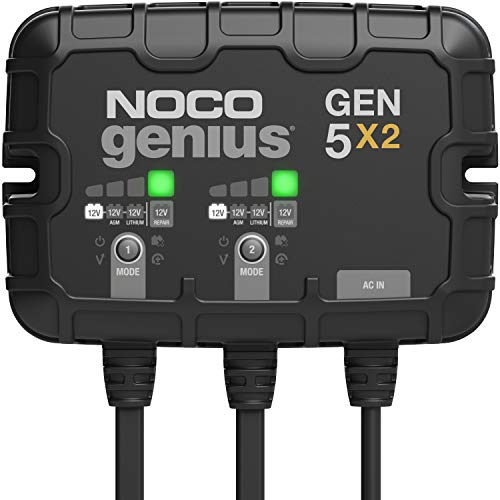
A two-bank onboard charger delivering 5A per bank for 12V batteries, with modes for 12V, AGM, Lithium, and a Repair Mode. Best for boats with separate starting and deep-cycle banks or dual-battery systems. Better for larger boats than GENIUS1, yet compact enough for cabin walls. Limitation: independent bank modes require clear battery type selection for accurate maintenance.
NEXPEAK NC201 10-Amp Battery Charger

NC201 offers a 10-amp 12V/24V setup with 7-stage charging and temp compensation. It supports a wide range of lead-acid chemistries, including AGM, GEL, SLA, and Flooded. Best for boat owners who need faster charging and the ability to support multiple battery configurations. Caution: High charging currents may stress very old or sulfated batteries; verify battery health before use.
NOCO GEN2D: 2A 12V Onboard Battery Charger
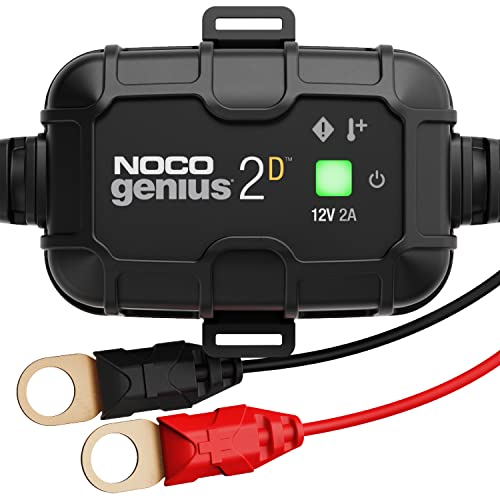
GEN2D is a direct-mount onboard solution for 12V lead-acid batteries, suitable for installation near the battery with a simple mounting bracket. Best for boats needing a compact, fixed charger with dual purpose as a maintainer and desulfator. Limitation: fewer banks and lower amperage than multi-bank models, so plan around battery bank size.
NOCO GENIUS5: 5A 6V/12V Charger
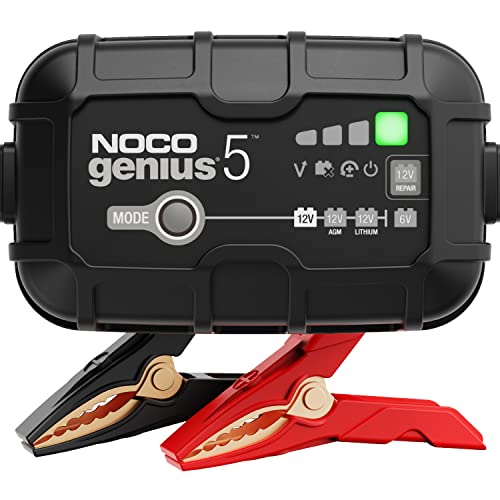
GENIUS5 provides 5A of charging across 6V or 12V with temperature compensation and desulfation. It’s a balanced option for mid-size boats needing reliable maintenance and more power than a 1A unit. Choose this if you have modestly sized battery banks and want better performance without a two-bank system. Caution: not ideal for very large battery banks requiring higher amperage.
Smart 2 Bank Marine Charger, 10A

A waterproof 2-bank charger delivering 5A per bank for 12V marine batteries with modes for SLA/AGM, Lithium, and Calcium. Best for boats that require separate charging for two independently managed batteries. Limitation: generic brand with fewer third-party validation references; ensure compatibility with your specific lithium chemistry.
YONHAN Battery Charger 10A

YONHAN’s 10-Amp 12V/24V smart charger is a versatile all-in-one solution for cars and boats, including auto and boat batteries. Best for multi-vehicle setups where a single unit handles both 12V and 24V needs. Caution: Not suitable for RC LiPo or lab use; verify battery type before charging.
Buying Guide
What amperage do I need for my boat? Larger boats with bigger start or deep-cycle batteries often benefit from higher amperage (5A–10A per bank) for faster charging, while small craft can do well with 1A–2A models for maintenance-only needs.
How many banks matter? Single-bank chargers are simplest and compact; two-bank units help when you have a dedicated starting battery and a deep-cycle battery. For boats with more than two batteries, a multi-bank charger or separate units may be more practical.
What about battery chemistries? Most marine chargers support lead-acid variants (AGM, Gel, SLA) and LiFePO4. Confirm battery chemistry before charging to avoid incompatibility and to ensure proper charging modes.
Is temperature compensation important? Yes. Temperature-based charging reduces overcharge risk in heat and maintains full charge in cold weather, which is crucial for winter storage or variable climates on the water.
Installation considerations: For onboard units like GEN2D, ensure a secure mounting location with access to battery terminals. For portable options, verify that the dock or boat power setup provides safe supply and proper cable management.
FAQ
- What is a smart battery charger for boats? A smart charger automatically adjusts charging based on battery type, temperature, and state of charge to protect and extend battery life.
- Do I need a desulfator? Desulfation helps restore some sulfated lead-acid batteries and can improve performance, though results vary by battery age and condition.
- Can I use a 12V charger on a 24V boat system? Only if the charger is explicitly rated for 24V or has a compatible 24V mode; otherwise, avoid using 12V chargers on 24V systems.
- How do I choose between one-bank and two-bank chargers? If you have separate starting and deep-cycle batteries, a two-bank unit provides independent control and maintenance for each battery bank.
- Is temperature compensation essential for marine charging? It helps prevent both overcharging in hot weather and undercharging in cold conditions, improving battery longevity.
- Are these chargers waterproof? Many marine models are designed for water exposure; always check IP ratings and install with appropriate protection if using in exposed locations.